
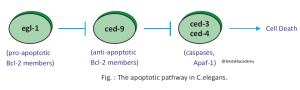
























































































































Q.91 Which one of the following defects do you expect to see if you were able to specifically blockapoptosis in the developing limb bud of a frog embryo?(A) The digits will […]


Q.91 Which one of the following defects do you expect to see if you were able to specifically blockapoptosis in the developing limb bud of a frog embryo?(A) The digits will […]

Q.90 Testicular feminization syndrome is a genetic condition wherein an individual with a XY genotypewill have an external female-like phenotype. This is caused by(A) Functional loss of androgen receptor(B) Increased production […]

Q.89 Control mechanisms operate at any of the several steps involved in gene expression. Which one ofthe following is the key mode of regulation during the cell cycle?(A) Transcription(B) mRNA processing(C) […]

Q.88 The primary difference between glycogen and cellulose is in the (A)types of constituent monosaccharides (B)number of monomers per molecule (C)configuration of the monomers (D)susceptibility to acid hydrolysis Glycogen and […]

Q.87 Which one of the following is an example of sympatric speciation?(A) Origin of new species among wasps that pollinate figs(B) Emergence of a new species among finches that migrated to […]

Q.86 Which one of the following provides the strongest support for the theory of “descent withmodification”?(A) Early embryonic forms of diverse organisms (examples: fishes, birds and mammals) appearsimilar(B) Ability of fishes […]

Q.85 A bacterial population increases from 103 cells to 109 cells in 10 h. Calculate the number of generations per hour. (A) 20 (B) 10 (C) 4 (D) 2 Introduction […]

Q.84 How many electrons are accepted when sulfate acts as the terminal electron acceptor in bacteria such as Desulfovibrio? (A) 8 (B) 6 (C) 4 (D) 2 Sulfate (SO₄²⁻) is […]

Q.83 In a phenol coefficient test for determining the efficacy of a disinfectant X, the maximum effective dilution for X and phenol was found to be 1/450 and 1/90, respectively. […]

Q.82 Match the microscopes in Group I with their working principles in Group II Group I Group II P. Phase contrast Q. Dark field R. Bright field S. Electron microscopy I. […]


