





















































Question 36: When a protein has two or more polypeptide subunits, their folding arrangement is called: (A) Primary structure (B) Secondary structure (C) Tertiary structure (D) Quaternary structure Answer: (D) Quaternary […]

Question 36: When a protein has two or more polypeptide subunits, their folding arrangement is called: (A) Primary structure (B) Secondary structure (C) Tertiary structure (D) Quaternary structure Answer: (D) Quaternary […]

Question 35: The number of enzyme units per milligram of total protein is called: (A) Activity (B) Specific activity (C) Kcat (D) Km Specific activity is the number of enzyme […]

Question 34: Match List I with List II: List I Protein Name List II Molecular Weight (kDa) A. β-galactosidase (ii) 116.25 B. Bovine Serum Albumin (iv) 66.2 C. Ovalbumin (i) […]

Question 33: One calorie (cal) equals to how many joules (J)? (A) 2.18 (B) 4.18 (C) 6.18 (D) 7.18 One calorie equals 4.18 joules, making option (B) correct for this […]

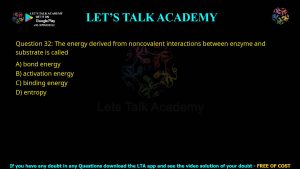
Question 32: The energy derived from noncovalent interactions between enzyme and substrate is called: (A) Bond energy (B) Activation energy (C) Binding energy (D) Entropy Answer: (C) Binding energy. This is […]

Question 31: Which one of the following i.e., number of molecules per gram molecular weight, represents the Avogadro’s number (N)? (A) 6.02 × 10⁶ (B) 6.02 × 10⁷ (C) 6.02 […]

Question 30: The catabolic lysosomal degradation of cellular proteins is called: (A) Phagocytosis (B) Autophagy (C) Chaperon (D) Autotroph Autophagy is the lysosomal process degrading cellular proteins catabolically. The correct […]

Question 29: Which one of the following is the basis for protein structural classification? (A) Length (B) Genus (C) Composition (D) Motif Protein structural classification primarily relies on motifs, which […]

Question 28: A researcher engineers a lac operon on a plasmid inactivating all parts of the lac operator and the lac promoter, replacing them with the binding site for the […]

Question 27: Read the following statements carefully: (A) DNA ligases are enzymes that create a phosphodiester bond between DNA fragments. (B) A protein containing one or more prosthetic groups is […]


