



















































































Q.2 Match List-I with List-II List-I List-II (Amino Acid) (pK value) (A) α-Carboxyl groups (I) 1.8 – 2.9 (B) α-Amino groups (II) 8.8 – 10.8 (C) Acidic Amino Acid – […]
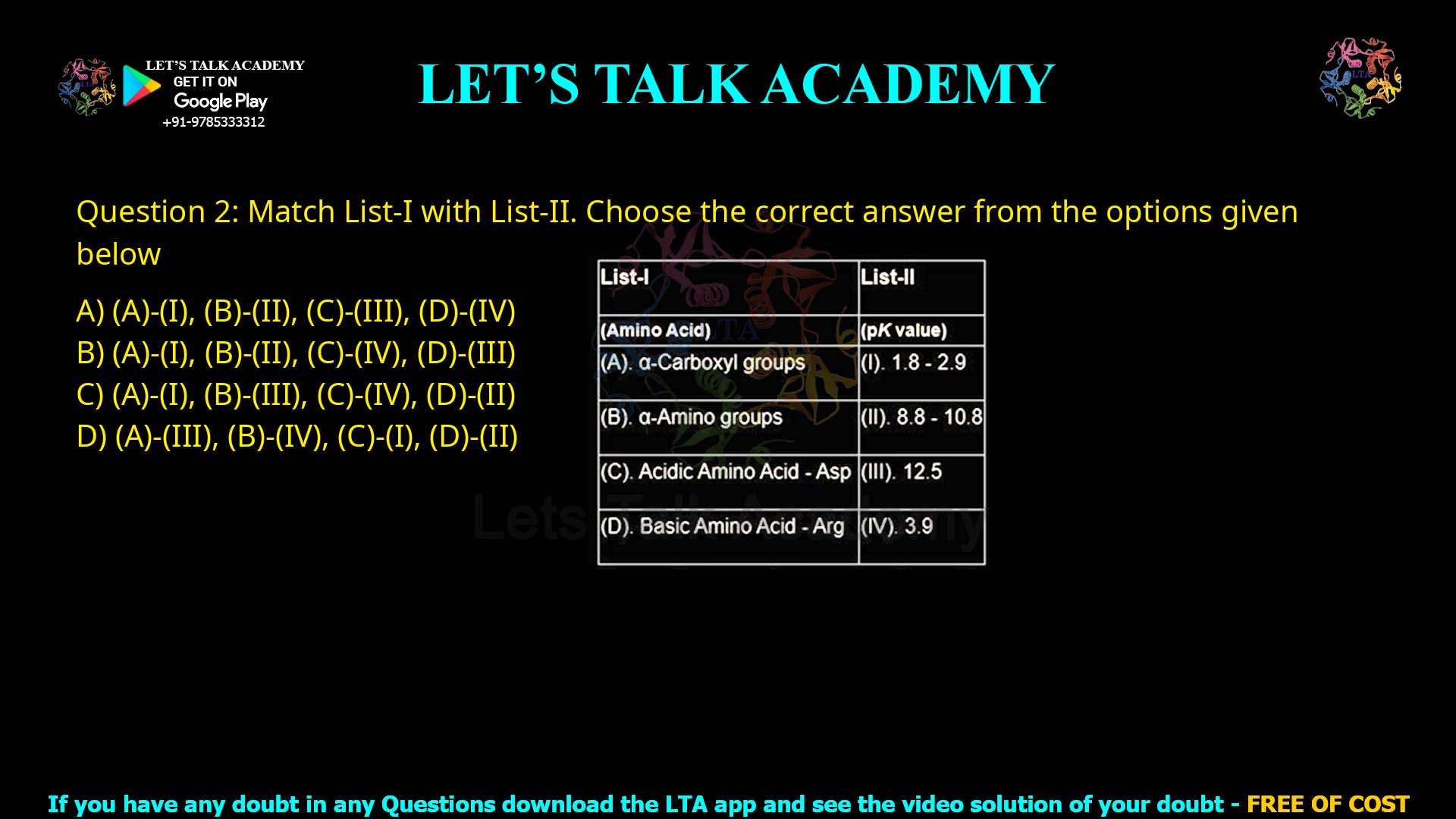
Q.2 Match List-I with List-II List-I List-II (Amino Acid) (pK value) (A) α-Carboxyl groups (I) 1.8 – 2.9 (B) α-Amino groups (II) 8.8 – 10.8 (C) Acidic Amino Acid – […]

Q.1 Sickle cell anemia is a disease characterised by the patient’s erythrocyte, having a characteristic sickle or crescent shape. Select the correct statement hut the disease – l. Deletion of […]

Question 64: Enzymes that are involved in the transfer of electrons (hydride ions or H atoms) are called: (A) Transferases (B) Hydrolases (C) Oxidoreductases (D) Ligases The correct answer is […]

Question 63: Immune cells that ingest large particles and cells by phagocytosis are called: (A) Macrophages (B) B lymphocytes (C) Cytotoxic T cells (D) Helper T cells The correct answer […]

Question 62: A metabolic condition in which the capacity of the body to buffer OH– is diminished, is called: (A) Acidosis (B) Alkalosis (C) Kurtosis (D) Lipidosis The correct answer is […]

Question 61: In a substrate-enzyme reaction, the term Kd denotes which one of the following? (A) Equilibrium constant (B) Dissociation constant (C) Association constant (D) Turnover rate The correct answer is […]

Question 60: Match List I with List II: List I: Ion Channel Defects List II: Disease A. Na+ (iii) Cystic fibrosis B. Ca2+ (iv) Dominant deafness C. K+ (i) Polycystic […]

Question 59: Match List I with List II: List I: Animal Plasma Membrane List II: Type of Sterol A. Human myelin sheath (iii) Cholesterol B. Maize leaf (iv) Stigmasterol C. […]

Question 58: Match List I with List II: List I: Category List II: Examples A. Fatty acids (iv) Oleate B. Prenol lipids (ii) Farnesol C. Saccharolipids (iii) Lipopolysaccharide D. Polyketides […]

Question 57: Phosphatidylcholine and phosphatidylserine are examples of: (A) Fatty acids (B) Glycerolipids (C) Glycerophospholipids (D) Sphingolipids The correct answer is (C) Glycerophospholipids. Phosphatidylcholine and phosphatidylserine are glycerophospholipids, characterized by […]


