


















































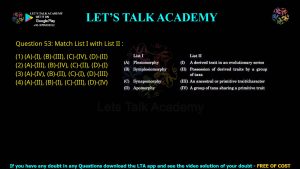




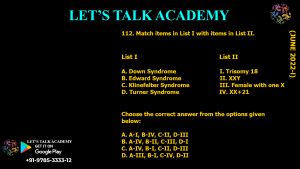






























Q.69 Match List I with List II LIST I LIST II A. Vitamin A B. Vitamin K C. Vitamin C D. Vitamin D I. Rickets II. Excessive bleeding III. Night […]


Q.69 Match List I with List II LIST I LIST II A. Vitamin A B. Vitamin K C. Vitamin C D. Vitamin D I. Rickets II. Excessive bleeding III. Night […]

Q.68 Which of the following techniques can be used for analysis of gene expression? A. Northern blotting B. Southern blotting C. Western blotting D. qRT-PCR E. RNA sequence Choose the […]

Q.67 Two proteins X (Mol. wt. 20 kD, pI 6.3) and Y (Mol. wt. 90 kD, pI 6.4) can be separated by which of the following techniques? A. Gel filtration […]

Q.66 What information about protein can be derived most accurately from gene sequence? A. Primary structure of protein B. Function of protein C. Secondary structure of protein D. Three-dimensional structure […]

Q.65 Which of the following proteins do not belong to the group of chromoproteins? A. Fibroin B. Haemoglobin C. Keratin D. Cytochromes E. Flavoproteins Choose the correct answer from the […]

Q.64 Resting membrane potential is conducted by: A. Active transport B. Selective permeability of phospholipid bilayer C. Passive diffusion across lipid bilayer D. Differential distribution of ions across membrane Choose […]

Q.63 Which of the following statements is true about histones? A. Histones are rich in acidic amino acids. B. Histones are rich in basic amino acids. C. Histones are important […]

Q.62 What is true about steroid hormones? A. Steroid hormones bind to specific receptors. B. Steroid hormones bind to DNA to control gene expression. C. Steroid hormones travel to distant […]

Q.61 Given below are two statements: Statement–I: Cyanide results in cellular hypoxia. Statement–II: The tight coupling of electron transport and phosphorylation is uncoupled by cyanide. In the light of the […]

Q.60 Given below are two statements: Statement–I: Ammonia is produced during catabolism of amino acids in muscle cells. Statement–II: In muscle cells, ammonia is converted to urea and then excreted […]


