




















































































The maximum ionic interaction would be observed (1) In presence of polar solvent (2) In presence of mixture of water and alcohol (3) Almost equal in all kinds of solvents […]


The maximum ionic interaction would be observed (1) In presence of polar solvent (2) In presence of mixture of water and alcohol (3) Almost equal in all kinds of solvents […]

There are hydrogen bond donors (D), and acceptors (A). When the mixture (A+D) is transferred from water, designated as (w) to a nonpolar solvent (np), the free energy change (ΔG) […]

The main force involved in protein folding are- (1) H-bonding (2) Hydrophobic interactions (3) Covalent bonds (4) Vander wall force What is the Main Force Involved in Protein Folding? What […]
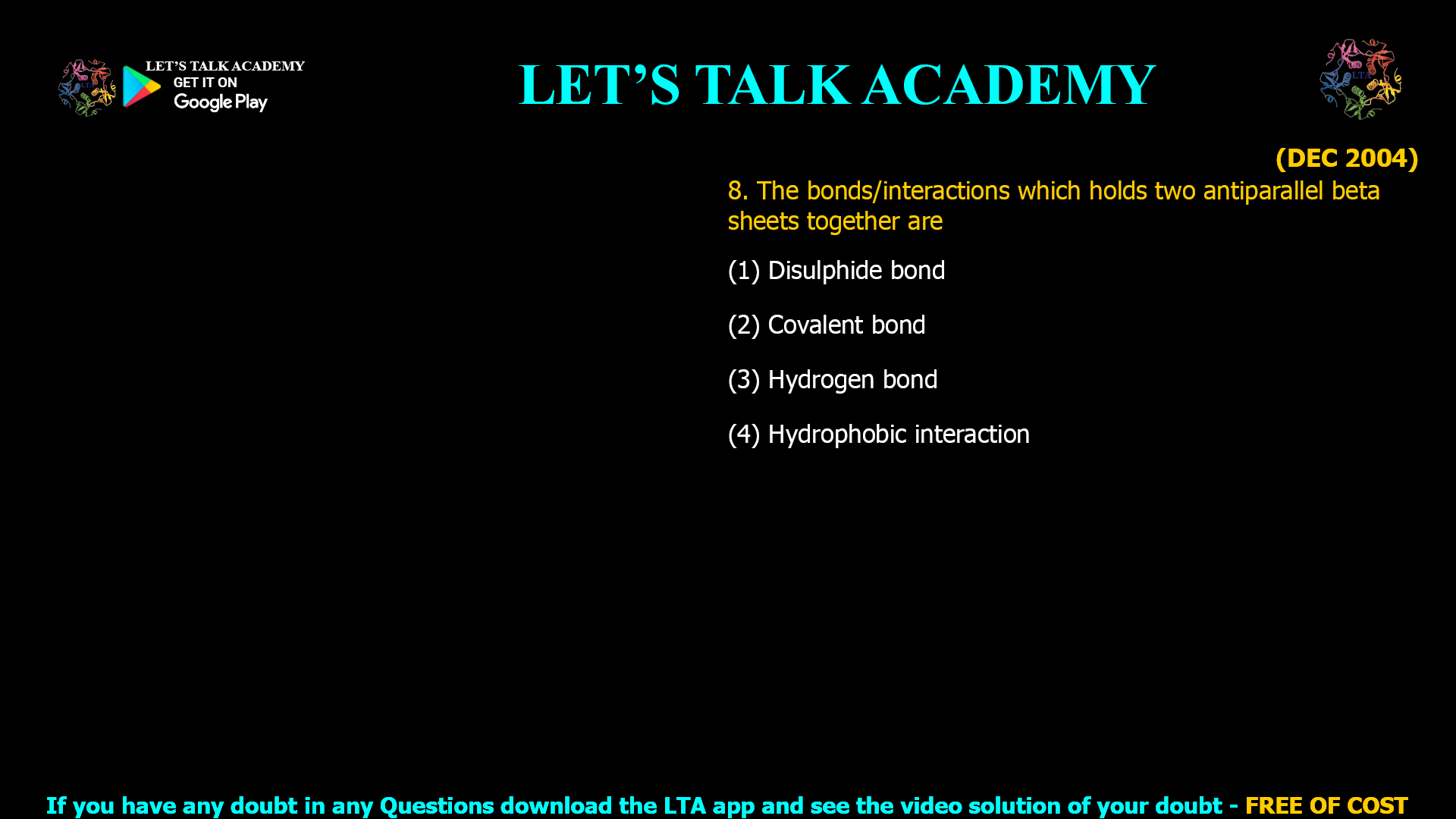
The bonds/interactions which holds two antiparallel beta sheets together are (1) Disulphide bond (2) Covalent bond (3) Hydrogen bond (4) Hydrophobic interaction How Antiparallel Beta Sheets Are Held Together The […]

Which of the following molecule can in intermolecular hydrogen bonding with water? (1) Urea (2) CH4 (3) CCl4 (4) CHCl3 Molecules that Form Intermolecular Hydrogen Bonds with Water An important […]

H2O is a liquid whereas H2S is a gas at 250C. The reason for this is (1) the number of electrons in the outermost electron shells of oxygen and sulfur […]
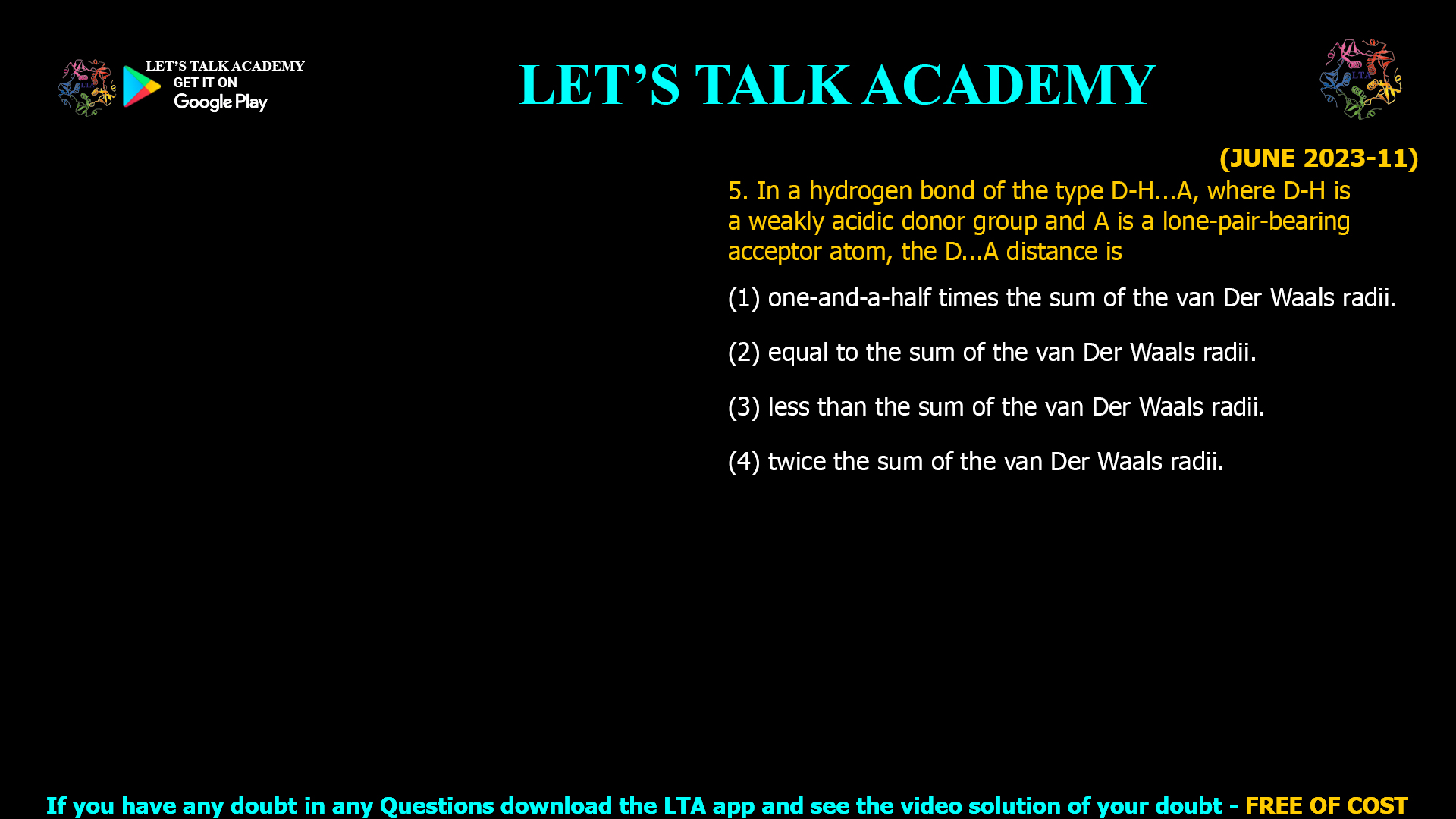
5. In a hydrogen bond of the type D-H…A, where D-H is a weakly acidic donor group and A is a lone-pair-bearing acceptor atom, the D…A distance is (1) one-and-a-half […]
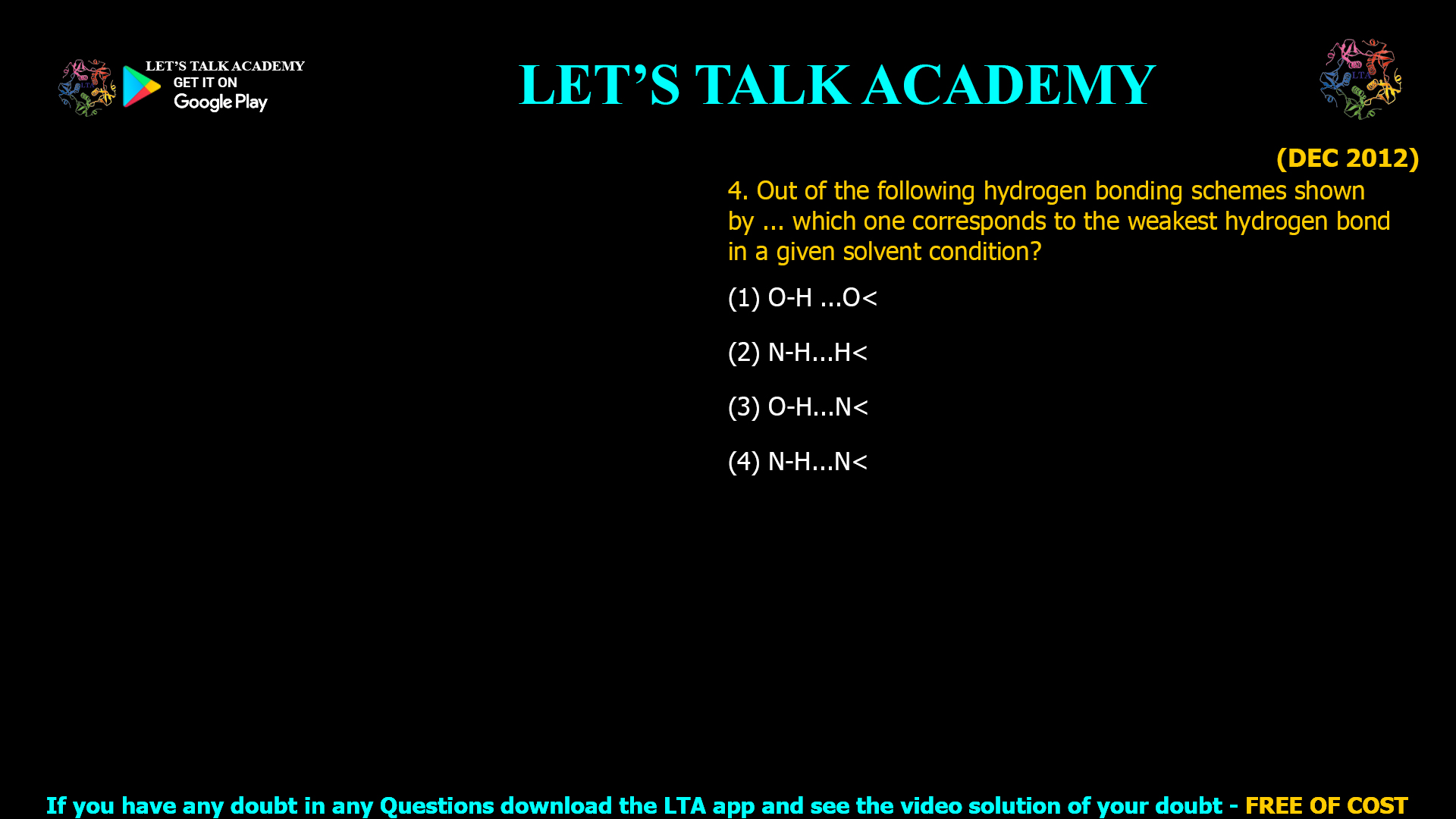
Out of the following hydrogen bonding schemes shown by … which one corresponds to the weakest hydrogen bond in a given solvent condition? (1) O-H …O< (2) N-H…H< (3) O-H…N< […]

The maximum number of hydrogen bonds that can form between H2N – NH2 (hydrazine) and water is (1) 2 (2) 1 (3) 3 (4) 4 Hydrogen Bonding Between Hydrazine and […]

In proteins, hydrogen bonds form as follows: Donor (D)- H—-Acceptor (A). Hydrogen bond is more favorable if the angle between D-H and A is (1) <900 (2) 1800 (3) >1800 […]


