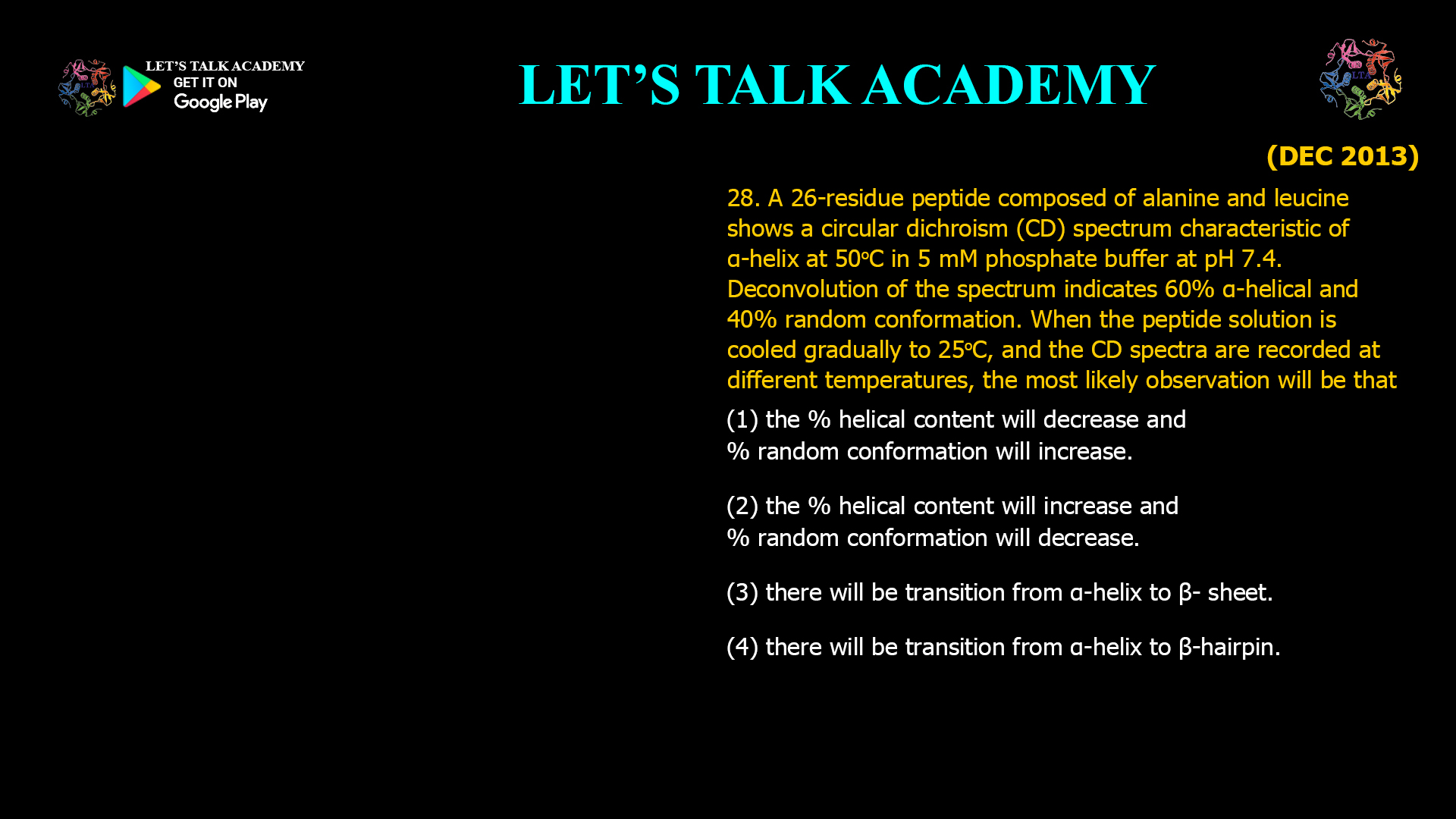
28. A 26-residue peptide composed of alanine and leucine shows a circular dichroism (CD) spectrum characteristic of α-helix at 50°C in 5 mM phosphate buffer at pH 7.4. Deconvolution of the spectrum indicates 60% α-helical and 40% random conformation. When the peptide solution is cooled gradually to 25°C, and the CD spectra are recorded at different temperatures, the most likely observation will be that
(A) The % helical content will decrease and % random conformation will increase.
(B) The % helical content will increase and % random conformation will decrease.
(C) There will be transition from α-helix to β-sheet.
(D) There will be transition from α-helix to β-hairpin.
Alpha-Helix Stability During Cooling in Circular Dichroism (CD) Spectroscopy
Correct Answer
Option (2): The % helical content will increase and % random conformation will decrease.
Explanation
Circular Dichroism (CD) spectroscopy is one of the most widely used techniques for determining the secondary structure of proteins and peptides in solution. Different secondary structural elements produce characteristic CD spectra because they interact differently with circularly polarized light. An α-helix produces two strong negative bands near 208 nm and 222 nm along with a positive band close to 190 nm. By analyzing the intensity of these signals, the percentage of α-helix, β-sheet, turns, and random coil can be estimated through spectral deconvolution.
The peptide described in this question consists only of alanine and leucine residues. Both amino acids possess a strong tendency to adopt an α-helical conformation. Alanine is considered one of the most favorable amino acids for helix formation because its small side chain causes minimal steric hindrance while allowing stable backbone hydrogen bonding. Leucine also stabilizes α-helices due to its hydrophobic side chain, which contributes to favorable packing interactions. Therefore, the peptide naturally prefers an α-helical structure under physiological buffer conditions.
At 50°C, the peptide exhibits 60% α-helical content and 40% random conformation. Although the α-helix remains the dominant structure, elevated temperature increases molecular motion throughout the peptide chain. This additional thermal energy weakens backbone hydrogen bonds and increases conformational flexibility, allowing a significant fraction of peptide molecules to exist in an unfolded or random coil state.
As the solution is cooled gradually to 25°C, thermal motion decreases and backbone hydrogen bonds become more stable. The reduction in molecular vibrations favors the formation and maintenance of the α-helical conformation. Consequently, peptide molecules that were previously present as random coils progressively refold into α-helices. This process shifts the equilibrium toward the ordered secondary structure, increasing the overall percentage of α-helix while decreasing the proportion of random conformation.
The CD spectrum recorded during cooling would therefore show progressively stronger negative ellipticity at approximately 208 nm and 222 nm, reflecting the increase in α-helical content. Spectral deconvolution performed at each temperature would reveal a gradual increase in helix percentage accompanied by a corresponding decrease in random coil content.
Why Option (1) is Incorrect
Option (1) states that the α-helical content decreases while the random conformation increases during cooling. This contradicts the thermodynamic behavior of most α-helical peptides. Lower temperatures stabilize hydrogen bonding and reduce thermal disruption of the peptide backbone. Instead of unfolding, the peptide becomes more ordered, making this option incorrect.
Why Option (2) is Correct
This option correctly describes the expected structural changes. Cooling stabilizes the hydrogen bonds responsible for maintaining the α-helix and shifts the equilibrium from random coil toward the folded helical structure. As a result, the percentage of α-helix increases, whereas the proportion of random conformation decreases. This behavior is commonly observed for peptides rich in helix-forming amino acids such as alanine and leucine.
Why Option (3) is Incorrect
A direct transition from an α-helix to a β-sheet is not expected simply by lowering the temperature. Formation of β-sheets depends on the amino acid sequence, intermolecular interactions, chain alignment, and specific folding pathways. Since the peptide already exhibits a stable α-helical structure and contains residues that strongly favor helices, cooling alone will not induce conversion into a β-sheet.
Why Option (4) is Incorrect
β-Hairpins are specialized structural motifs consisting of two antiparallel β-strands connected by a short turn. Their formation requires an appropriate amino acid sequence capable of producing a stable turn and maintaining β-strand interactions. The alanine-leucine peptide described here lacks the sequence characteristics necessary for spontaneous β-hairpin formation. Therefore, lowering the temperature does not promote an α-helix to β-hairpin transition.
Temperature and Secondary Structure Stability
The stability of an α-helix depends primarily on intramolecular hydrogen bonds formed between the carbonyl oxygen of one amino acid residue and the amide hydrogen located four residues ahead in the sequence. These hydrogen bonds create a rigid helical backbone that becomes increasingly stable as thermal motion decreases. While extremely low temperatures or unusual solvent conditions may influence protein dynamics differently, cooling from 50°C to 25°C under normal aqueous buffer conditions generally enhances α-helical stability.
Role of Circular Dichroism in Monitoring Structural Changes
One of the major advantages of Circular Dichroism spectroscopy is its ability to monitor structural transitions continuously without modifying the sample. By recording spectra at different temperatures, researchers can observe changes in secondary structure as they occur. An increase in the intensity of the characteristic α-helical bands directly indicates an increase in helical content, whereas a reduction in these signals reflects partial unfolding or conversion to less ordered conformations.
Conclusion
Cooling the peptide solution from 50°C to 25°C stabilizes backbone hydrogen bonding and reduces thermal disruption of the α-helical structure. As a result, more peptide molecules adopt the energetically favorable α-helical conformation while fewer remain in the random coil state. Therefore, the percentage of α-helix increases and the percentage of random conformation decreases, making Option (2) the correct answer.


