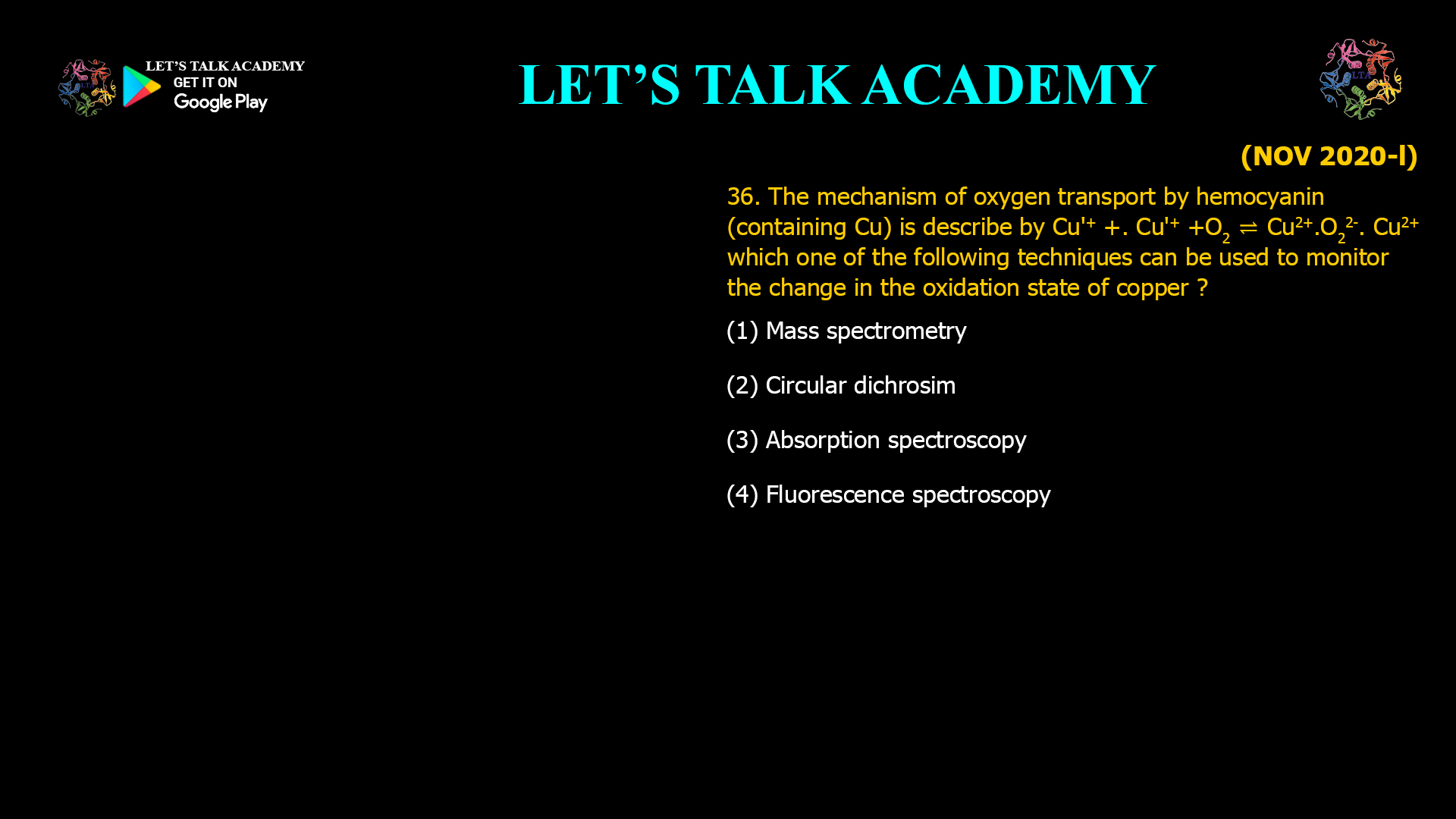
36. The mechanism of oxygen transport by hemocyanin (containing Cu) is described by:
Cu⁺ + Cu⁺ + O₂ ⇌ Cu²⁺–O₂²⁻–Cu²⁺
Which one of the following techniques can be used to monitor the change in the oxidation state of copper?
(A) Mass spectrometry
(B) Circular dichroism
(C) Absorption spectroscopy
(D) Fluorescence spectroscopy
Monitoring the Oxidation State of Copper in Hemocyanin Using Spectroscopic Techniques
Correct Answer
Option (3): Absorption Spectroscopy
Explanation
Hemocyanin is an oxygen-transport metalloprotein found in many molluscs and arthropods. Unlike hemoglobin, which uses iron as the oxygen-binding metal, hemocyanin contains two copper ions at its active site. In the deoxygenated state, both copper ions are present in the cuprous oxidation state (Cu+). During oxygen binding, molecular oxygen bridges the two copper atoms, forming a peroxide complex in which both copper ions are oxidized to the cupric state (Cu2+). Monitoring this reversible oxidation-reduction process requires a technique that is sensitive to changes in the electronic structure of the metal center.
Absorption spectroscopy is ideally suited for this purpose because changes in the oxidation state of transition metals produce characteristic changes in their electronic absorption spectra. Copper ions in different oxidation states possess different electronic configurations, resulting in distinct ligand-field and charge-transfer transitions. When Cu+ is oxidized to Cu2+ during oxygen binding, the absorption spectrum changes significantly. By recording these spectral changes, the oxidation state of copper can be followed continuously without disrupting the protein structure.
The oxygenated form of hemocyanin exhibits an intense absorption band due to ligand-to-metal charge transfer between the peroxide bridge and the Cu2+ ions. The appearance and disappearance of this characteristic absorption band directly reflect the conversion between the deoxygenated and oxygenated states, making absorption spectroscopy the most appropriate method for monitoring the oxidation state of copper.
Why Option (1) is Incorrect
Mass spectrometry measures the mass-to-charge ratio of ions and is highly effective for determining molecular mass, identifying proteins, and detecting post-translational modifications. However, it does not directly monitor changes in the oxidation state of metal ions during a reversible biochemical reaction. Although specialized mass spectrometric techniques can provide information about metal-containing complexes, they are not routinely used to follow oxidation-state changes in solution.
Why Option (2) is Incorrect
Circular dichroism spectroscopy primarily provides information about protein secondary and tertiary structures by measuring the differential absorption of circularly polarized light. While structural changes associated with oxygen binding may influence the CD spectrum, the technique does not directly determine whether copper exists in the Cu+ or Cu2+ oxidation state. Therefore, it is not the most suitable technique for monitoring the redox change of the metal center.
Why Option (3) is Correct
Absorption spectroscopy directly detects changes in the electronic transitions associated with different oxidation states of copper. The conversion of Cu+ to Cu2+ alters the electronic structure of the metal center, producing characteristic absorption bands that can be monitored in real time. This makes absorption spectroscopy the most reliable technique for following the oxidation and reduction of copper during oxygen transport.
Why Option (4) is Incorrect
Fluorescence spectroscopy measures light emitted by fluorescent molecules after excitation. Copper ions themselves are not intrinsically fluorescent, and changes in their oxidation state generally do not produce measurable fluorescence signals. Although nearby amino acid residues may exhibit fluorescence changes because of conformational alterations, these changes do not directly report the oxidation state of the copper ions.
Copper-Mediated Oxygen Binding in Hemocyanin
Each oxygen-binding site in hemocyanin contains two closely positioned copper ions. In the absence of oxygen, both copper atoms remain in the Cu+ state. When molecular oxygen binds, it forms a peroxide bridge between the two metal ions, simultaneously oxidizing each copper atom to Cu2+. This oxygen-binding process is completely reversible, allowing hemocyanin to transport oxygen efficiently between respiratory organs and tissues.
Why Absorption Spectroscopy Detects Oxidation-State Changes
Transition metal ions possess partially filled d-orbitals whose energy levels depend on the oxidation state and surrounding ligand environment. Changes in oxidation state alter the energies of these orbitals, producing different electronic transitions and consequently different absorption spectra. Because these spectral changes occur immediately after oxidation or reduction, absorption spectroscopy provides a rapid and highly sensitive method for monitoring redox processes in metalloproteins.
Conclusion
The oxygen-binding mechanism of hemocyanin involves oxidation of two Cu+ ions to Cu2+ as molecular oxygen forms a peroxide bridge between them. Since oxidation-state changes produce characteristic alterations in the electronic absorption spectrum of copper, Absorption Spectroscopy is the most appropriate technique for monitoring this process. Therefore, the correct answer is Option (3).


