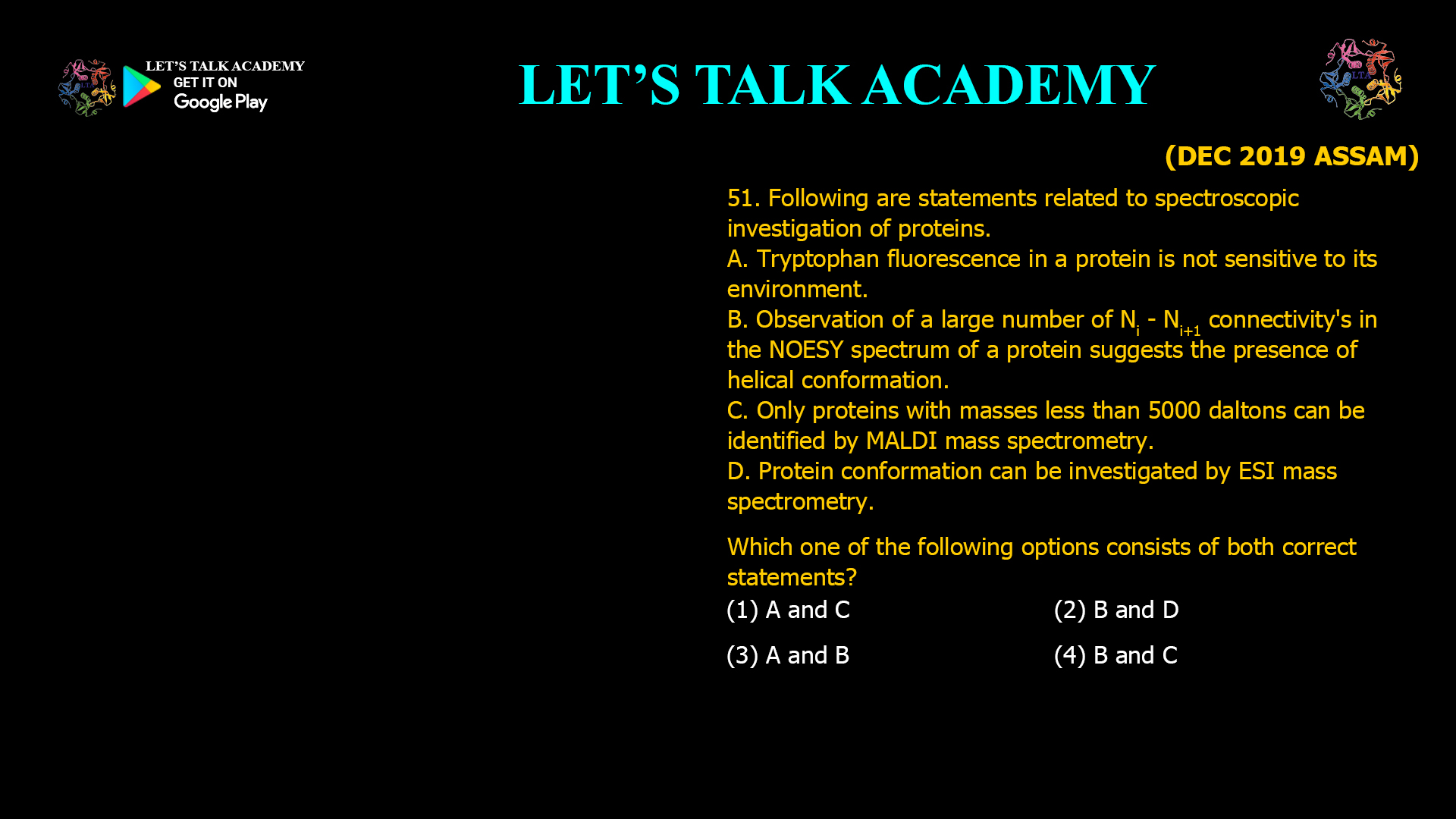
51. Following are statements related to spectroscopic investigation of proteins.
A. Tryptophan fluorescence in a protein is not sensitive to its environment.
B. Observation of a large number of Nᵢ − Nᵢ₊₁ connectivities in the NOESY spectrum of a protein suggests the presence of helical conformation.
C. Only proteins with masses less than 5000 daltons can be identified by MALDI mass spectrometry.
D. Protein conformation can be investigated by ESI mass spectrometry.
Which one of the following options consists of both correct statements?
(A) A and C
(B) B and D
(C) A and B
(D) B and C
Spectroscopic Investigation of Proteins Using Fluorescence, NOESY NMR, MALDI, and ESI Mass Spectrometry
Correct Answer
Option (2): B and D
Explanation
Modern protein characterization relies on several complementary spectroscopic and mass spectrometric techniques. Each technique provides different structural information, including secondary structure, tertiary structure, molecular mass, conformational flexibility, and intermolecular interactions. To determine the correct answer, each statement must be evaluated independently based on the principles of the corresponding technique.
Analysis of Statement A
Statement A is incorrect.
Tryptophan is the strongest intrinsic fluorophore present in proteins, and its fluorescence is highly sensitive to its surrounding environment. When a tryptophan residue is buried inside the hydrophobic core of a folded protein, the fluorescence emission maximum occurs at shorter wavelengths and the fluorescence intensity is generally higher. When unfolding or conformational changes expose the residue to the aqueous environment, the emission maximum shifts toward longer wavelengths and the fluorescence intensity often changes. Because of this remarkable environmental sensitivity, tryptophan fluorescence is widely used to monitor protein folding, unfolding, ligand binding, and conformational transitions.
Analysis of Statement B
Statement B is correct.
NOESY spectroscopy detects through-space interactions between nuclei that are separated by approximately 5 Å or less. In α-helical structures, adjacent backbone amide protons are positioned close together because of the regular helical geometry. As a result, strong and continuous Ni–Ni+1 NOE connectivities are observed throughout the helical region. The presence of numerous sequential NH-NH connectivities is therefore considered one of the characteristic NMR signatures of a helical conformation.
Analysis of Statement C
Statement C is incorrect.
Matrix-Assisted Laser Desorption/Ionization (MALDI) mass spectrometry is capable of analyzing molecules over an extremely broad mass range. It is routinely used for peptides, intact proteins, protein complexes, polymers, and other large biomolecules whose molecular masses extend far beyond 5000 daltons. Many proteins with molecular masses of tens or even hundreds of kilodaltons are successfully analyzed by MALDI. Therefore, restricting MALDI to proteins smaller than 5000 daltons is scientifically incorrect.
Analysis of Statement D
Statement D is correct.
Electrospray Ionization (ESI) mass spectrometry has become a powerful method for studying protein conformation. Native ESI preserves many non-covalent interactions during ionization, allowing folded proteins and protein complexes to be analyzed. Furthermore, techniques such as ion mobility mass spectrometry, hydrogen-deuterium exchange coupled with ESI-MS, and native mass spectrometry provide valuable information about conformational changes, structural flexibility, folding intermediates, and protein-ligand interactions. Consequently, ESI mass spectrometry is widely used for investigating protein conformation.
Why Option (1) is Incorrect
This option contains Statements A and C. Both statements are incorrect because tryptophan fluorescence is highly environment-sensitive, and MALDI mass spectrometry is capable of analyzing proteins much larger than 5000 daltons.
Why Option (2) is Correct
Statement B correctly identifies extensive sequential Ni–Ni+1 NOE connectivities as evidence of a helical structure, while Statement D correctly states that protein conformation can be investigated using ESI mass spectrometry. Since both statements are scientifically accurate, this is the correct option.
Why Option (3) is Incorrect
Although Statement B is correct, Statement A is incorrect because tryptophan fluorescence changes significantly with alterations in solvent exposure, polarity, hydrogen bonding, and nearby quenching groups. Therefore, this option cannot be accepted.
Why Option (4) is Incorrect
Statement B is correct, but Statement C is incorrect because MALDI mass spectrometry is not limited to proteins below 5000 daltons. Consequently, this combination contains one incorrect statement.
Role of Tryptophan Fluorescence in Protein Studies
Tryptophan fluorescence is extensively used to monitor protein folding and structural transitions because the indole ring is extremely sensitive to its molecular environment. Changes in solvent polarity, proximity to quenching groups, ligand binding, and conformational rearrangements alter both fluorescence intensity and emission wavelength. These properties make intrinsic fluorescence one of the most informative techniques for studying protein dynamics in solution.
Role of NOESY in Secondary Structure Determination
NOESY spectroscopy identifies protons that are spatially close to one another regardless of their positions in the amino acid sequence. The pattern of NOE cross-peaks depends on the geometry of the peptide backbone. Helices generate strong sequential NH-NH and characteristic medium-range NOEs, whereas β-sheets produce numerous long-range inter-strand contacts. Analysis of these connectivities is fundamental to protein structure determination by solution NMR.
Applications of MALDI and ESI Mass Spectrometry
MALDI mass spectrometry is widely used for determining molecular masses of peptides, proteins, and large biomolecules with high sensitivity and minimal fragmentation. Electrospray Ionization complements MALDI by generating multiply charged ions that enable analysis of very large proteins and protein complexes. Native ESI, hydrogen-deuterium exchange mass spectrometry, and ion mobility mass spectrometry further extend its capability to investigate protein folding, conformational changes, and structural dynamics.
Conclusion
Among the four statements, Statement B correctly identifies sequential NH-NH NOE connectivities as evidence of helical structure, and Statement D correctly states that ESI mass spectrometry can be used to investigate protein conformation. Statements A and C are scientifically incorrect. Therefore, the correct answer is Option (2): B and D.


