
1. Introduction
During embryonic development, cells continuously receive signals from neighboring cells and their surrounding environment. However, not every cell responds to every signal.
A signaling molecule may be present around many cells, but only certain cells may respond to it. This ability of a cell or tissue to receive and interpret a particular developmental signal is known as competence.
Competence is therefore an essential concept for understanding:
- Induction
- Cell fate determination
- Specification
- Differentiation
- Tissue patterning
- Organ formation
- Developmental signaling
A simple way to understand it is:
Signal + Competent cell → Developmental response
Whereas:
Signal + Non-competent cell → No appropriate response
2. Definition of Competence
Competence is the ability of a cell or tissue to respond to a particular inductive signal and undergo the developmental change associated with that signal.
In developmental biology, competence is generally determined by the presence of the appropriate:
- Receptors
- Signal-transduction machinery
- Transcription factors
- Chromatin state
- Regulatory proteins
- Cellular environment
Therefore, competence is not simply the presence of a receptor. It represents the overall ability of a cell to interpret a developmental signal and produce a biological response.
3. Basic Concept
Consider two cells:
- Cell A has the required receptor and signaling machinery.
- Cell B lacks the required machinery.
Both cells are exposed to the same signal.
Cell A
Signal → Receptor → Signaling pathway → Gene expression → Response
Cell B
Signal → No appropriate response
Therefore:
The same signal can produce different responses in different cells because the cells have different competence.
4. Competence and Induction
Competence is closely associated with induction.
In induction:
Inducer → Signal → Competent responder → Developmental response
The inducer provides the signal, but the responder must be competent to interpret that signal.
Important relationship
Induction = communication
Competence = ability to respond to that communication
For example, an inducer may release a growth factor, but only cells expressing the appropriate receptor and downstream signaling components may respond.
5. Inducer, Signal, Competence and Responder
| Term | Meaning |
|---|---|
| Inducer | Cell/tissue that produces the developmental signal |
| Signal | Molecule or interaction carrying developmental information |
| Responder | Cell/tissue receiving the signal |
| Competence | Ability of the responder to interpret the signal |
| Response | Change in gene expression, fate or behavior |
Overall mechanism
Inducer
↓
Produces signal
↓
Signal reaches responder
↓
Responder is competent
↓
Signal is detected
↓
Intracellular pathway activated
↓
Gene expression changes
↓
Developmental response
6. Molecular Basis of Competence
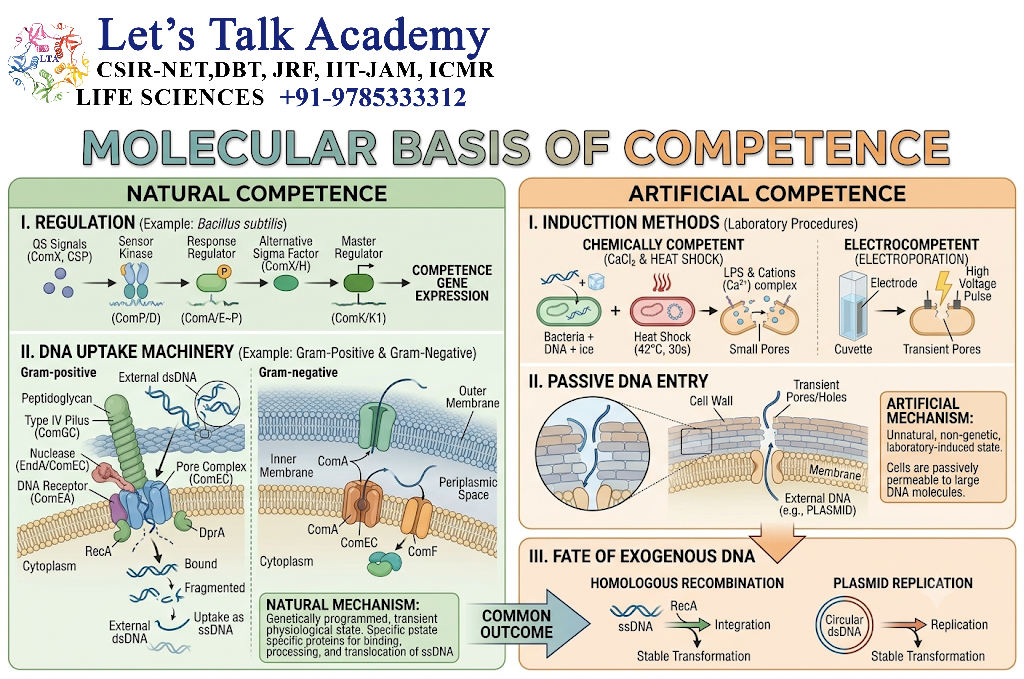
Competence is produced by the molecular state of a cell.
Several factors contribute to it.
Major components
- Receptors
- Intracellular signaling proteins
- Transcription factors
- Chromatin accessibility
- Epigenetic state
- Cofactors
- Cellular metabolism
- Developmental history
These factors determine whether a cell can properly respond to a particular signal.
7. Role of Receptors
Receptors are one of the most important components of competence.
A signal generally needs to bind to a specific receptor.
For example:
Ligand → Receptor → Signaling pathway
If a cell does not express the required receptor, the signal may have little or no direct effect.
Example
If Signal X requires Receptor X:
Cell A: Receptor X present → responds
Cell B: Receptor X absent → does not respond appropriately
Therefore, receptor expression contributes strongly to cellular competence.
8. Intracellular Signaling Machinery
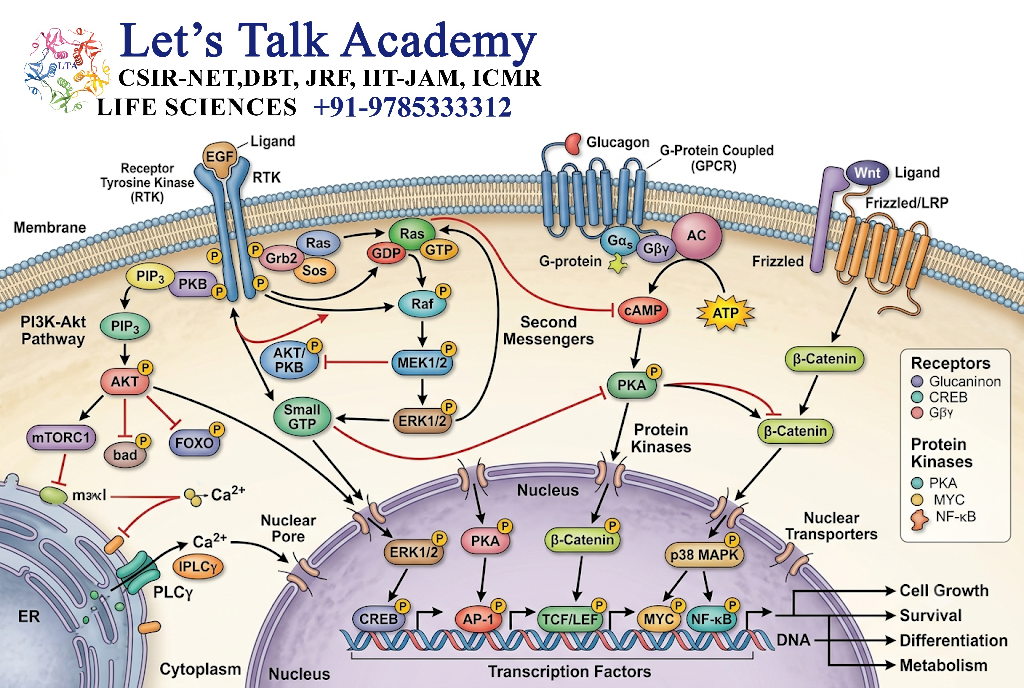
Having a receptor alone may not always be sufficient.
After receptor activation, the signal must be transmitted inside the cell.
This requires intracellular signaling proteins.
Examples include:
- Kinases
- GTPases
- SMAD proteins
- β-catenin
- STAT proteins
- Transcriptional regulators
Therefore:
Receptor + intracellular signaling machinery = functional signaling competence
9. Role of Transcription Factors
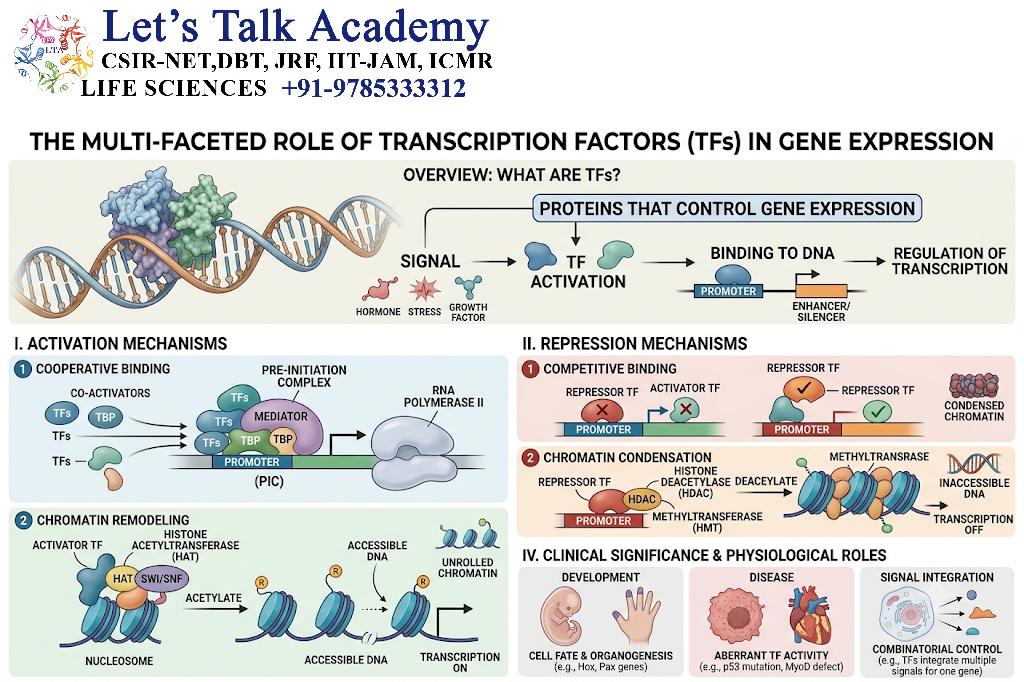
Transcription factors regulate the expression of developmental genes.
A competent cell must often contain the appropriate transcriptional environment to convert a signal into a specific developmental response.
For example:
Developmental signal
↓
Activates signaling pathway
↓
Activates transcription factor
↓
Transcription factor binds regulatory DNA
↓
Target developmental genes expressed
↓
Cell changes its developmental state
Different transcription-factor combinations can produce different responses to the same signal.
10. Role of Chromatin
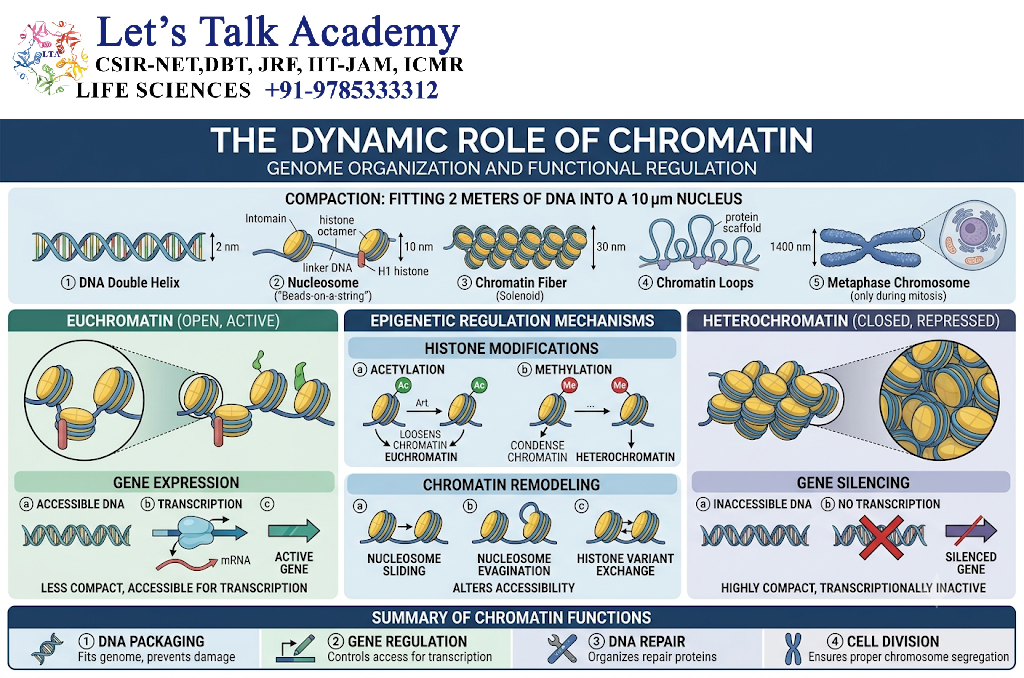
The chromatin state of a cell can influence competence.
Genes located in accessible chromatin are generally more available for transcriptional regulation.
If a developmental gene is inaccessible because of chromatin organization, a signal may fail to activate the appropriate developmental program.
Therefore:
Signal → transcription factor → accessible regulatory region → gene activation
is more likely to occur in a competent cell.
11. Epigenetic Regulation of Competence
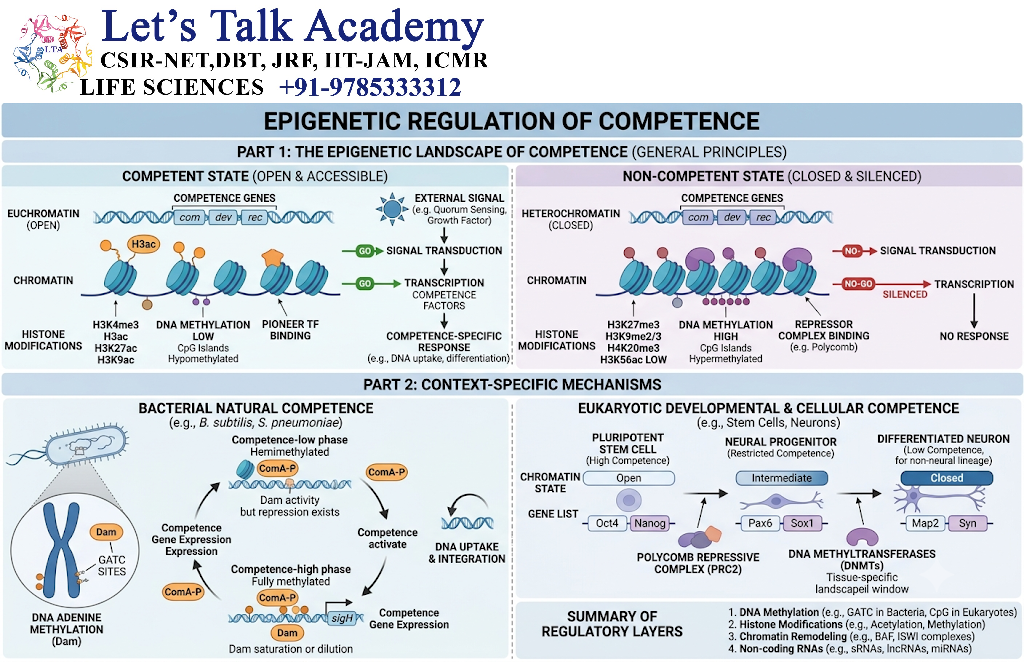
Epigenetic mechanisms can alter the ability of cells to respond to developmental signals.
Important mechanisms include:
- DNA methylation
- Histone modifications
- Chromatin remodeling
- Enhancer activation
- Non-coding RNA regulation
These mechanisms influence which genes are available for activation or repression.
Thus, competence can change as development progresses.
12. Competence Changes During Development
Competence is not necessarily permanent.
A cell may be competent to respond to a particular signal during one developmental stage but lose that competence later.
Example
Early developmental stage
Cell expresses receptor + signaling machinery
↓
Cell is competent
↓
Signal produces response
Later:
Receptor expression decreases
↓
Signaling machinery changes
↓
Cell becomes less competent or non-competent
Therefore:
Developmental competence is often temporary and stage-dependent.
13. Developmental Timing and Competence
The same signal can produce different effects depending on when it reaches the cell.
This occurs because the molecular state of the cell changes during development.
For example:
Signal X + early cell → Response A
Signal X + later cell → Response B
Signal X + non-competent cell → No major response
Therefore, both signal and developmental timing are important.
14. Competence and Cell Fate
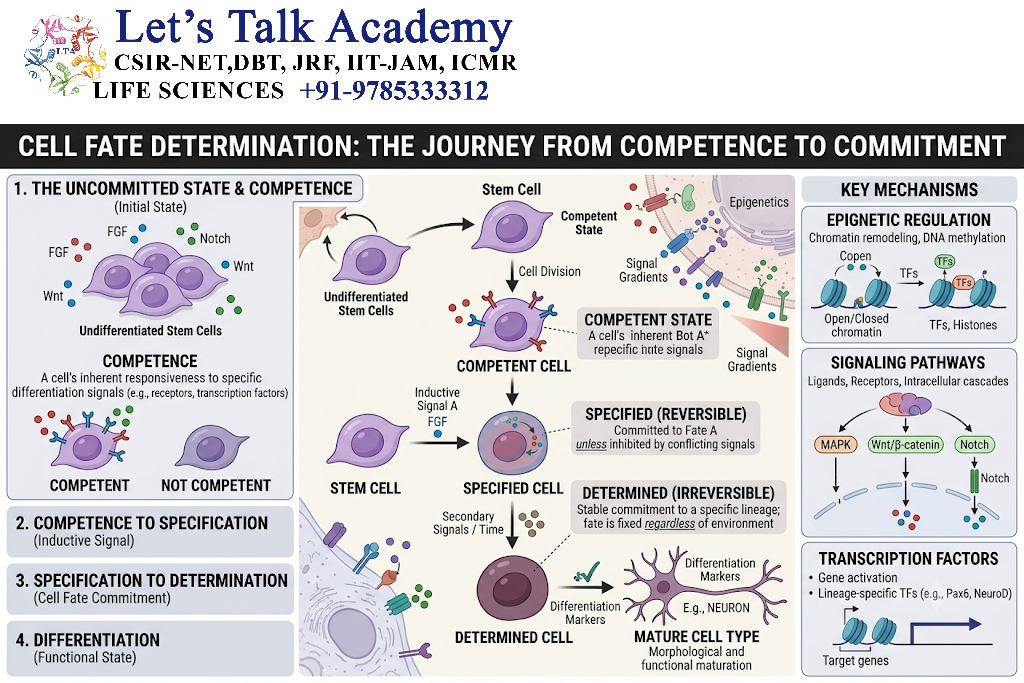
Cell fate is strongly influenced by competence.
A cell can only follow certain developmental pathways if it possesses the molecular machinery required for those pathways.
General relationship
Competence
↓
Ability to interpret signal
↓
Activation of developmental genes
↓
Specification
↓
Commitment
↓
Differentiation
Thus, competence provides an important foundation for developmental fate decisions.
15. Competence and Specification
Specification is the process through which a cell becomes biased toward a particular developmental fate.
Competence determines whether a cell can respond to an inductive signal that promotes such specification.
Example
Inducer
↓
Signal
↓
Competent ectoderm
↓
Neural developmental program
↓
Neural specification
If the ectoderm is not competent to interpret the signal, the same inductive interaction may not produce neural specification.
16. Competence and Determination
Determination represents a more stable commitment toward a developmental fate.
Competence can help initiate the molecular events leading toward determination.
Sequence
Competence
↓
Signal reception
↓
Gene regulatory changes
↓
Specification
↓
Commitment
↓
Determination
↓
Differentiation
This sequence is simplified because real development involves overlapping and feedback processes.
17. Competence and Differentiation
Differentiation involves acquisition of specialized cellular characteristics.
Competence can determine whether a cell can respond to signals that initiate or regulate differentiation.
For example:
Signal → competent precursor cell → transcription factors → tissue-specific genes → differentiated cell
Therefore, competence can be an early requirement for differentiation.
18. Competence in Neural Development
Neural development provides important examples of competence.
During embryogenesis, ectodermal cells respond to developmental signals in a context-dependent manner.
Cells that possess the appropriate molecular machinery can respond to neural-inducing environments.
The response involves changes in:
- Signaling pathways
- Transcription factors
- Gene expression
- Cell morphology
- Tissue organization
Ultimately, this contributes to formation of neural tissues.
19. Competence in Eye Development
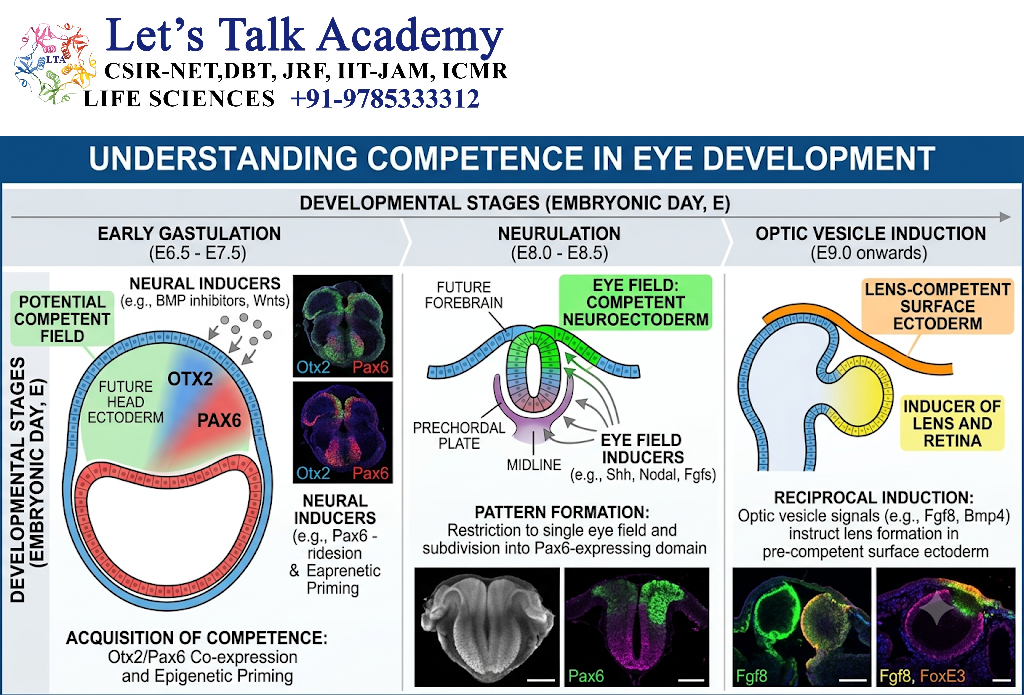
Eye development involves interactions between different embryonic tissues.
The responding tissue must possess appropriate molecular machinery to interpret signals from neighboring tissues.
If the responding tissue is competent:
Signal → receptor/pathway → developmental genes → eye-related developmental program
Thus, competence is essential for tissue interactions during eye development.
20. Competence in Limb Development
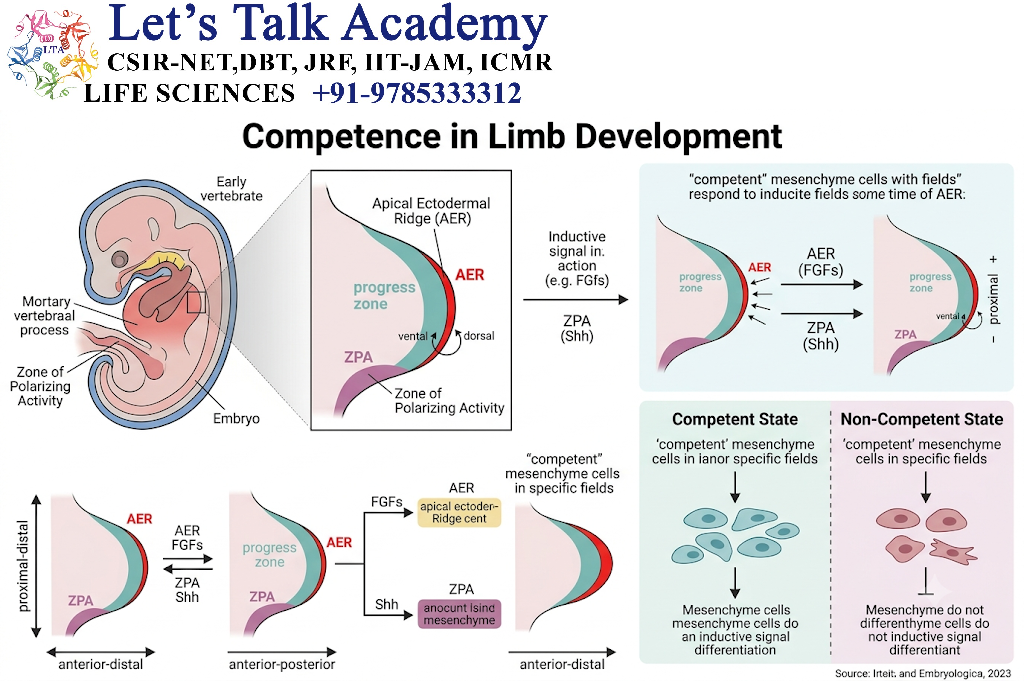
Limb development depends on several signaling centers and pathways.
Important signaling systems include:
- FGF
- SHH
- WNT
- BMP
Cells within the developing limb must be competent to respond to these signals.
Changes in receptor expression, transcription factors or signaling components can alter how cells respond to developmental cues.
21. Competence in Organogenesis
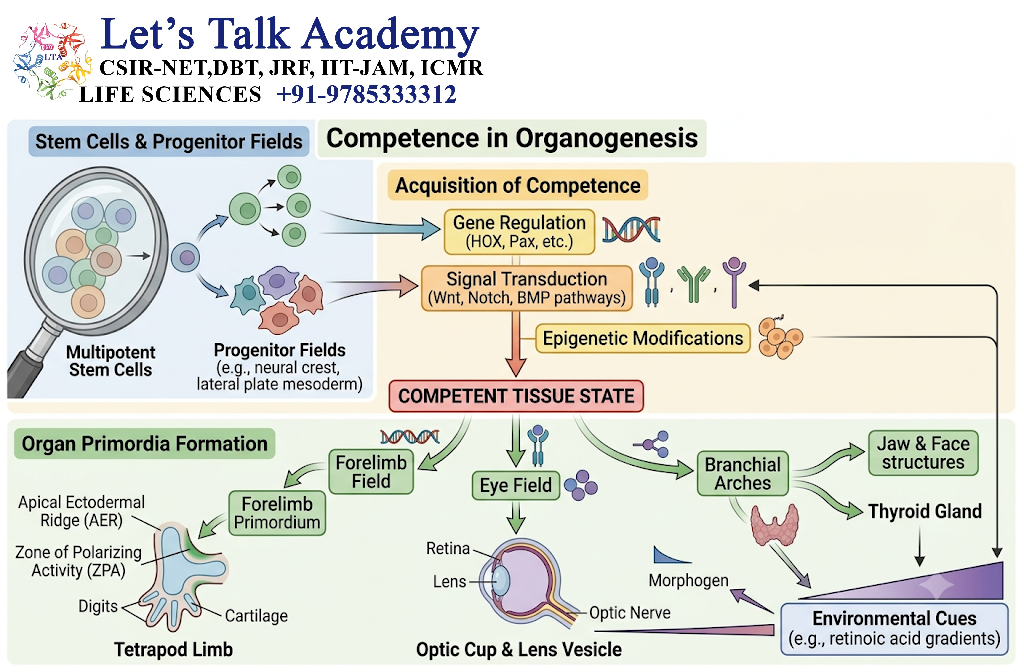
Organ formation usually requires interactions between different tissues.
Examples include:
- Kidney
- Tooth
- Lung
- Liver
- Pancreas
- Eye
During organogenesis:
Inducing tissue
↓
Developmental signal
↓
Competent responding tissue
↓
Changes in proliferation/differentiation
↓
Tissue organization
↓
Organ formation
Therefore, competence is essential for coordinated organ development.
22. Competence and Morphogens
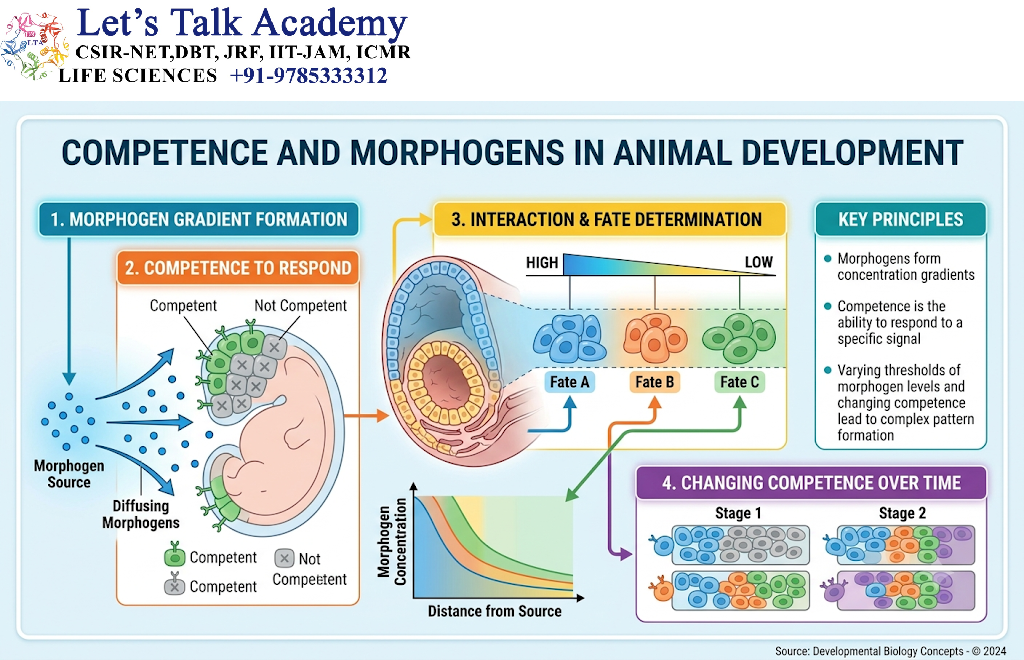
Morphogens provide positional information through concentration-dependent signaling.
A cell must be competent to interpret the morphogen concentration.
For example:
High morphogen + competent cell → Fate A
Intermediate morphogen + competent cell → Fate B
Low morphogen + competent cell → Fate C
A non-competent cell may fail to respond appropriately even when the morphogen is present.
23. Competence and Major Signaling Pathways
WNT
Competence to respond to WNT depends on appropriate receptors and intracellular components.
WNT signaling contributes to:
- Cell fate
- Pattern formation
- Stem-cell maintenance
- Organ development
BMP/TGF-β
BMP signaling involves receptors and SMAD proteins.
It regulates:
- Tissue patterning
- Differentiation
- Bone development
- Organogenesis
FGF
FGF signaling commonly occurs through receptor tyrosine kinases.
It contributes to:
- Proliferation
- Migration
- Differentiation
- Limb development
Hedgehog
Hedgehog signaling contributes to:
- Pattern formation
- Neural development
- Limb development
- Organogenesis
Notch
Notch signaling frequently requires direct cell-cell contact.
It regulates:
- Cell fate
- Differentiation
- Lateral inhibition
- Tissue organization
24. Competence and Cell-Cell Communication
Development is based on continuous communication between cells.
However, communication is meaningful only if the receiving cell can interpret the message.
Therefore:
Communication requires both signal production and signal interpretation.
The inducer controls the signal.
The responder’s competence controls its ability to interpret that signal.
25. Competence Is Context-Dependent
A cell’s response depends on its developmental context.
The same signaling molecule can cause different responses in different tissues.
Why?
Because cells may have different:
- Receptors
- Transcription factors
- Chromatin states
- Signaling proteins
- Previous developmental history
Therefore:
Same signal + different cellular context = different developmental response
This is a major principle of developmental biology.
26. Competence and Signal Combination
Cells rarely receive only one signal.
They often receive multiple signals simultaneously.
For example:
Signal A + Signal B + Signal C
may produce a response that is different from:
Signal A alone
Therefore, competence also includes the ability to integrate multiple developmental signals.
This is sometimes called signal integration.
27. Competence and Gene Regulatory Networks
Developmental genes operate in networks rather than independently.
An inductive signal can activate one transcription factor, which activates several additional genes.
Example
Signal
↓
Transcription factor A
↓
Genes B + C + D
↓
Additional transcription factors
↓
Stable developmental program
Thus, competence allows a cell to enter an appropriate gene regulatory network in response to developmental signals.
28. Competence and Feedback Mechanisms
Developmental signaling can involve feedback.
For example:
Signal → gene activation → additional signaling molecule → reinforcement of developmental state
Positive feedback can stabilize a developmental decision.
Negative feedback can prevent excessive signaling.
Therefore, competence can be dynamically regulated during development.
29. Loss of Competence
A cell may lose competence because of:
- Loss of receptor
- Receptor downregulation
- Changes in signaling proteins
- Changes in transcription factors
- Epigenetic modifications
- Chromatin changes
- Differentiation
- Changes in cellular environment
This helps prevent cells from responding to signals that are no longer appropriate.
30. Acquisition of Competence
Cells can also acquire competence.
During development, expression of a receptor or transcription factor may make a previously unresponsive cell capable of responding to a signal.
Mechanism
Previously non-responsive cell
↓
Receptor/signaling machinery expressed
↓
Cell becomes competent
↓
Developmental signal received
↓
Specific developmental response
This allows developmental competence to change over time.


