
1. Electrical Properties of Membranes
Cell membranes are not merely physical barriers that separate the interior of a cell from its external environment. They are also electrically active structures that regulate the movement of charged particles and generate electrical differences across the membrane.
The electrical behavior of a membrane arises mainly from three features: the lipid bilayer, the selective permeability of membrane proteins, and the unequal distribution of ions between the intracellular and extracellular environments.
Because ions such as K⁺, Na⁺, Ca²⁺, and Cl⁻ carry electrical charges, their movement across the membrane produces changes in electrical potential. These changes are fundamental to cellular communication, transport, secretion, muscle contraction, sensory processes, and signal transduction.
A useful way to understand membrane electrical properties is to think of the membrane as an electrical circuit. The lipid bilayer behaves largely like a capacitor, while ion channels provide pathways through which electrical charge can move. Ion pumps and transporters maintain the concentration gradients that provide the driving forces for these movements.
Thus, the electrical properties of membranes are closely connected with both membrane transport and cellular signaling.
1.1 Why Membranes Have Electrical Properties
The electrical properties of biological membranes originate from the presence of charged ions on either side of a thin, insulating lipid bilayer.
The membrane itself is composed primarily of phospholipids. The hydrophobic interior of the lipid bilayer is a poor conductor of ions. Therefore, ions cannot freely cross the membrane through the lipid portion.
Instead, ions cross the membrane through specialized proteins such as:
- Ion channels
- Ion pumps
- Ion exchangers
- Cotransporters
- Other membrane transport proteins
Because ions are distributed unequally across the membrane, and because the membrane has selective permeability, a small separation of electrical charge develops across the membrane.
This charge separation produces a membrane potential.
1.2 Charge Separation Across the Membrane
In a typical animal cell, the concentrations of ions inside and outside the cell are different.
For example:
- K⁺ concentration is generally higher inside the cell.
- Na⁺ concentration is generally higher outside the cell.
- Ca²⁺ concentration is much higher outside the cell than inside.
- Cl⁻ distribution varies among different cell types but often differs significantly across the membrane.
Although the overall cytoplasm remains electrically close to neutral, there is a very small excess of charge near the membrane surfaces.
This is important because a large voltage can be generated by the separation of a relatively small number of ions.
The membrane therefore behaves as a structure capable of storing separated electrical charges.
2. Membrane Potential
The membrane potential is the electrical potential difference across a biological membrane.
It is usually expressed as:
Vₘ = Vinside − Voutside
By convention, the electrical potential outside the cell is often considered to be approximately zero. Therefore, if the inside of a cell has a potential of −70 mV relative to the outside, the membrane potential is:
Vₘ = −70 mV
A negative membrane potential means that the inside of the cell is electrically negative relative to the outside.
The membrane potential is not a fixed property of all cells. It varies depending on:
- Ion concentrations
- Membrane permeability
- Number and type of open ion channels
- Activity of ion pumps
- Cell type
- Cellular physiological state
2.1 Resting Membrane Potential
When a cell is not actively producing an electrical signal, it generally maintains a characteristic membrane potential called the resting membrane potential.
In many animal cells, the resting membrane potential is negative, commonly ranging from approximately −40 to −90 mV, depending on the cell type.
For example, neurons commonly have resting membrane potentials around −60 to −70 mV.
The resting membrane potential develops primarily because the membrane is selectively permeable to different ions, especially K⁺, and because concentration gradients are maintained by active transport mechanisms.
2.2 Role of Potassium in Resting Potential
Potassium plays a major role in establishing the resting membrane potential in many cells.
The concentration of K⁺ is generally much higher inside the cell than outside. If potassium channels are open, K⁺ tends to move outward because of its concentration gradient.
As positively charged K⁺ leaves the cell, the inside becomes relatively more negative.
However, the movement of K⁺ does not continue indefinitely. As the inside becomes negative, the electrical force begins to attract K⁺ back toward the cell.
Eventually, the chemical and electrical forces acting on K⁺ can reach a balance.
This concept is central to understanding the equilibrium potential of an ion.
3. Ion Concentration Gradients
An ion concentration gradient is the difference in concentration of a particular ion across the membrane.
For example:
[K⁺]inside > [K⁺]outside
and
[Na⁺]outside > [Na⁺]inside
These gradients represent stored chemical energy.
Cells continuously use energy to maintain these gradients. The most important mechanism responsible for maintaining the Na⁺ and K⁺ gradients in many animal cells is the Na⁺/K⁺-ATPase.
3.1 Na⁺/K⁺-ATPase
The Na⁺/K⁺-ATPase is an ATP-dependent membrane pump.
For each ATP molecule hydrolyzed, the pump generally transports:
- 3 Na⁺ out of the cell
- 2 K⁺ into the cell
This transport occurs against the respective concentration gradients.
As a result, the pump contributes to the maintenance of:
- High intracellular K⁺
- High extracellular Na⁺
- Ionic gradients
- Cell volume regulation
- Membrane electrical properties
The pump is also electrogenic because it moves a net positive charge outward during each transport cycle.
However, the resting membrane potential in most cells is determined more directly by ion permeability, particularly K⁺ permeability, than by the direct electrical contribution of the pump.
4. Electrochemical Gradient
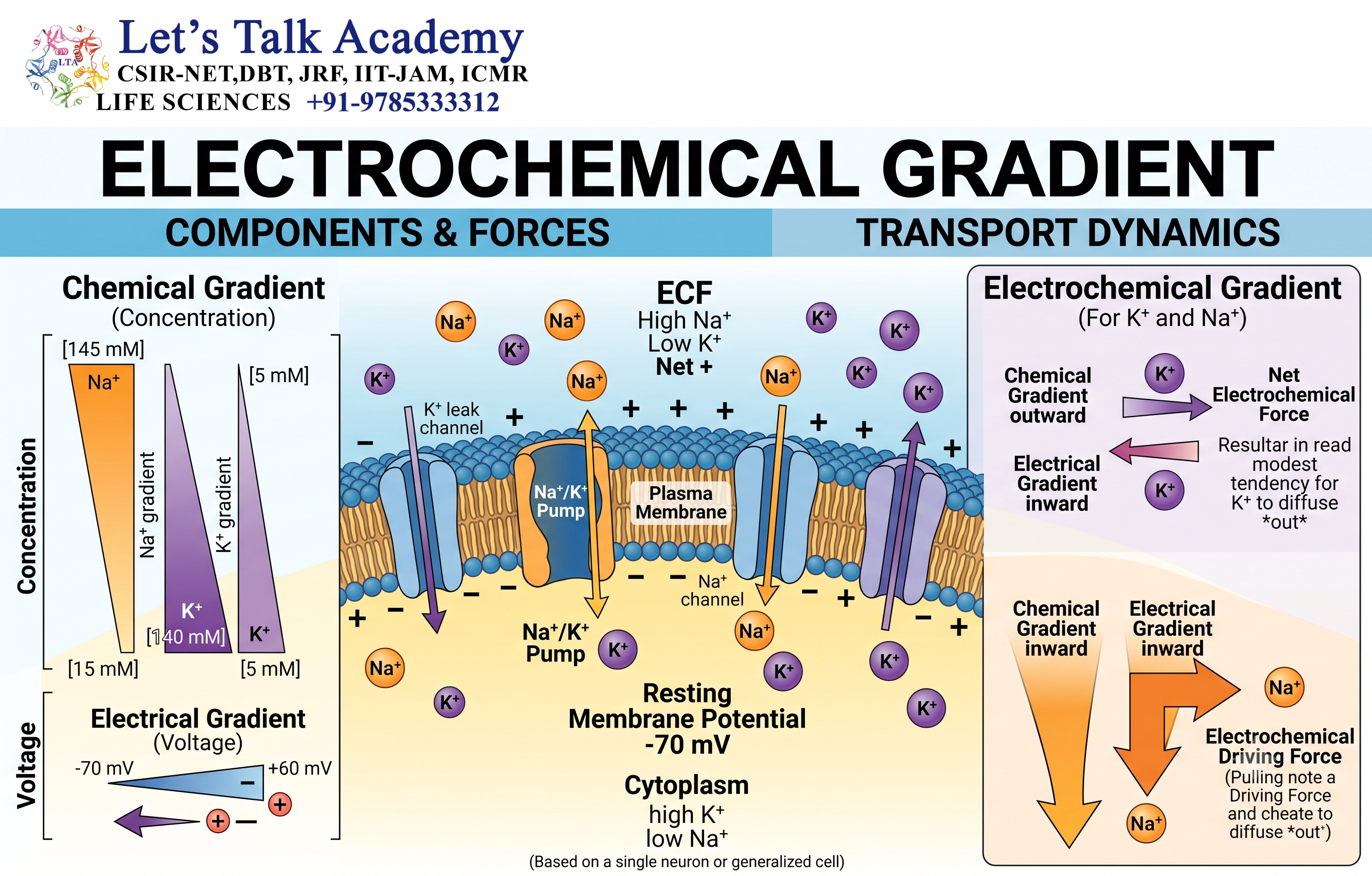
An ion does not respond only to its concentration gradient. Because ions are electrically charged, they are influenced by both:
- The chemical gradient
- The electrical gradient
Together, these form the electrochemical gradient.
The electrochemical gradient determines the direction in which an ion tends to move across a membrane.
For a positively charged ion such as K⁺:
- A higher concentration outside favors inward movement.
- A negative membrane interior favors inward movement.
- A higher concentration inside favors outward movement.
- A positive membrane interior favors outward movement.
The actual direction of ion movement depends on the combined effects of these forces.
4.1 Chemical Driving Force
The chemical driving force results from differences in ion concentration.
Particles tend to move from regions of higher concentration toward regions of lower concentration.
For example, because K⁺ concentration is normally higher inside a cell, K⁺ has a chemical tendency to move outward when appropriate K⁺ channels are open.
4.2 Electrical Driving Force
The electrical driving force results from the attraction or repulsion between electrical charges.
Because opposite charges attract:
- Cations are attracted toward a negative region.
- Anions are attracted toward a positive region.
Therefore, the electrical force can either oppose or reinforce the chemical force.
5. Equilibrium Potential
The equilibrium potential of an ion is the membrane potential at which the electrical force exactly balances the chemical driving force for that ion.
At this voltage, there is no net movement of that particular ion across the membrane, although individual ions may still move in both directions.
The equilibrium potential depends on:
- Ion concentration inside the cell
- Ion concentration outside the cell
- Temperature
- Ion charge
For a monovalent ion, the Nernst equation can be written as:
Eion = (RT/zF) ln([ion]outside/[ion]inside)
where:
- Eion = equilibrium potential of the ion
- R = gas constant
- T = absolute temperature
- z = valence of the ion
- F = Faraday constant
At approximately 37°C, the equation is commonly expressed in a simplified logarithmic form.
5.1 Nernst Equation
For physiological applications, the Nernst equation is extremely useful for determining the equilibrium potential of a single ion.
For a monovalent ion:
Eion ≈ 61.5/z log([ion]outside/[ion]inside) mV
at approximately 37°C.
For example, because intracellular K⁺ concentration is much greater than extracellular K⁺ concentration, the equilibrium potential for K⁺ is normally negative.
This explains why the resting membrane potential of many cells is close to, although not necessarily identical to, the equilibrium potential of K⁺.
6. Membrane Permeability
Membrane permeability refers to the ability of a membrane to allow a particular substance to cross it.
The lipid bilayer itself is highly impermeable to charged ions. Therefore, ion movement largely depends on membrane proteins.
A membrane may be:
- Highly permeable to K⁺
- Less permeable to Na⁺
- Selectively permeable to Cl⁻
- Highly regulated with respect to Ca²⁺
The relative permeability of a membrane can change rapidly when ion channels open or close.
This is why changes in channel activity can produce rapid changes in membrane potential.
6.1 Selective Permeability
Selective permeability means that the membrane allows some substances to cross more easily than others.
Ion channels achieve selectivity through structural features within their pores.
For example, a K⁺ channel can discriminate between K⁺ and other ions despite their similar charge because of the precise arrangement of amino acid residues within the channel.
Selective permeability is therefore essential for the generation and regulation of electrical signals.
7. Ion Channels and Electrical Signaling
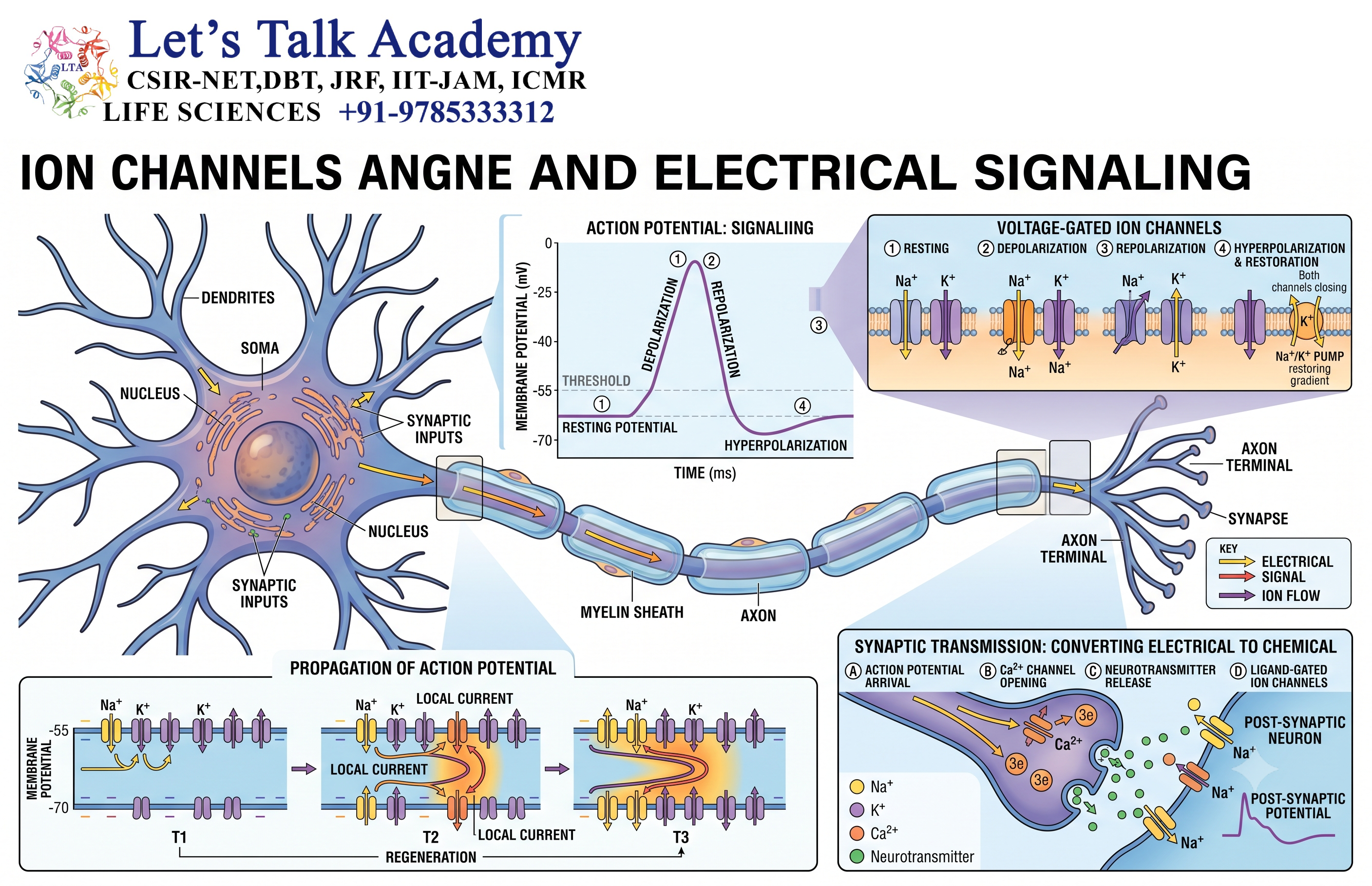
Ion channels are membrane proteins that create hydrophilic pathways through which specific ions can move down their electrochemical gradients.
Different channels respond to different stimuli.
Major categories include:
- Voltage-gated channels
- Ligand-gated channels
- Mechanically gated channels
- Leak channels
- Second-messenger-regulated channels
7.1 Voltage-Gated Ion Channels
Voltage-gated channels respond to changes in membrane potential.
Important examples include:
- Voltage-gated Na⁺ channels
- Voltage-gated K⁺ channels
- Voltage-gated Ca²⁺ channels
These channels are particularly important in neurons and muscle cells.
7.2 Ligand-Gated Ion Channels
Ligand-gated channels open when a chemical messenger binds to the channel or an associated receptor.
Neurotransmitters can activate such channels at synapses.
The resulting ion movement can either depolarize or hyperpolarize the membrane.
7.3 Mechanically Gated Channels
Mechanically gated channels respond to physical forces such as:
- Stretch
- Pressure
- Vibration
- Membrane deformation
They are important in sensory systems, including touch, hearing, and balance.
8. Membrane Resistance
Membrane resistance describes how strongly a membrane opposes the movement of electrical charge.
A membrane with high resistance allows relatively little ionic current to pass.
A membrane with low resistance allows greater ionic current.
Membrane resistance is strongly influenced by the number of open ion channels.
When more ion channels are open:
Ion permeability increases → membrane resistance decreases
When fewer channels are open:
Ion permeability decreases → membrane resistance increases
This relationship is important in understanding how electrical signals spread through cells.
9. Membrane Conductance
Conductance is the reciprocal of resistance.
It is represented by G:
G = 1/R
where:
- G = conductance
- R = resistance
Conductance describes how easily electrical current can flow through a membrane.
Opening ion channels increases membrane conductance.
For an ion channel:
I = g(Vₘ − Eion)
where:
- I = ionic current
- g = conductance
- Vₘ = membrane potential
- Eion = equilibrium potential of the ion
This relationship helps explain how opening a specific channel affects membrane voltage.
10. Membrane Capacitance
The lipid bilayer behaves electrically like a capacitor.
A capacitor is a structure capable of storing electrical charge.
In a biological membrane:
- The conductive cytoplasm acts as one electrical medium.
- The extracellular fluid acts as another.
- The insulating lipid bilayer separates them.
Therefore, the membrane can store separated electrical charges.
Membrane capacitance is commonly expressed per unit area, often approximately:
1 µF/cm²
for many biological membranes.
10.1 Importance of Membrane Capacitance
Membrane capacitance determines how much charge must move to change the membrane potential by a given amount.
The relationship is:
Q = CV
where:
- Q = charge
- C = capacitance
- V = voltage
A membrane with high capacitance requires more charge movement to produce the same change in voltage.
This property influences the speed with which membrane potential changes.
11. Electrical Equivalent Circuit of a Membrane
The electrical behavior of a biological membrane can be represented using an equivalent electrical circuit.
A simplified membrane circuit contains:
- A capacitor representing the lipid bilayer
- Resistors or conductances representing ion channels
- Batteries or voltage sources representing ion equilibrium potentials
- Pumps representing active transport mechanisms
This model allows complex biological electrical behavior to be analyzed using principles of electrical circuits.
11.1 Capacitive and Resistive Components
The membrane’s capacitive component comes mainly from the lipid bilayer.
The membrane’s resistive component comes mainly from ion channels and other pathways through which ions can cross.
Thus:
Lipid bilayer → capacitance
Ion channels → conductance/resistance
This simple relationship is extremely useful for understanding membrane electrophysiology.
12. Membrane Time Constant
The membrane time constant is represented by:
τ = RmCm
where:
- τ = membrane time constant
- Rm = membrane resistance
- Cm = membrane capacitance
The time constant describes how quickly the membrane potential changes in response to a current.
A larger time constant means that the membrane potential changes more slowly.
A smaller time constant means that the membrane potential changes more rapidly.
This concept is particularly important when studying how electrical signals spread along neurons.
13. Membrane Potential Changes
Changes in membrane potential can occur when ion channels open or close.
The major forms of membrane potential changes include:
- Depolarization
- Hyperpolarization
- Repolarization
13.1 Depolarization
Depolarization means that the membrane potential becomes less negative relative to the resting state.
For example:
−70 mV → −50 mV
This can occur when positively charged ions, particularly Na⁺ or Ca²⁺, enter the cell.
Depolarization can bring an excitable cell closer to the threshold required for generating an action potential.
13.2 Repolarization
Repolarization refers to the return of membrane potential toward its resting value after depolarization.
In neurons, repolarization commonly involves the opening of voltage-gated K⁺ channels and the outward movement of K⁺.
13.3 Hyperpolarization
Hyperpolarization occurs when the membrane potential becomes more negative than its resting level.
For example:
−70 mV → −80 mV
Hyperpolarization can result from:
- K⁺ efflux
- Cl⁻ influx
- Increased permeability to particular ions
Hyperpolarization generally makes an excitable cell less likely to reach threshold.
14. Action Potential
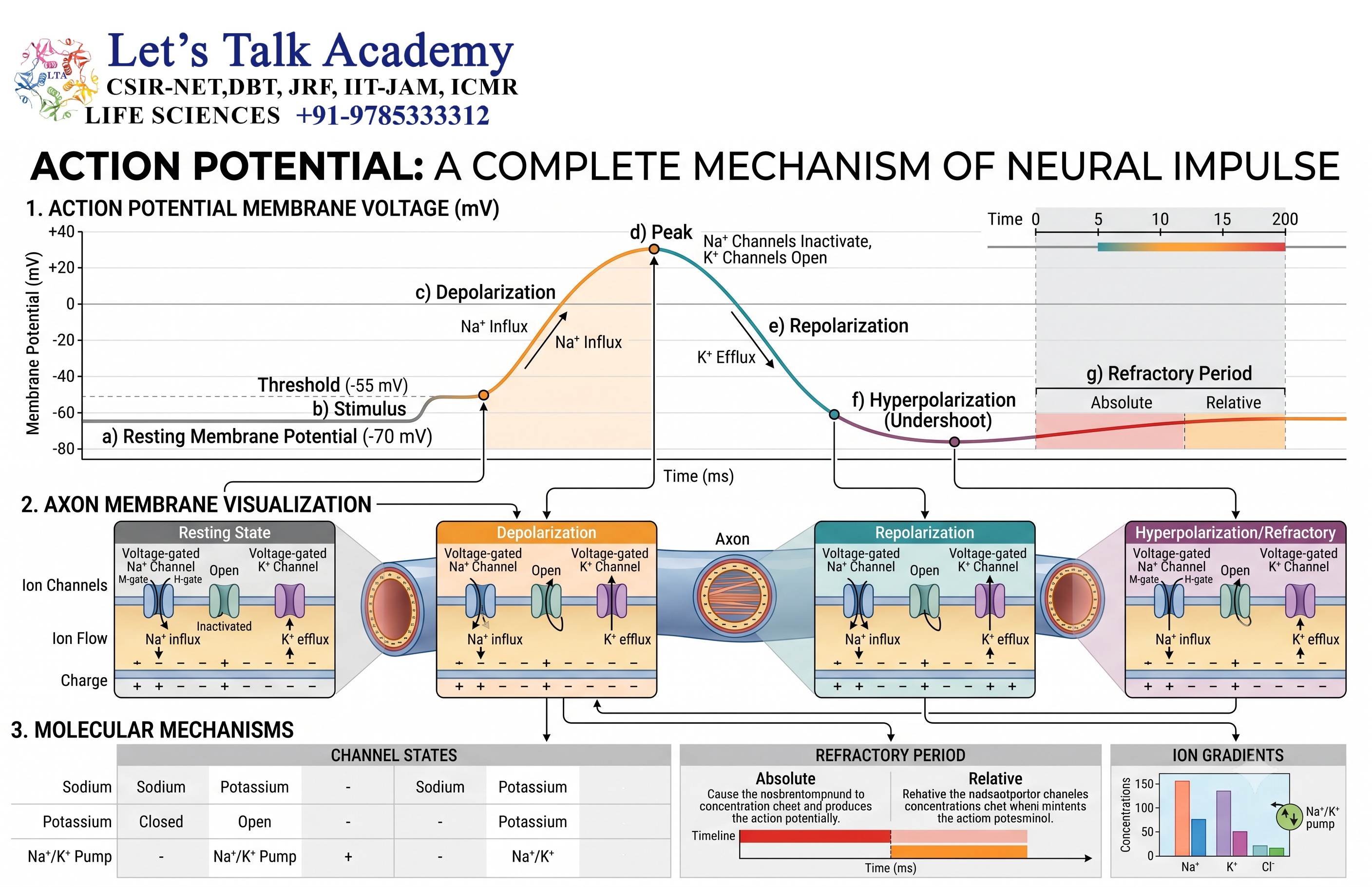
An action potential is a rapid, transient change in membrane potential that occurs in excitable cells such as neurons and muscle cells.
A typical neuronal action potential involves:
- Resting membrane potential
- Depolarization
- Peak potential
- Repolarization
- After-hyperpolarization
- Return to resting potential
14.1 Role of Sodium Channels
When the membrane reaches threshold, voltage-gated Na⁺ channels open rapidly.
Na⁺ enters the cell because:
- Na⁺ concentration is higher outside.
- The cell interior is electrically negative.
The combined electrochemical gradient strongly favors Na⁺ entry.
This produces rapid depolarization.
14.2 Role of Potassium Channels
Voltage-gated K⁺ channels generally open more slowly than voltage-gated Na⁺ channels.
When they open, K⁺ moves outward.
This contributes to:
- Repolarization
- After-hyperpolarization
- Restoration of the resting membrane potential
15. Graded Potentials
Not every electrical change in a cell is an action potential.
Graded potentials are changes in membrane potential whose amplitude depends on the strength of the stimulus.
They may be:
- Depolarizing
- Hyperpolarizing
Unlike action potentials, graded potentials can vary continuously in magnitude.
Their effects can also spread passively through the membrane and decrease with distance.
16. Electrotonic Spread of Electrical Signals
Electrical changes can spread passively through the cytoplasm and along the membrane.
This passive spread is called electrotonic conduction.
The signal becomes progressively smaller as it travels because of the electrical resistance and capacitance of the membrane.
Two important properties determine the spatial spread of membrane potential:
- Membrane resistance
- Internal resistance
16.1 Length Constant
The length constant, represented by λ, describes how far a passive electrical signal can spread along a membrane before decreasing substantially in amplitude.
A larger length constant allows electrical signals to spread farther.
In neurons, a larger membrane resistance generally favors greater passive spread because less current leaks across the membrane.
17. Electrical Properties of Neuronal Membranes
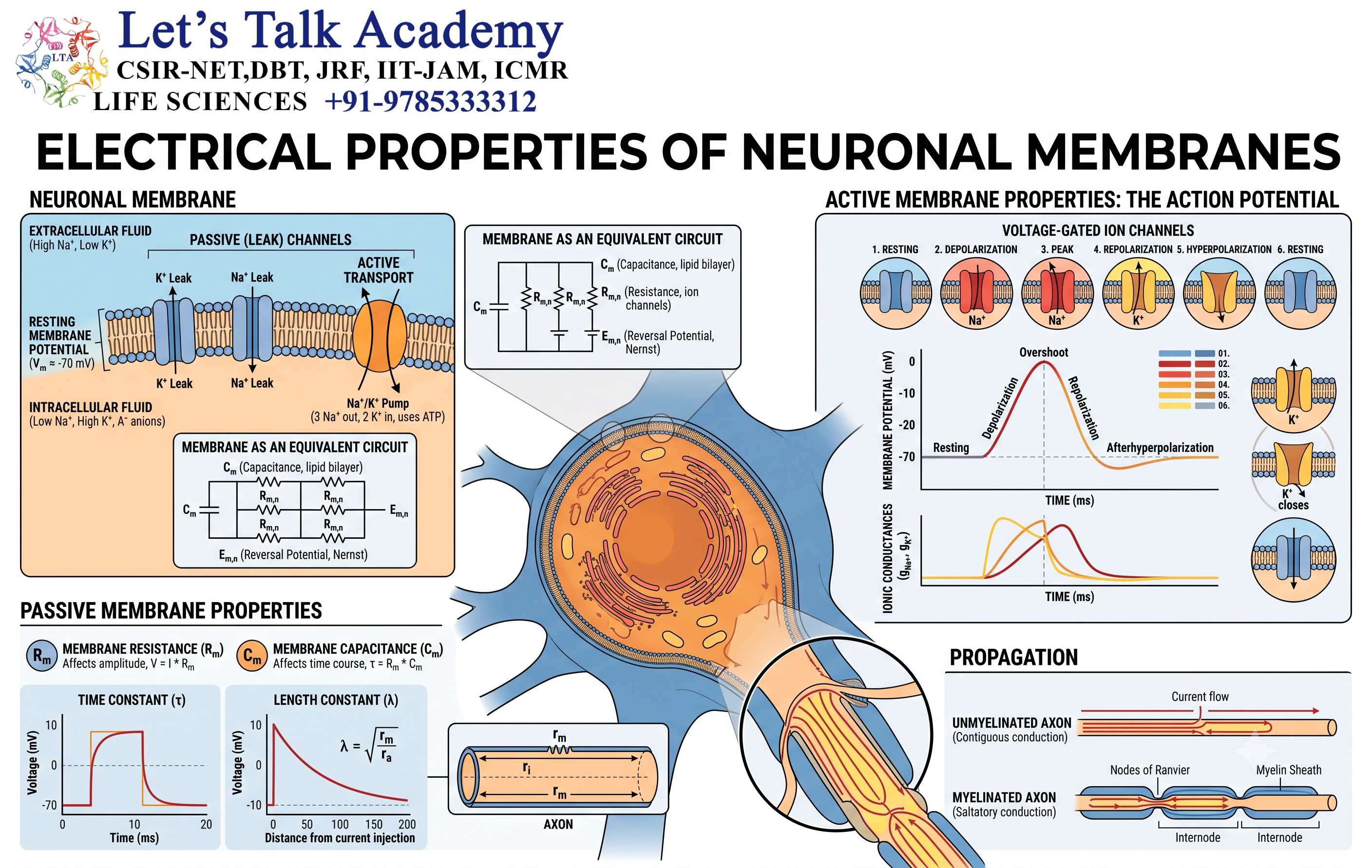
Neurons are highly specialized for electrical signaling.
Their electrical behavior depends on:
- Ion gradients
- Ion channels
- Membrane resistance
- Membrane capacitance
- Membrane potential
- Axonal geometry
- Distribution of voltage-gated channels
The dendrites and cell body mainly receive and integrate signals, whereas the axon can generate and propagate action potentials.
17.1 Myelination and Electrical Properties
Myelin acts as an electrical insulator around many axons.
It increases membrane resistance and decreases effective membrane capacitance over the insulated regions.
As a result, electrical signals can travel more rapidly.
Voltage-gated ion channels are concentrated at specialized gaps called nodes of Ranvier.
Action potentials can therefore appear to jump from node to node, a process called saltatory conduction.
18. Electrical Properties of Muscle Membranes
Muscle cells also depend on membrane electrical activity.
Changes in membrane potential can activate voltage-sensitive mechanisms that ultimately regulate contraction.
In skeletal muscle, an action potential travels along the sarcolemma and into the transverse tubules, triggering intracellular Ca²⁺ release.
Ca²⁺ then interacts with the contractile machinery to initiate contraction.
Thus, electrical signaling is directly connected to mechanical activity in muscle.
19. Calcium and Membrane Electrical Activity
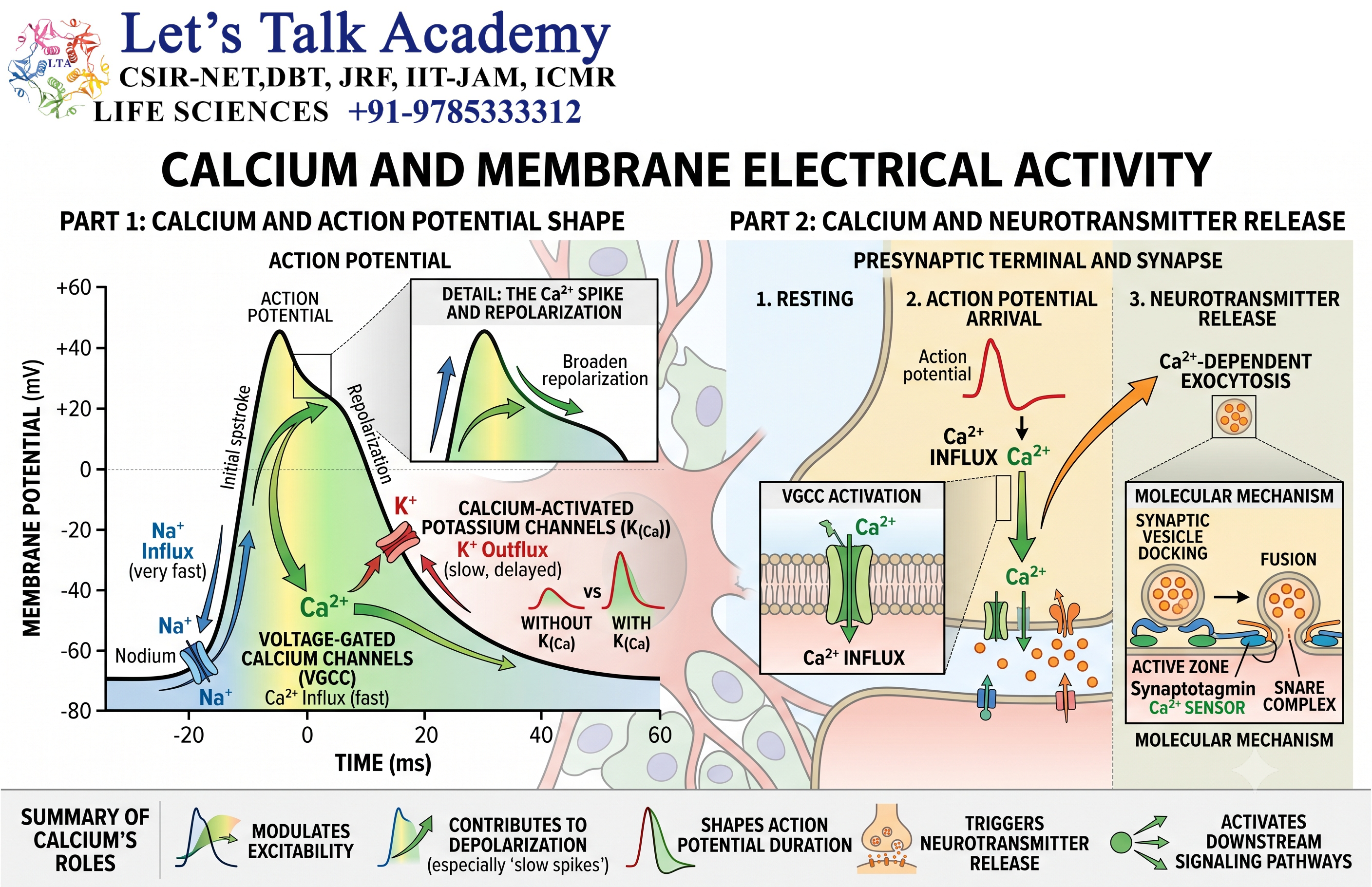
Ca²⁺ is especially important because it has both electrical and signaling functions.
The concentration of free Ca²⁺ is usually much higher outside the cytoplasm than inside it.
When Ca²⁺ channels open, Ca²⁺ can enter the cell rapidly.
Ca²⁺ influx contributes to:
- Membrane depolarization
- Neurotransmitter release
- Muscle contraction
- Hormone secretion
- Enzyme activation
- Intracellular signaling
Because excessive cytosolic Ca²⁺ can be harmful, cells maintain very low resting cytosolic Ca²⁺ concentrations through pumps, exchangers, buffering systems, and sequestration.
20. Chloride and Membrane Potential
Cl⁻ is an important anion that contributes to membrane electrical behavior.
The effect of Cl⁻ movement depends on its electrochemical gradient and the chloride equilibrium potential.
Opening Cl⁻ channels can stabilize the membrane potential or produce hyperpolarizing effects, depending on the cell’s existing membrane potential and chloride concentration.
This is particularly important in neuronal inhibition.
21. Goldman-Hodgkin-Katz Equation
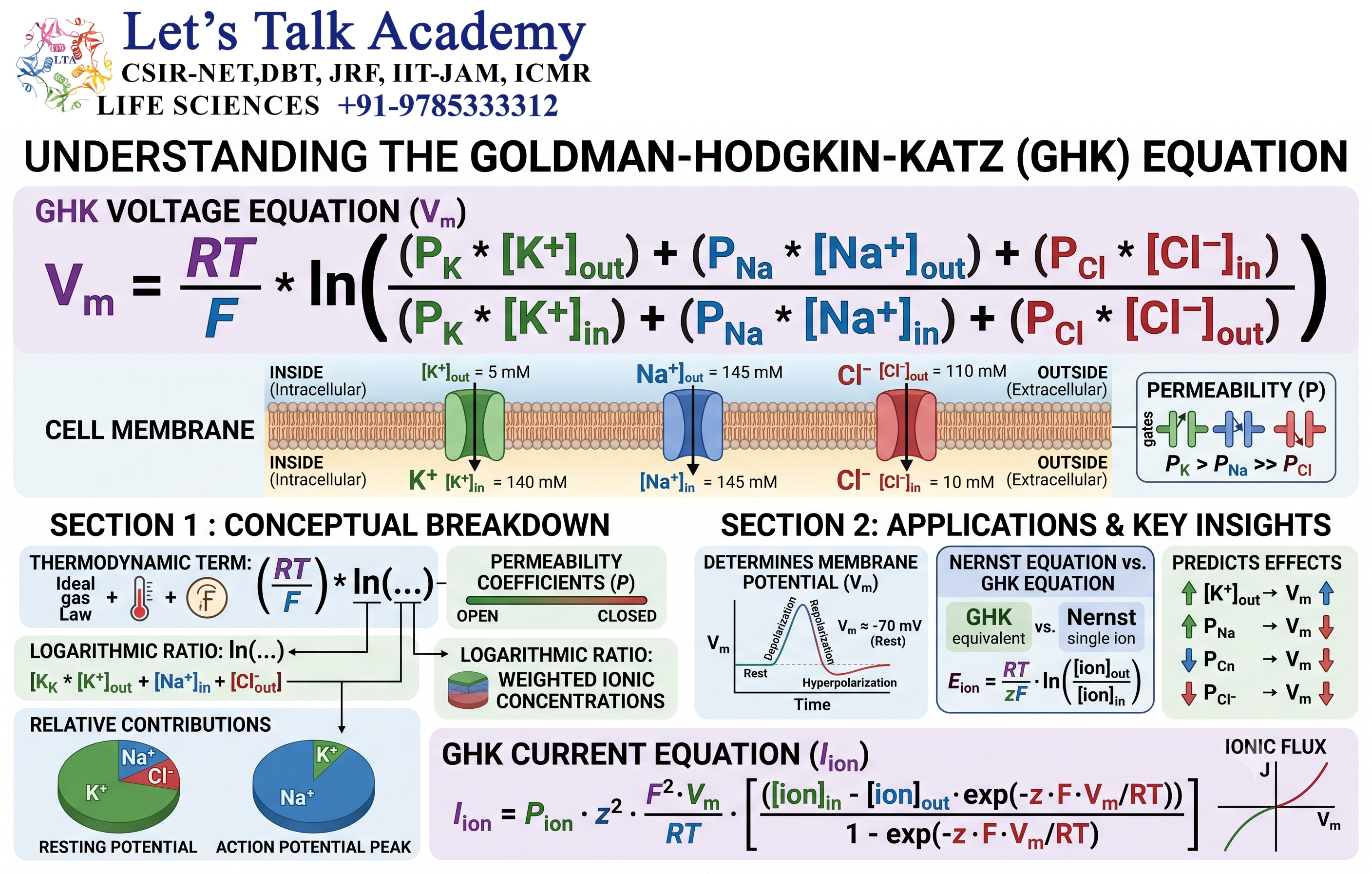
The Nernst equation determines the equilibrium potential for a single ion.
However, real cell membranes are usually permeable to several ions simultaneously.
The Goldman-Hodgkin-Katz equation is therefore useful for estimating membrane potential when multiple ions contribute to the membrane potential.
For a membrane permeable mainly to K⁺, Na⁺, and Cl⁻, the equation considers:
- Concentration of each ion
- Relative membrane permeability of each ion
- Direction of the concentration gradient
- Charge of the ion
A simplified form for these ions is:
Vₘ = (RT/F) ln [(Pₖ[K⁺]out + PNa[Na⁺]out + PCl[Cl⁻]in) / (Pₖ[K⁺]in + PNa[Na⁺]in + PCl[Cl⁻]out)]
The reversal of inside and outside concentrations for Cl⁻ occurs because chloride is negatively charged.
22. Reversal Potential
The reversal potential is the membrane potential at which the net current through a particular ion channel or channel population becomes zero.
For a channel that is highly selective for one ion, its reversal potential is close to that ion’s equilibrium potential.
For channels permeable to multiple ions, the reversal potential depends on the relative permeability and concentration of all relevant ions.
This concept is useful for interpreting electrophysiological experiments.
23. Driving Force
The driving force for an ion can be expressed as:
Driving force = Vₘ − Eion
where:
- Vₘ = actual membrane potential
- Eion = equilibrium potential of the ion
The larger the difference between these two values, the greater the electrical driving force on the ion.
For example, if:
Vₘ = −70 mV
and
EK = −90 mV
then the difference between membrane potential and K⁺ equilibrium potential determines the driving force acting on K⁺.
The direction of current also depends on the ion’s charge.
24. Membrane Current
Electrical current across a membrane is produced by the movement of charged particles.
For an ion channel, the current can be approximated by:
Iion = gion(Vₘ − Eion)
This equation demonstrates three important concepts:
- Current depends on conductance.
- Current depends on membrane potential.
- Current depends on the ion’s equilibrium potential.
If conductance increases because more channels open, ionic current generally increases when a sufficient driving force exists.
25. Electrical Excitability
Some cells are described as excitable cells because they can rapidly change their membrane potential in response to appropriate stimuli.
Important excitable cells include:
- Neurons
- Skeletal muscle cells
- Cardiac muscle cells
- Smooth muscle cells
Excitability depends on the presence and properties of voltage-sensitive ion channels.
The ability of these cells to generate electrical signals is fundamental to:
- Nervous system function
- Muscle contraction
- Heart rhythm
- Sensory perception
- Intercellular communication
26. Threshold Potential
The threshold potential is the membrane potential at which regenerative opening of voltage-gated channels can initiate an action potential.
In many neurons, threshold is reached when depolarization activates enough voltage-gated Na⁺ channels to produce further depolarization.
This creates a positive-feedback process:
Depolarization → Na⁺ channel opening → Na⁺ influx → further depolarization → more Na⁺ channel opening
Once the process reaches sufficient strength, an action potential is generated.
27. Refractory Period
Following an action potential, the membrane temporarily becomes less capable of generating another action potential.
This period is called the refractory period.
It consists of:
- Absolute refractory period
- Relative refractory period
During the absolute refractory period, another normal action potential cannot be initiated because many Na⁺ channels are in an inactivated state.
During the relative refractory period, a stronger-than-normal stimulus may be required because the membrane is still recovering and may remain hyperpolarized.
28. Importance of Electrical Properties in Cellular Physiology
Electrical properties of membranes influence almost every aspect of cellular communication.
They are involved in:
- Neuronal signaling
- Synaptic transmission
- Muscle contraction
- Hormone secretion
- Sensory transduction
- Cardiac activity
- Cell volume regulation
- Ion homeostasis
- Intracellular signaling
- Membrane transport
The electrical state of a membrane therefore provides a link between ion movement and cellular function.
29. Factors Affecting Membrane Potential
Several factors can influence membrane potential.
29.1 Ion Concentration
Changes in intracellular or extracellular ion concentrations can alter equilibrium potentials and consequently membrane potential.
29.2 Membrane Permeability
Increasing permeability to a particular ion shifts membrane potential toward that ion’s equilibrium potential.
29.3 Ion Channel Activity
Opening or closing channels changes membrane conductance and therefore changes the movement of ions.
29.4 Temperature
Temperature influences ion movement, channel kinetics, and the numerical relationship described by equations such as the Nernst equation.
29.5 Pump Activity
Ion pumps maintain concentration gradients that are essential for long-term electrical stability.
30. Experimental Study of Membrane Electrical Properties
Membrane electrical properties can be studied using electrophysiological techniques.
Important techniques include:
- Intracellular recording
- Extracellular recording
- Voltage clamp
- Current clamp
- Patch clamp
30.1 Voltage Clamp
In the voltage-clamp technique, the membrane potential is experimentally controlled at a desired value while the current required to maintain that voltage is measured.
This allows researchers to study ion currents and channel behavior.
30.2 Patch Clamp
The patch-clamp technique allows electrical currents through individual ion channels or populations of channels to be measured.
It has been particularly important for understanding:
- Channel conductance
- Channel gating
- Ion selectivity
- Channel kinetics
- Voltage dependence
31. Relationship Between Membrane Resistance and Conductance
Resistance and conductance describe opposite aspects of membrane electrical behavior.
The relationship is:
G = 1/R
Therefore:
- High resistance → low conductance
- Low resistance → high conductance
When ion channels open, conductance increases and membrane resistance decreases.
When channels close, conductance decreases and membrane resistance increases.
32. Relationship Between Membrane Capacitance and Signal Transmission
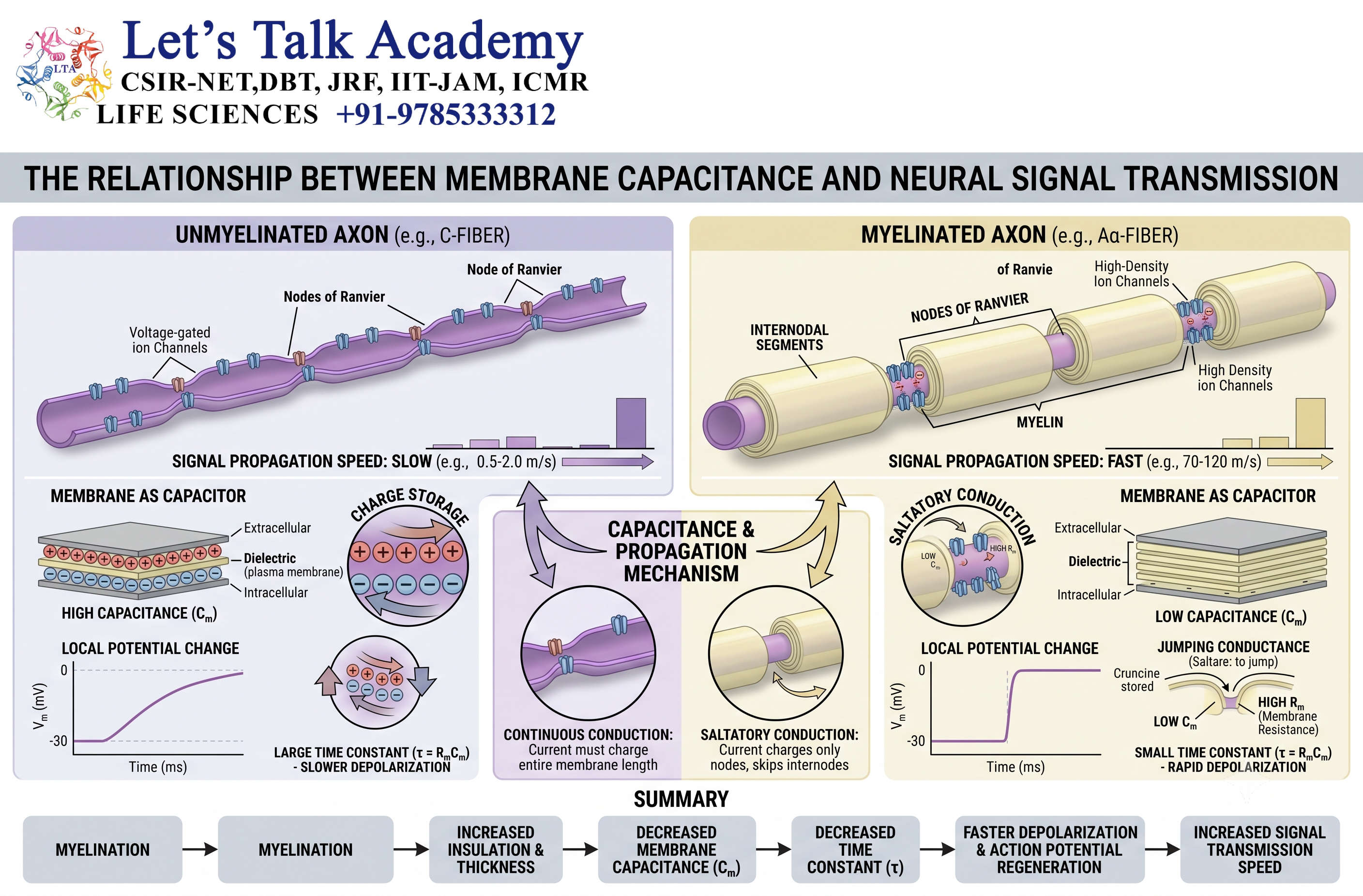
Membrane capacitance determines how much charge must accumulate on the membrane before the membrane potential changes.
Because biological membranes have capacitance, electrical signals do not always change instantaneously.
The membrane must charge or discharge.
This explains why membrane capacitance is important in:
- Action potential generation
- Passive signal propagation
- Neuronal integration
- Axonal conduction velocity
33. Integrated View of Membrane Electrical Properties
The electrical behavior of a biological membrane can be understood by integrating several concepts.
Ion gradients provide the chemical driving forces.
Ion channels provide selective pathways for ion movement.
Ion pumps maintain the concentration gradients.
Membrane potential represents the electrical difference across the membrane.
Membrane resistance determines how strongly the membrane opposes current flow.
Membrane conductance represents the ease with which current can flow.
Membrane capacitance allows the membrane to store separated charge.
Together, these properties determine how cells generate, transmit, and regulate electrical signals.


