
1. Introduction to Active Transport
1.1 Definition of Active Transport
Active transport is a membrane transport process in which a cell moves ions, molecules, or other substances across a biological membrane using energy. The substance is generally transported against its concentration gradient or, in the case of charged particles, against its electrochemical gradient.
In passive transport, substances naturally move in the energetically favorable direction, usually from a region of higher concentration to a region of lower concentration. Active transport is different because the cell invests energy to establish or maintain an unequal distribution of substances across the membrane.
For example, an animal cell maintains a much higher concentration of potassium ions (K⁺) inside the cell and a much higher concentration of sodium ions (Na⁺) outside the cell. These concentration differences are not maintained spontaneously. They require continuous activity of membrane transport proteins, particularly the Na⁺/K⁺-ATPase.
Active transport is therefore essential for maintaining the internal chemical environment of cells.
1.2 General Principle of Active Transport
The fundamental principle of active transport is the coupling of an energy-releasing process to the movement of a substance in an energetically unfavorable direction.
The simplest representation is:
Energy source → Transport protein → Movement against gradient
The energy source may be ATP hydrolysis, as in primary active transport, or an electrochemical gradient, as in secondary active transport.
A transport protein recognizes a particular substance and undergoes controlled conformational changes. These structural changes allow the substance to be transported from one side of the membrane to the other.
Active transport is therefore not simply the physical movement of a molecule through a membrane. It is a highly regulated molecular process involving energy conversion, substrate recognition, membrane proteins, and conformational changes.
1.3 Why Cells Require Active Transport
Living cells are organized systems that must maintain internal conditions different from their surroundings. This condition is called cellular homeostasis.
For example, a typical animal cell must maintain:
- High K⁺ concentration inside the cell
- High Na⁺ concentration outside the cell
- Very low free Ca²⁺ concentration in the cytoplasm
- Appropriate intracellular pH
- Appropriate osmotic pressure
- A suitable membrane potential
Without active transport, these gradients would gradually disappear because ions tend to move through channels and other pathways toward equilibrium.
The loss of these gradients would have serious consequences. The membrane potential would become disturbed, nutrient transport would be affected, calcium signaling could become abnormal, and water could enter the cell excessively.
Thus, active transport allows the cell to remain in a controlled, organized state rather than reaching chemical equilibrium with its surroundings.
2. Membrane Transport and Energy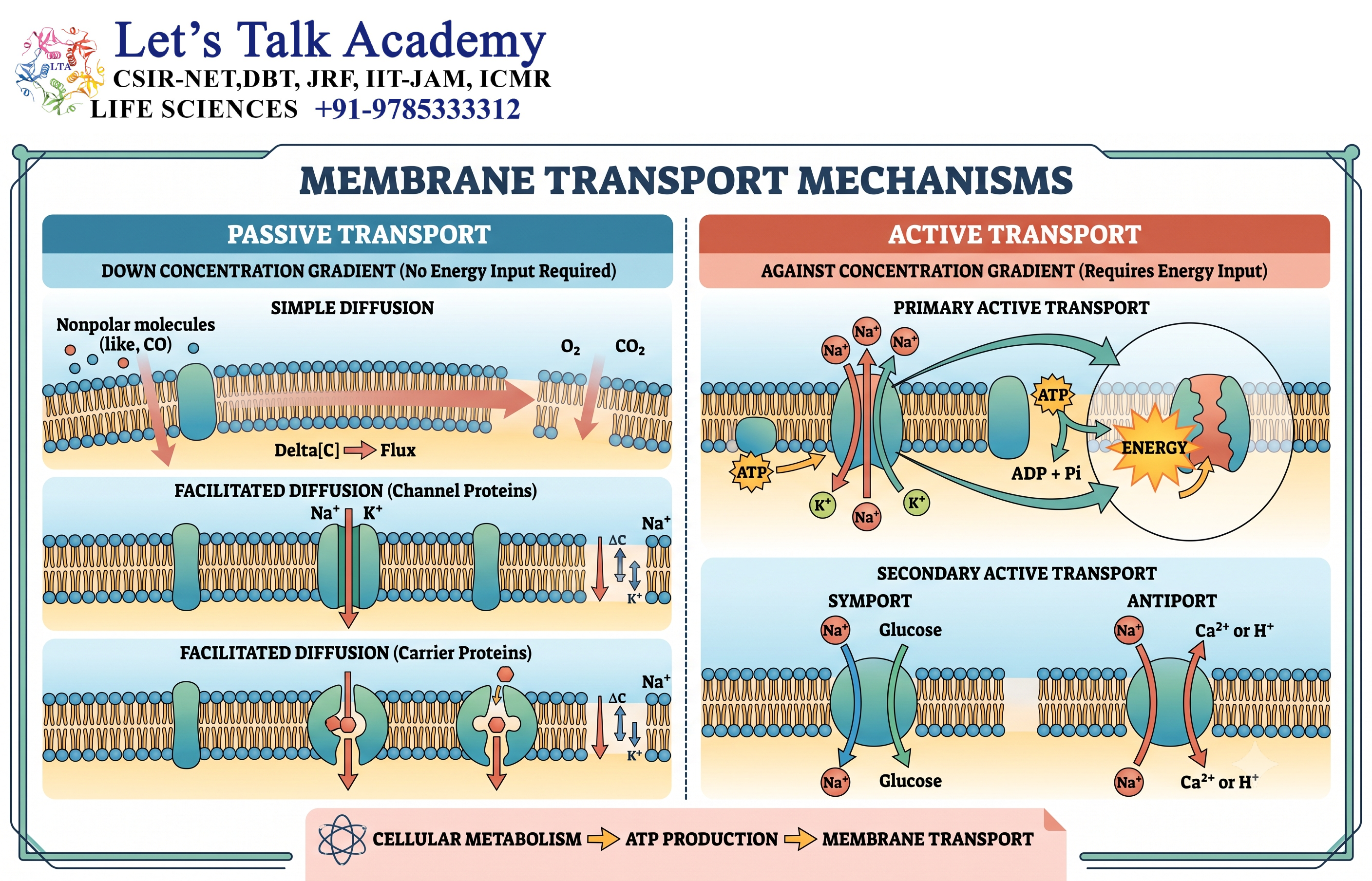
2.1 The Plasma Membrane
The plasma membrane surrounds the cell and separates the cytoplasm from the extracellular environment. It consists primarily of a phospholipid bilayer containing membrane proteins, cholesterol, and carbohydrates.
The interior of the lipid bilayer is hydrophobic. Consequently, ions and many polar molecules cannot easily cross it.
This property is extremely important because it allows the cell to maintain different concentrations of substances on the two sides of the membrane.
Membrane proteins then provide selective pathways for transport.
Some proteins form channels, while others function as carriers or pumps.
Active transport specifically depends on membrane proteins capable of coupling molecular transport to an energy source.
2.2 Concentration Gradient
A concentration gradient is a difference in the concentration of a substance between two regions.
Suppose a membrane separates two compartments:
Outside: 100 molecules/mL
Inside: 20 molecules/mL
There is a concentration gradient from outside to inside.
If the membrane is permeable to the substance, the substance will tend to move from the region of higher concentration toward the region of lower concentration.
This is passive movement.
However, a cell may need to accumulate the substance in the region where its concentration is already high. In that case, energy must be supplied.
This is where active transport becomes important.
2.3 Electrical Gradient
Charged particles are also influenced by electrical forces.
If one side of a membrane is negatively charged relative to the other side, positively charged ions are attracted toward the negative side.
Similarly, negatively charged ions are repelled by a negatively charged region.
Therefore, the movement of ions depends not only on concentration but also on electrical potential.
This is particularly important for:
- Na⁺
- K⁺
- Ca²⁺
- Cl⁻
- H⁺
2.4 Electrochemical Gradient
The combination of the concentration gradient and electrical gradient is called the electrochemical gradient.
For ions, this is the biologically important driving force.
For example, Na⁺ may have both:
- A concentration tendency to enter the cell
- An electrical tendency to enter because the inside of the cell is relatively negative
Together, these forces create a strong inward electrochemical gradient.
The Na⁺/K⁺-ATPase uses ATP to maintain the Na⁺ gradient, while secondary transporters can later use that gradient as an energy source.
2.5 Energy and Gibbs Free Energy
The direction of a transport process can be understood using Gibbs free energy.
A movement that produces a negative free-energy change is thermodynamically favorable.
Movement against a concentration or electrochemical gradient requires energy.
For an ion, the electrochemical free-energy change can be represented by:
ΔG = RT ln(C₂/C₁) + zFΔψ
where:
- ΔG = change in Gibbs free energy
- R = gas constant
- T = absolute temperature
- C₁ and C₂ = ion concentrations
- z = charge of the ion
- F = Faraday constant
- Δψ = membrane potential difference
Active transport becomes possible when an energy-releasing process provides enough energy to drive the unfavorable transport step.
3. Transport Proteins
3.1 Carrier Proteins
Carrier proteins bind specific molecules or ions and transport them across the membrane by changing their conformation.
The general process can be described as:
Substrate binding → Conformational change → Translocation → Substrate release
Unlike an open channel, a carrier does not necessarily provide a continuous aqueous pore across the membrane.
Instead, the binding site alternates between accessibility to the two sides of the membrane.
Carrier proteins are involved in both facilitated diffusion and active transport.
3.2 Pumps
Pumps are transport proteins that use energy to move substances against their gradients.
Important examples include:
Na⁺/K⁺-ATPase
This maintains Na⁺ and K⁺ gradients.
Ca²⁺-ATPases
These maintain low cytoplasmic Ca²⁺.
H⁺-ATPases
These generate proton gradients and regulate pH.
H⁺/K⁺-ATPase
This contributes to gastric acid secretion.
3.3 Transporter Specificity
Transport proteins are generally selective.
A transporter may recognize a particular ion based on:
- Charge
- Size
- Molecular shape
- Chemical groups
- Hydration properties
- Interactions with amino acid residues in the protein
This specificity allows cells to control the movement of individual substances.
For example, the Na⁺/K⁺-ATPase specifically recognizes Na⁺ and K⁺ and transports them according to its characteristic stoichiometry.
3.4 Alternating Access Mechanism
The alternating-access model explains how many carrier proteins transport substances across membranes.
The transporter can exist in different conformational states:
Outward-facing → Occluded → Inward-facing
In the outward-facing state, the binding site is accessible from the extracellular side.
The substrate binds and the transporter changes conformation.
The binding site becomes temporarily inaccessible to both sides.
The protein then adopts an inward-facing state, allowing the substrate to be released into the cytoplasm.
This mechanism prevents uncontrolled movement of substances across the membrane.
4. Classification of Active Transport
4.1 Primary Active Transport
Primary active transport uses energy directly from an energy source, most commonly ATP hydrolysis.
The basic sequence is:
ATP hydrolysis → Conformational change → Solute transport
Examples include:
- Na⁺/K⁺-ATPase
- SERCA
- Plasma membrane Ca²⁺-ATPase
- H⁺/K⁺-ATPase
- V-type H⁺-ATPase
4.2 Secondary Active Transport
Secondary active transport does not directly hydrolyze ATP at the transporter.
Instead, it uses the energy stored in an electrochemical gradient.
For example:
Na⁺/K⁺-ATPase → Na⁺ gradient → Na⁺-glucose cotransport
The Na⁺/K⁺ pump uses ATP to establish the Na⁺ gradient.
The Na⁺-glucose cotransporter then uses the energy stored in that gradient to transport glucose.
Therefore, secondary active transport ultimately depends on metabolic energy, even though the secondary transporter itself does not directly use ATP.
4.3 Symport
A symporter transports two or more substances in the same direction.
For example:
Na⁺ + glucose → cell
Na⁺ moves down its electrochemical gradient, while glucose can be transported against its concentration gradient.
The favorable movement of Na⁺ provides the energy for glucose transport.
4.4 Antiport
An antiporter moves substances in opposite directions.
For example:
Na⁺ → inside
while
Ca²⁺ → outside
The inward movement of Na⁺ provides the energy needed to transport Ca²⁺ outward.
Antiport systems are important in:
- Calcium regulation
- pH regulation
- Ion balance
- Cellular homeostasis
5. Primary Active Transport
5.1 Mechanism of Primary Active Transport
Primary active transport directly connects an energy-releasing reaction to membrane transport.
The transporter contains binding sites for its substrate and often an ATP-binding or catalytic region.
The cycle generally includes:
- Substrate binding
- ATP interaction
- ATP hydrolysis
- Protein phosphorylation or another conformational event
- Structural rearrangement
- Substrate release
- Return to the original state
This repeated cycle allows the transporter to move many molecules or ions over time.
5.2 ATP Hydrolysis
ATP is the major energy currency used by primary active transporters.
ATP hydrolysis releases free energy:
ATP + H₂O → ADP + Pi
The transporter captures part of the energy associated with this reaction.
The energy is converted into structural changes in the protein.
Therefore, ATP is not acting like a mechanical motor that physically pushes an ion. Instead, ATP-driven chemical changes alter the protein’s conformation and its affinity for transported ions.
6. Na⁺/K⁺-ATPase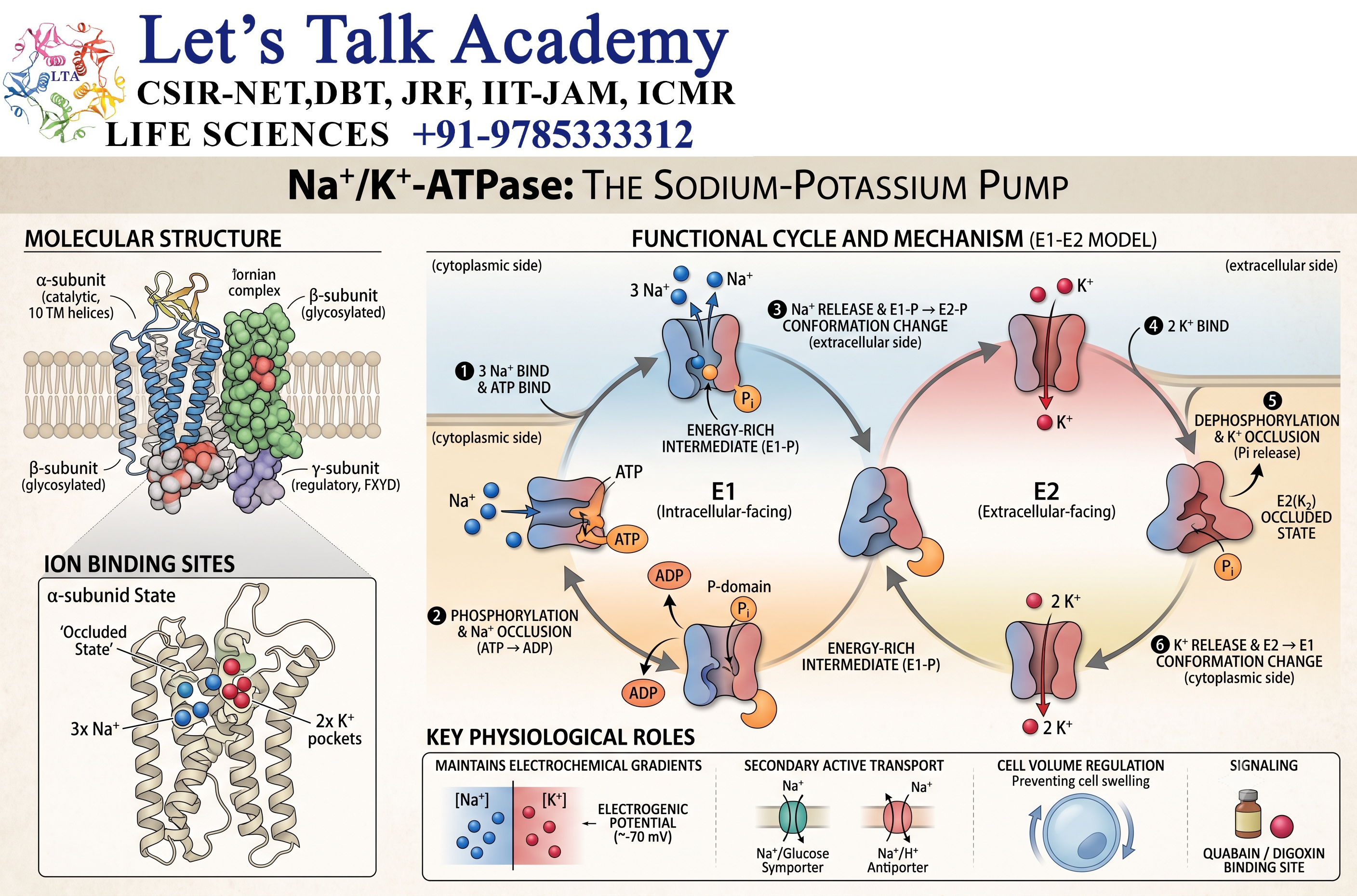
6.1 Introduction
The Na⁺/K⁺-ATPase is one of the most important active transport proteins in animal cells.
It maintains the characteristic distribution of sodium and potassium ions across the plasma membrane.
For each ATP molecule hydrolyzed, the pump generally transports:
3 Na⁺ out of the cell
and
2 K⁺ into the cell.
This unequal movement of positive charges makes the pump electrogenic.
6.2 Mechanism
The transport cycle begins when three Na⁺ ions bind to cytoplasmic sites.
ATP is then hydrolyzed and the pump becomes phosphorylated.
Phosphorylation causes a conformational change.
The pump opens toward the extracellular side and releases the three Na⁺ ions.
Two K⁺ ions then bind from outside.
The transporter undergoes dephosphorylation and returns toward its original conformation.
The two K⁺ ions are then released into the cytoplasm.
The cycle repeats continuously.
6.3 Physiological Importance
The Na⁺/K⁺-ATPase:
- Maintains Na⁺ gradients
- Maintains K⁺ gradients
- Supports membrane potential
- Provides energy for secondary transport
- Helps regulate cell volume
- Supports neuronal activity
- Supports muscle function
Because so many cellular processes depend on Na⁺ and K⁺ gradients, failure of this pump can have widespread consequences.
7. Calcium Transport
7.1 Importance of Calcium Homeostasis
Calcium is one of the most important intracellular signaling ions.
Cytoplasmic Ca²⁺ can regulate:
- Muscle contraction
- Neurotransmitter release
- Hormone secretion
- Enzyme activity
- Fertilization
- Gene expression
- Cell death pathways
Because Ca²⁺ is such a powerful signal, cells keep resting cytoplasmic Ca²⁺ concentration very low.
Active transport mechanisms are essential for maintaining this low concentration.
7.2 SERCA
SERCA stands for sarco/endoplasmic reticulum Ca²⁺-ATPase.
It uses ATP to transport Ca²⁺ from the cytoplasm into the endoplasmic reticulum or sarcoplasmic reticulum.
In muscle cells, SERCA is essential for relaxation.
After contraction, SERCA removes Ca²⁺ from the cytoplasm and stores it inside the sarcoplasmic reticulum.
7.3 Plasma Membrane Ca²⁺-ATPase
The plasma membrane Ca²⁺-ATPase transports Ca²⁺ out of the cytoplasm across the plasma membrane.
Together, SERCA and plasma membrane Ca²⁺-ATPase help restore low cytoplasmic Ca²⁺ after signaling events.
8. Secondary Active Transport
8.1 Basic Mechanism
Secondary active transport depends on an electrochemical gradient.
One substance moves down its gradient, releasing free energy.
Another substance uses that energy to move against its gradient.
For example:
Na⁺ movement inward = favorable
Glucose movement inward against its gradient = unfavorable
The transporter couples these two processes.
8.2 Importance of Ion Gradients
Ion gradients are therefore not merely concentration differences. They represent stored potential energy.
The Na⁺ gradient generated by Na⁺/K⁺-ATPase can drive:
- Glucose uptake
- Amino acid uptake
- Ca²⁺ extrusion
- H⁺ transport
- Other coupled transport processes
This demonstrates how primary and secondary transport systems function together.
9. Active Transport in Epithelial Cells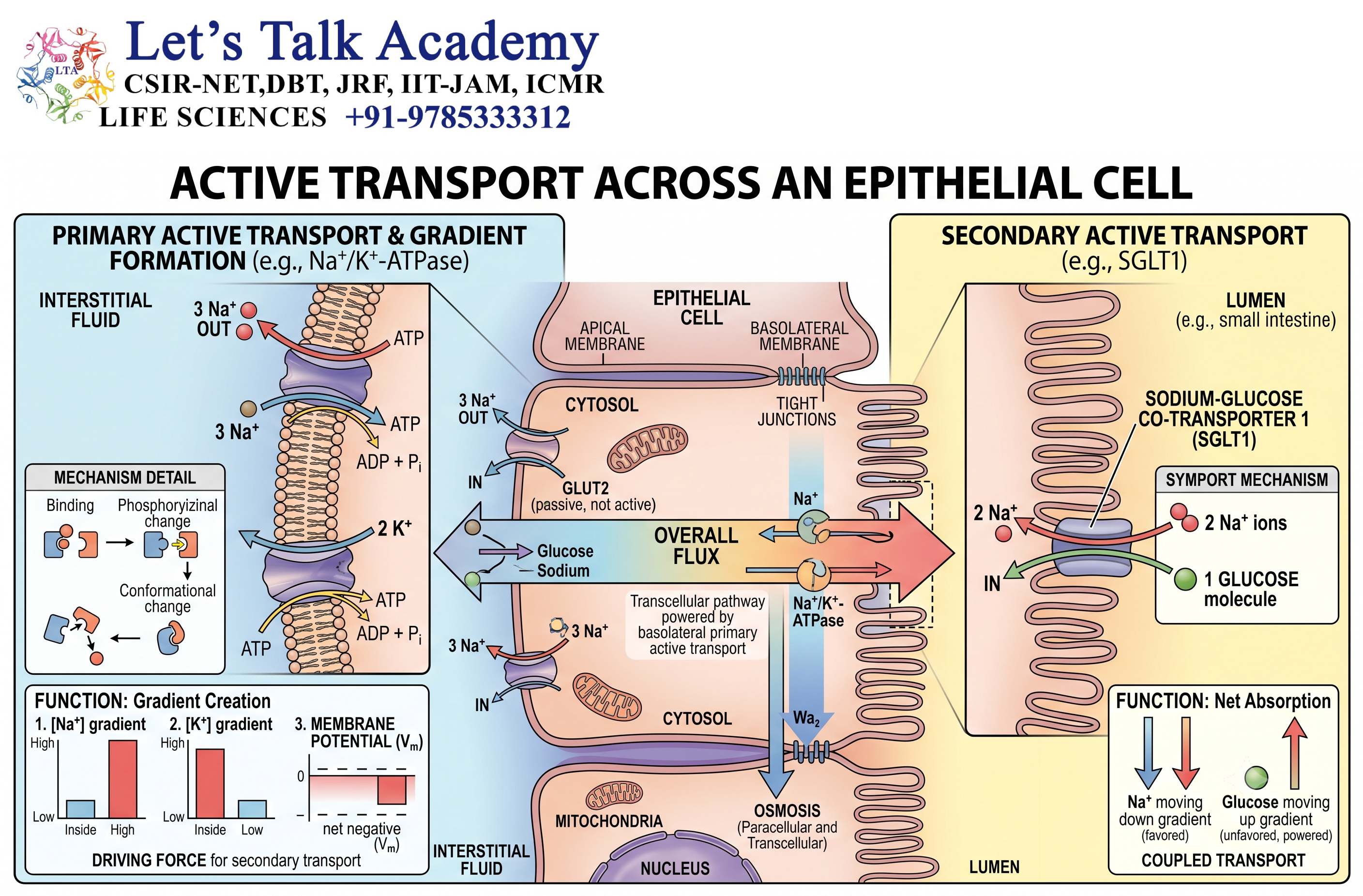
9.1 Polarized Organization
Epithelial cells have two functionally different surfaces:
Apical membrane — faces the lumen.
Basolateral membrane — faces the interstitial fluid and blood.
Different transport proteins are positioned on these surfaces.
This organization allows substances to move directionally across the entire epithelial layer.
9.2 Intestinal Absorption
In the intestine, secondary active transport helps absorb nutrients.
For glucose, the Na⁺ gradient is used to drive glucose uptake across the apical membrane.
The Na⁺/K⁺-ATPase on the basolateral membrane maintains the Na⁺ gradient.
Glucose can subsequently leave the epithelial cell through a facilitated transporter on the basolateral side.
Thus, active transport contributes to the movement of nutrients from the intestinal lumen toward the blood.
10. Active Transport in the Kidney
10.1 General Role
The kidney continuously filters blood and then selectively reabsorbs valuable substances.
Active transport mechanisms are essential for controlling:
- Sodium
- Potassium
- Chloride
- Calcium
- Glucose
- Amino acids
- Hydrogen ions
- Bicarbonate
The Na⁺/K⁺-ATPase provides the driving force for many secondary transport processes in renal epithelial cells.
10.2 Importance in Homeostasis
By controlling ion and solute movement, active transport contributes to:
- Blood volume regulation
- Electrolyte balance
- Acid-base balance
- Osmotic regulation
- Nutrient conservation
Thus, active transport is essential not only for individual cells but also for maintaining the internal environment of the entire organism.
11. Active Transport in Neurons
11.1 Ion Gradients
Neurons maintain different concentrations of Na⁺ and K⁺ across their membranes.
These gradients are essential for electrical signaling.
Ion channels allow rapid movement of ions during neuronal activity, while active transport mechanisms maintain the gradients over longer periods.
11.2 Role of Na⁺/K⁺-ATPase
The Na⁺/K⁺-ATPase continuously maintains the Na⁺ and K⁺ gradients required for neuronal excitability.
Without these gradients, voltage-dependent ion channels would eventually lose their ability to generate normal electrical signals.
Therefore, active transport indirectly supports:
- Resting membrane potential
- Action potentials
- Synaptic transmission
- Repeated neuronal activity
12. Active Transport in Muscle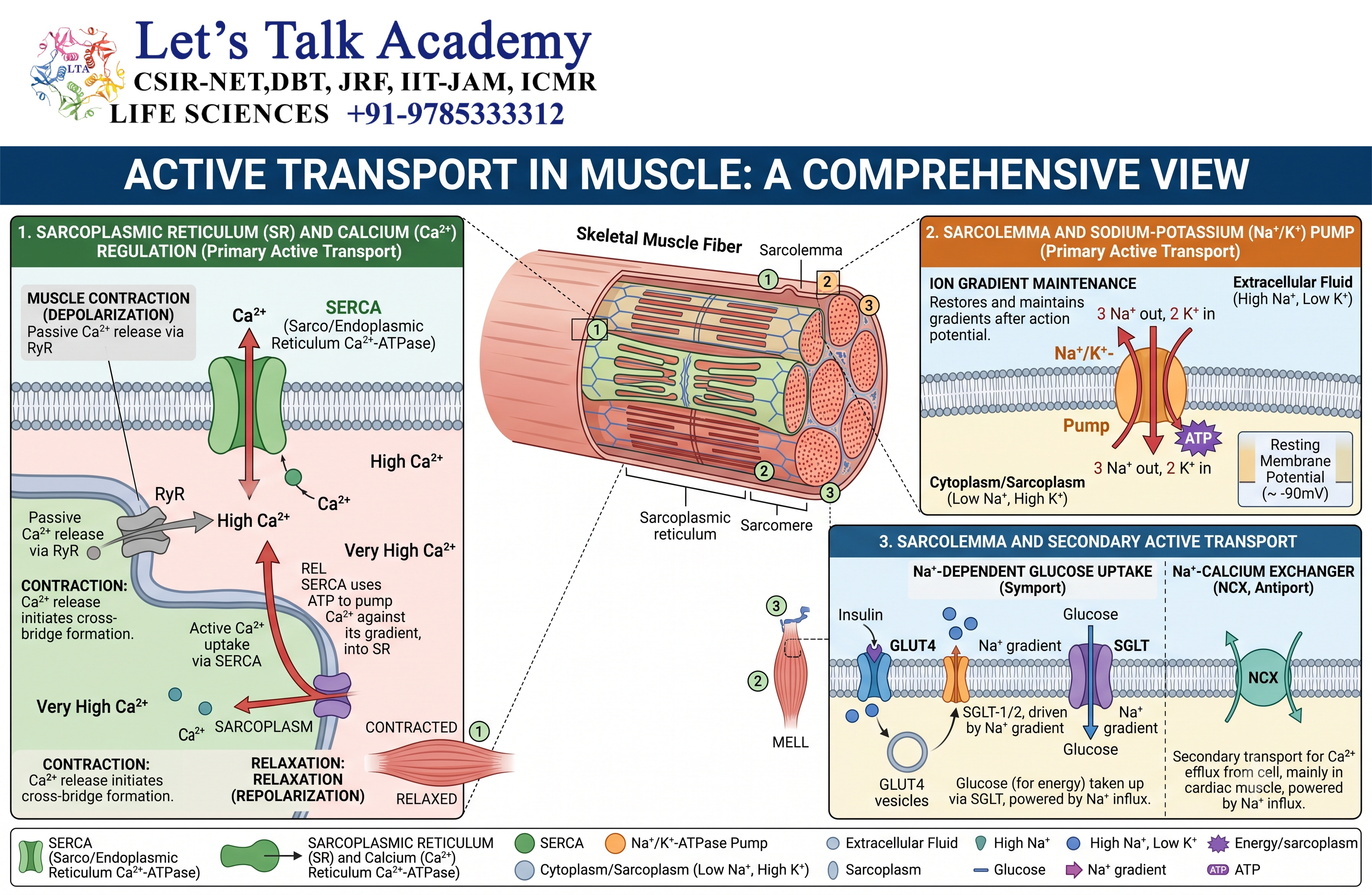
12.1 Calcium and Contraction
Muscle contraction depends on an increase in cytoplasmic Ca²⁺.
When Ca²⁺ concentration rises, it interacts with regulatory proteins and permits the contractile machinery to generate force.
After contraction, Ca²⁺ must be removed from the cytoplasm.
12.2 Role of SERCA
SERCA uses ATP to pump Ca²⁺ back into the sarcoplasmic reticulum.
This reduces cytoplasmic Ca²⁺ and promotes muscle relaxation.
Therefore:
ATP → SERCA activity → Ca²⁺ removal → muscle relaxation
This is a direct example of how energy-dependent membrane transport is linked to physiological movement.
13. Active Transport and Cell Volume
13.1 Osmotic Regulation
The concentration of ions and other solutes inside a cell influences water movement.
If intracellular solute concentration becomes too high, water may enter the cell.
If intracellular solute concentration decreases, water may leave.
Active transport helps regulate intracellular ion concentrations and therefore contributes indirectly to water balance.
13.2 Consequences of Transport Failure
If ion pumps fail, Na⁺ may accumulate inside the cell.
Water may follow osmotically.
This can cause:
Na⁺ accumulation → Water entry → Cell swelling
Severe disruption can damage cellular structures and impair cellular function.
14. Active Transport and pH Regulation
14.1 Importance of pH
Cellular enzymes and proteins are sensitive to pH.
Even relatively small changes in intracellular pH can affect:
- Enzyme activity
- Protein structure
- Metabolism
- Ion transport
- Cellular signaling
Transporters and pumps that move H⁺ or bicarbonate are therefore important components of acid-base regulation.
14.2 Proton Transport
Proton pumps can move H⁺ across membranes using ATP.
Other transporters can couple H⁺ movement to Na⁺, bicarbonate, or other substances.
These mechanisms help cells maintain a suitable intracellular pH.
15. Active Transport in Plant Cells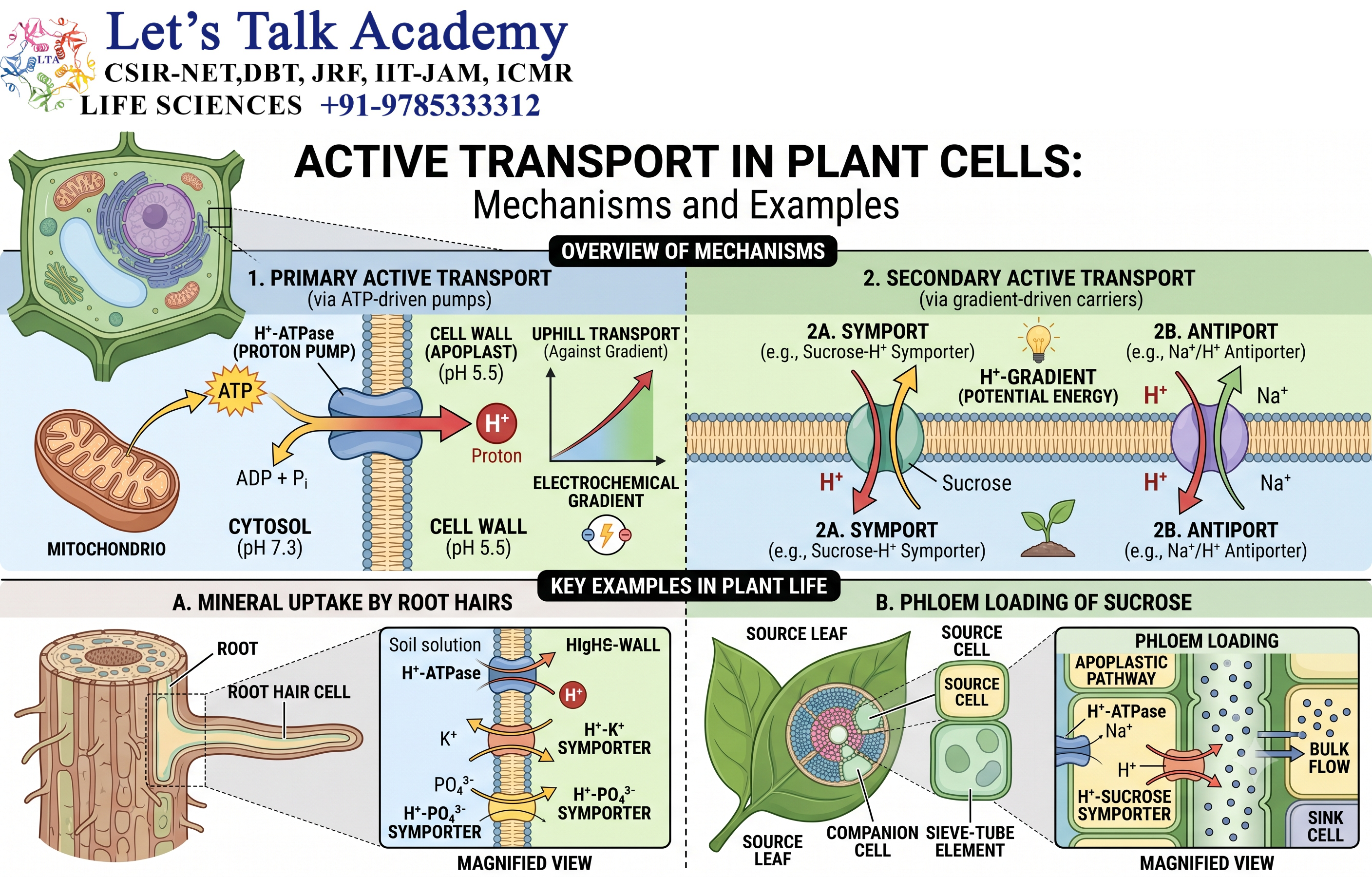
15.1 Plasma Membrane H⁺-ATPase
Plant cells commonly use H⁺-ATPases to pump protons across the plasma membrane.
This creates an electrochemical proton gradient.
The gradient can then drive secondary transport processes.
For example, nutrient uptake by plant roots often depends on proton-coupled transport.
15.2 Mineral Nutrient Uptake
Plants require minerals such as:
- K⁺
- NO₃⁻
- PO₄³⁻
- Mg²⁺
- Ca²⁺
Many of these nutrients cannot simply diffuse into plant cells in the required amounts.
Active and secondary active transport systems allow plants to acquire nutrients even when their concentrations outside the cell are relatively low.
16. Active Transport and Cellular Homeostasis
Active transport is one of the major mechanisms through which cells maintain stable internal conditions.
It contributes to:
- Ionic homeostasis
- Osmotic balance
- Cell volume
- Membrane potential
- Calcium homeostasis
- pH regulation
- Nutrient uptake
- Waste removal
- Electrical signaling
The importance of active transport becomes especially clear when cellular energy production is severely reduced. ATP-dependent pumps begin to fail, ion gradients collapse, membrane potential becomes disturbed, and cellular homeostasis can eventually be lost.
17. Active Transport Versus Passive Transport
17.1 Active Transport
Active transport requires energy directly or indirectly and can move substances against their electrochemical gradients.
Examples include:
- Na⁺/K⁺-ATPase
- Ca²⁺-ATPase
- H⁺-ATPase
- Na⁺-glucose cotransport
17.2 Passive Transport
Passive transport does not require metabolic energy to drive movement.
Substances move down their concentration or electrochemical gradients.
Examples include:
- Simple diffusion
- Osmosis
- Ion movement through channels
- Facilitated diffusion
The major difference is therefore the energetic direction of transport.
18. Transport Kinetics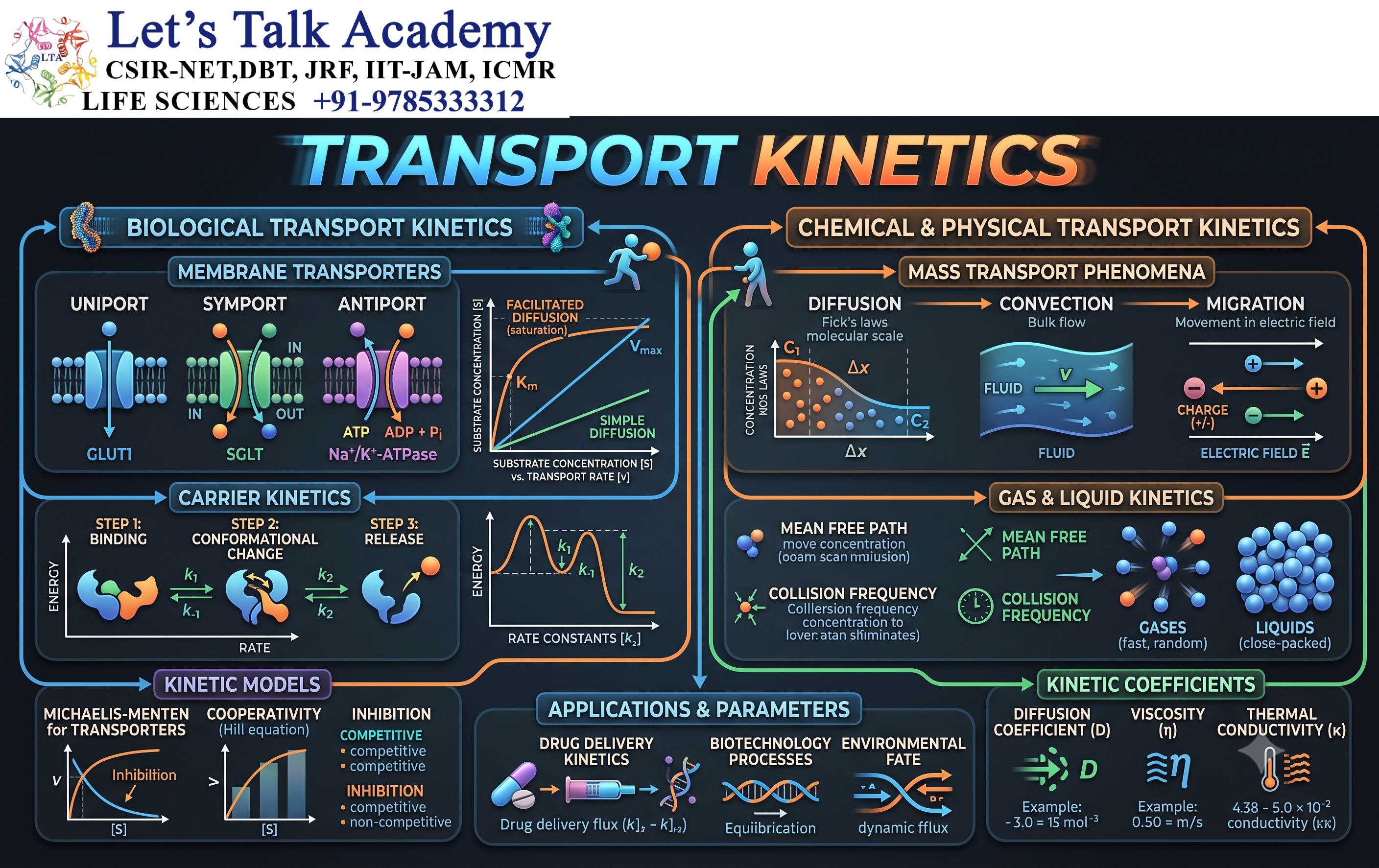
18.1 Transport Saturation
Carrier proteins have a finite capacity.
At low substrate concentration, increasing substrate concentration generally increases transport rate.
As substrate concentration increases, more transporters become occupied.
Eventually, most transporters are working near their maximum rate.
The system then approaches a maximum transport rate known as Vmax.
18.2 Km
The apparent Km is commonly used to describe transporter kinetics.
In simple Michaelis-Menten-like descriptions, Km is the substrate concentration at which the transport rate reaches approximately half of Vmax.
A lower apparent Km generally indicates higher apparent affinity under the assumptions of the model, although real transport systems can be more complex than simple enzyme kinetics.
19. Regulation of Active Transport
19.1 Regulation by ATP
Because primary active transport requires energy, ATP availability strongly affects transport activity.
When ATP production is reduced, ATP-dependent pumps may operate less effectively.
19.2 Regulation by Phosphorylation
Transport proteins can be regulated by phosphorylation.
Protein kinases add phosphate groups, while phosphatases remove them.
These modifications can change transporter activity, localization, or interaction with other proteins.
19.3 Regulation by Hormones
Hormones can regulate transport proteins by altering:
- Protein phosphorylation
- Transporter abundance
- Membrane localization
- Gene expression
- Signaling pathways
This allows the organism to coordinate cellular transport with physiological requirements.
20. Active Transport During Cellular Stress
When cells experience severe stress, ATP production may decline.
Reduced ATP availability can impair active transport.
The consequences may include:
Reduced ATP
↓
Pump dysfunction
↓
Loss of ion gradients
↓
Altered membrane potential
↓
Osmotic imbalance
↓
Cellular dysfunction
Calcium homeostasis may also become disrupted, leading to abnormal activation of calcium-dependent processes.
21. Biological Significance of Active Transport
Active transport is fundamental to life because it allows cells to maintain an internal environment that is different from the external environment.
Its major functions include:
21.1 Ion Homeostasis
Maintains appropriate concentrations of Na⁺, K⁺, Ca²⁺, H⁺, and other ions.
21.2 Membrane Potential
Maintains ion gradients required for electrical properties of cells.
21.3 Nutrient Uptake
Allows cells and tissues to accumulate nutrients against concentration gradients.
21.4 Osmoregulation
Helps regulate solute concentrations and therefore water balance.
21.5 pH Regulation
Controls proton and bicarbonate distribution.
21.6 Cellular Signaling
Maintains calcium and other ion gradients used in signaling.
21.7 Muscle Function
Supports calcium cycling required for contraction and relaxation.
21.8 Nervous System Function
Maintains ionic gradients required for electrical signaling.


