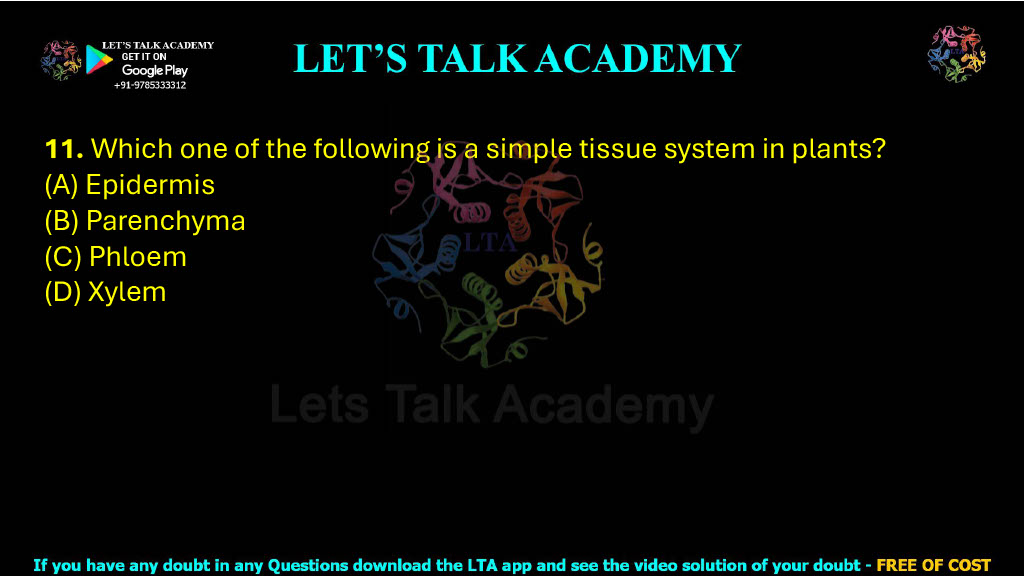
11. Which one of the following is a simple tissue system in plants?
(A) Epidermis
(B) Parenchyma
(C) Phloem
(D) Xylem
Parenchyma as a Simple Tissue System in Plants
Introduction
Plant tissues are organized into specialized groups of cells that perform specific physiological and structural functions. This organization allows plants to efficiently carry out photosynthesis, storage, transport of water and nutrients, mechanical support, and protection against environmental stress. Based on the similarity of their constituent cells, plant tissues are broadly classified into meristematic tissues and permanent tissues. Permanent tissues are further divided into simple permanent tissues and complex permanent tissues.
Simple permanent tissues are composed of only one type of mature cell performing similar functions. These tissues mainly provide storage, photosynthesis, secretion, and mechanical support. The three major simple tissues are parenchyma, collenchyma, and sclerenchyma. In contrast, complex permanent tissues such as xylem and phloem consist of several different cell types working together for conduction.
Correct Answer
Correct Option: (B) Parenchyma
Detailed Explanation
Parenchyma is the most abundant and widely distributed simple permanent tissue in plants. It is composed of living, thin-walled, isodiametric cells with large vacuoles and intercellular spaces. Since all its cells are structurally similar and perform comparable functions, parenchyma is classified as a simple tissue.
Parenchyma performs numerous physiological functions depending on its location. In leaves, chloroplast-containing parenchyma (chlorenchyma) carries out photosynthesis. In stems and roots, parenchyma stores starch, proteins, oils, and water. It also participates in wound healing, regeneration, secretion, gaseous exchange through aerenchyma, and lateral transport of nutrients.
Xylem and phloem are not simple tissues because each consists of several different cell types working together. Xylem contains tracheids, vessel elements, xylem fibers, and xylem parenchyma, whereas phloem contains sieve tube elements, companion cells, phloem fibers, and phloem parenchyma. Therefore, both are classified as complex permanent tissues.
Epidermis belongs to the epidermal tissue system, which forms the protective outer covering of the plant body. Although the epidermis consists mainly of epidermal cells, it also includes specialized structures such as guard cells and trichomes, making it a tissue system rather than a simple permanent tissue.
Explanation of Each Option
Option (A): Epidermis
This option is incorrect. The epidermis is a protective tissue system that forms the outermost covering of roots, stems, leaves, flowers, and fruits. It protects against water loss, pathogens, and mechanical injury but is not classified as a simple permanent tissue.
Option (B): Parenchyma
This option is correct. Parenchyma is a simple permanent tissue composed of living cells of one basic type. It performs storage, photosynthesis, secretion, regeneration, and other metabolic functions.
Option (C): Phloem
This option is incorrect. Phloem is a complex permanent tissue composed of sieve tubes, companion cells, phloem fibers, and phloem parenchyma that transport food throughout the plant.
Option (D): Xylem
This option is incorrect. Xylem is a complex permanent tissue containing tracheids, vessels, fibers, and parenchyma that transport water and minerals while providing mechanical support.
Why Option (B) is Correct
Parenchyma consists of only one principal type of living cell performing similar physiological functions. Because it lacks multiple specialized conducting elements, it is classified as a simple permanent tissue.
Why the Other Options are Incorrect
Why Option (A) is Incorrect
The epidermis is part of the epidermal tissue system responsible for protection rather than a simple permanent tissue.
Why Option (C) is Incorrect
Phloem contains multiple specialized cell types and is therefore a complex tissue.
Why Option (D) is Incorrect
Xylem also consists of several specialized conducting and supporting cells, making it a complex tissue.
Comparison of All Options
| Option | Tissue | Main Function | Classification |
|---|---|---|---|
| A | Epidermis | Protection | Epidermal Tissue System |
| B | Parenchyma | Storage, photosynthesis, secretion | Simple Permanent Tissue |
| C | Phloem | Transport of food | Complex Permanent Tissue |
| D | Xylem | Transport of water and minerals | Complex Permanent Tissue |
Classification of Permanent Tissues
| Category | Tissues Included |
|---|---|
| Simple Permanent Tissues | Parenchyma, Collenchyma, Sclerenchyma |
| Complex Permanent Tissues | Xylem, Phloem |
Functions of Major Plant Tissues
| Tissue | Major Function |
|---|---|
| Parenchyma | Storage, photosynthesis, regeneration |
| Collenchyma | Flexible mechanical support |
| Sclerenchyma | Mechanical strength and rigidity |
| Xylem | Water and mineral transport |
| Phloem | Food transport |
Components of Complex Tissues
| Complex Tissue | Major Cell Types |
|---|---|
| Xylem | Tracheids, vessel elements, xylem fibers, xylem parenchyma |
| Phloem | Sieve tube elements, companion cells, phloem fibers, phloem parenchyma |
Biological Significance
Simple tissues form the structural and physiological foundation of plant organs. Among them, parenchyma is the most versatile because it retains living protoplasm and can perform multiple functions depending on its location. It stores nutrients, carries out photosynthesis, facilitates gaseous exchange, participates in wound healing, and contributes to tissue regeneration. In contrast, complex tissues specialize in long-distance transport, ensuring efficient movement of water, minerals, sugars, hormones, and signaling molecules throughout the plant body.
Final Answer
Correct Option: (B) Parenchyma
Parenchyma is a simple permanent tissue because it is composed of a single type of living cell that performs functions such as storage, photosynthesis, secretion, regeneration, and lateral transport. In contrast, xylem and phloem are complex tissues composed of multiple specialized cell types, while the epidermis belongs to the protective epidermal tissue system.


