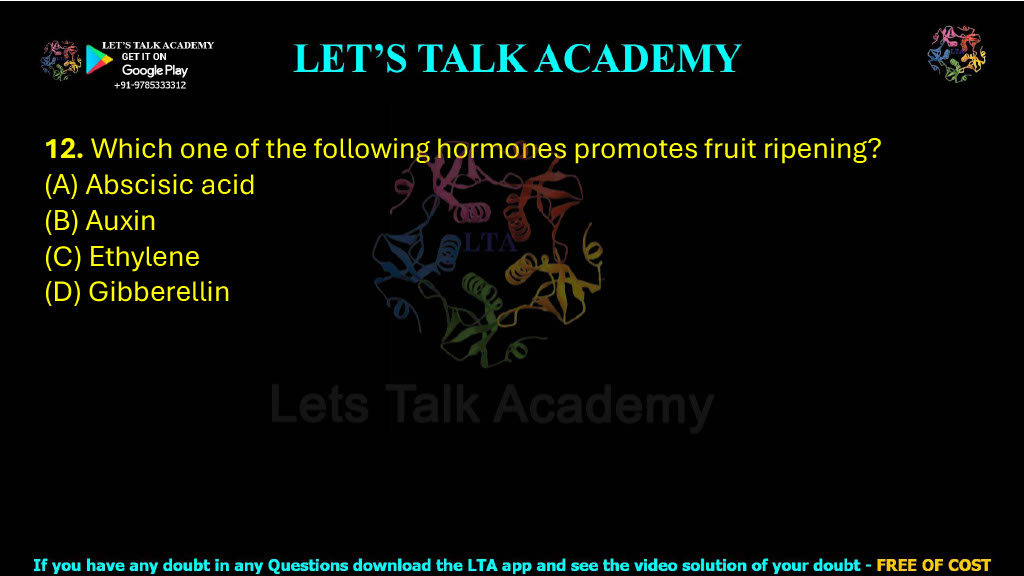
12. Which one of the following hormones promotes fruit ripening?
(A) Abscisic acid
(B) Auxin
(C) Ethylene
(D) Gibberellin
Ethylene Promotes Fruit Ripening in Plants
Introduction
Fruit ripening is one of the most important developmental processes in flowering plants. During ripening, fruits undergo a series of coordinated physiological and biochemical changes that make them attractive for seed dispersal. These changes include softening of tissues, conversion of starch into sugars, degradation of chlorophyll, development of attractive colors, production of characteristic aromas, and improvement in taste. The entire process is tightly regulated by plant hormones, among which ethylene plays the central role.
Ethylene is a naturally occurring gaseous phytohormone that regulates several developmental and stress-related processes in plants. It is best known for promoting the ripening of climacteric fruits such as banana, mango, tomato, apple, papaya, pear, avocado, and guava. During ripening, ethylene production increases dramatically, triggering numerous biochemical pathways that transform immature fruits into edible ripe fruits. Because of its commercial importance in agriculture and horticulture, ethylene is extensively used in fruit storage, transportation, and artificial ripening.
Correct Answer
Correct Option: (C) Ethylene
Detailed Explanation
Ethylene is the principal hormone responsible for fruit ripening in climacteric fruits. It is synthesized from the amino acid methionine through the intermediate compound 1-aminocyclopropane-1-carboxylic acid (ACC). During ripening, there is a rapid increase in ethylene production accompanied by an increase in respiration known as the climacteric rise. Ethylene then activates hundreds of genes responsible for ripening-related processes.
Ethylene stimulates chlorophyll degradation, allowing green fruits to develop yellow, orange, or red pigments such as carotenoids and anthocyanins. It activates enzymes including amylases that convert starch into sugars, making fruits sweeter. Cell wall-degrading enzymes such as polygalacturonase, cellulase, and pectin methylesterase soften the fruit by breaking down pectin and cellulose. Ethylene also promotes the synthesis of volatile aromatic compounds responsible for the characteristic fragrance of ripe fruits.
Although other hormones influence fruit development, none serves as the primary ripening hormone. Auxins mainly regulate cell elongation and apical dominance, gibberellins promote stem elongation and seed germination, and abscisic acid primarily regulates drought responses and seed dormancy. Therefore, ethylene is the correct answer.
Explanation of Each Option
Option (A): Abscisic Acid
This option is incorrect. Abscisic acid (ABA) functions mainly as a stress hormone. It induces seed dormancy, promotes stomatal closure during drought, and helps plants tolerate adverse environmental conditions. Although ABA may participate in the ripening of certain non-climacteric fruits, it is not regarded as the principal fruit-ripening hormone.
Option (B): Auxin
This option is incorrect. Auxin promotes cell elongation, vascular differentiation, apical dominance, root initiation, and tropic responses. It is important during early fruit development but does not initiate fruit ripening.
Option (C): Ethylene
This option is correct. Ethylene is the gaseous plant hormone that initiates and regulates fruit ripening by stimulating changes in color, texture, sweetness, aroma, and respiration.
Option (D): Gibberellin
This option is incorrect. Gibberellins stimulate stem elongation, seed germination, flowering, and fruit growth but are not responsible for the ripening process.
Why Option (C) is Correct
Ethylene coordinates the entire ripening program by activating genes responsible for pigment formation, sugar accumulation, softening of fruit tissues, aroma production, and increased respiration. Because it directly regulates these processes, it is universally recognized as the fruit-ripening hormone.
Why the Other Options are Incorrect
Why Option (A) is Incorrect
Abscisic acid mainly regulates stress responses and seed dormancy rather than climacteric fruit ripening.
Why Option (B) is Incorrect
Auxin promotes vegetative growth and early fruit development but does not trigger ripening.
Why Option (D) is Incorrect
Gibberellins stimulate growth and germination rather than biochemical changes associated with ripening.
Comparison of All Options
| Option | Hormone | Main Function | Correct or Incorrect |
|---|---|---|---|
| A | Abscisic Acid | Stress response and seed dormancy | Incorrect |
| B | Auxin | Cell elongation and apical dominance | Incorrect |
| C | Ethylene | Fruit ripening and stress signaling | Correct |
| D | Gibberellin | Stem elongation and seed germination | Incorrect |
Changes During Ethylene-Induced Fruit Ripening
| Change | Result |
|---|---|
| Chlorophyll Breakdown | Green color disappears |
| Carotenoid and Anthocyanin Formation | Development of yellow, orange, or red color |
| Starch Conversion to Sugars | Fruit becomes sweeter |
| Cell Wall Degradation | Fruit softens |
| Volatile Compound Production | Characteristic aroma develops |
| Respiration Increases | Climacteric rise occurs |
Major Functions of Ethylene
| Function | Role |
|---|---|
| Fruit Ripening | Promotes ripening of climacteric fruits |
| Triple Response | Helps seedlings overcome soil resistance |
| Leaf Abscission | Promotes leaf and fruit drop |
| Flower Senescence | Accelerates flower aging |
| Wound Response | Activates defense mechanisms |
Comparison of Major Plant Hormones
| Hormone | Primary Function |
|---|---|
| Auxin | Cell elongation and apical dominance |
| Gibberellin | Stem elongation and seed germination |
| Cytokinin | Cell division and delay of senescence |
| Ethylene | Fruit ripening, triple response, wound signaling |
| Abscisic Acid | Seed dormancy and drought tolerance |
Biological Significance
Ethylene-mediated fruit ripening is essential for successful seed dispersal in nature. Ripened fruits become colorful, soft, sweet, and aromatic, attracting animals that consume the fruits and disperse seeds to new locations. In agriculture, ethylene is widely used to synchronize fruit ripening during storage and transportation, ensuring better market quality and reducing post-harvest losses. Knowledge of ethylene biology has therefore become indispensable in horticulture, food technology, and plant biotechnology.
Final Answer
Correct Option: (C) Ethylene
Ethylene is the principal fruit-ripening hormone in plants. It stimulates color development, fruit softening, sugar accumulation, aroma formation, and the climacteric rise in respiration, transforming mature green fruits into fully ripe edible fruits.


