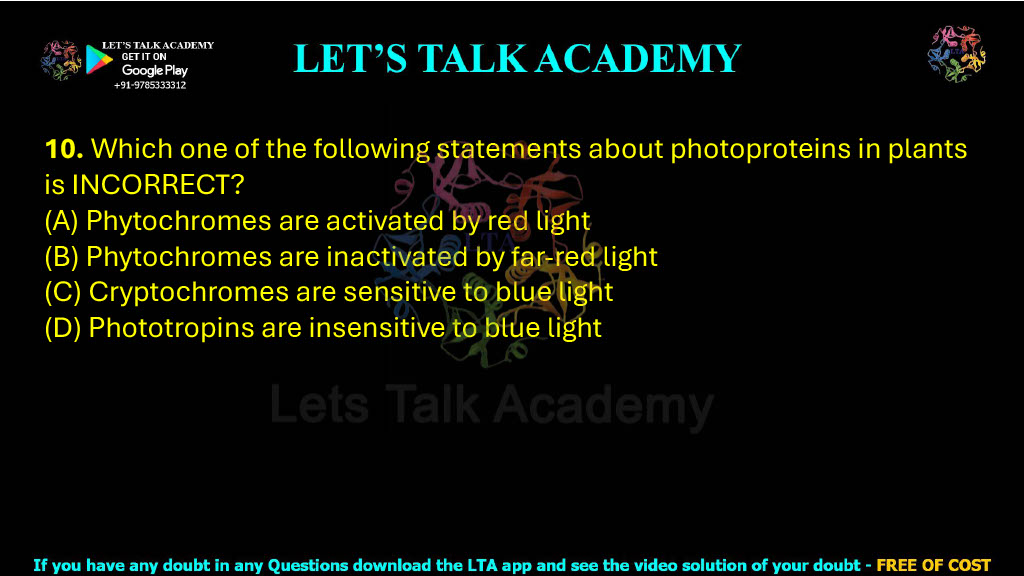
10. Which one of the following statements about photoproteins in plants is INCORRECT?
(A) Phytochromes are activated by red light
(B) Phytochromes are inactivated by far-red light
(C) Cryptochromes are sensitive to blue light
(D) Phototropins are insensitive to blue light
Photoreceptors in Plants Explained: Why Phototropins are Blue Light Receptors
Introduction
Plants are highly sensitive to light, which serves not only as an energy source for photosynthesis but also as an important environmental signal regulating growth and development. To perceive different wavelengths of light, plants possess specialized light-sensitive proteins called photoreceptors. These photoreceptors detect specific regions of the light spectrum and initiate signal transduction pathways that regulate seed germination, stem elongation, flowering, chloroplast development, stomatal opening, circadian rhythms, and directional growth.
The three major classes of plant photoreceptors are phytochromes, cryptochromes, and phototropins. Phytochromes primarily absorb red and far-red light, cryptochromes perceive blue and ultraviolet-A (UV-A) light, and phototropins are specialized blue-light receptors responsible for phototropism, chloroplast movement, and stomatal opening. A clear understanding of these photoreceptors is fundamental in Plant Physiology because they regulate nearly every stage of plant development.
Correct Answer
Correct Option: (D) Phototropins are insensitive to blue light
Detailed Explanation
Phototropins are actually blue-light photoreceptors. They are highly sensitive to blue light and UV-A wavelengths and regulate several important physiological responses, including phototropism (growth toward light), chloroplast relocation within cells, stomatal opening, and leaf positioning. Therefore, the statement that phototropins are insensitive to blue light is scientifically incorrect.
Phytochromes exist in two interconvertible forms: Pr and Pfr. The inactive Pr form absorbs red light (approximately 660 nm) and is converted into the biologically active Pfr form. Exposure to far-red light (approximately 730 nm) converts Pfr back into the inactive Pr form. Consequently, phytochromes are activated by red light and inactivated by far-red light.
Cryptochromes are flavoproteins that absorb blue light and ultraviolet-A radiation. They regulate inhibition of hypocotyl elongation, entrainment of the circadian clock, flowering time, chloroplast development, and various aspects of photomorphogenesis.
Since phototropins are themselves blue-light receptors, describing them as insensitive to blue light is incorrect.
Explanation of Each Option
Option (A): Phytochromes are Activated by Red Light
This statement is correct. Red light converts the inactive Pr form of phytochrome into the active Pfr form, initiating numerous developmental responses such as seed germination and flowering.
Option (B): Phytochromes are Inactivated by Far-red Light
This statement is correct. Far-red light converts the active Pfr form back into the inactive Pr form, thereby reversing many phytochrome-mediated responses.
Option (C): Cryptochromes are Sensitive to Blue Light
This statement is correct. Cryptochromes absorb blue light and regulate photomorphogenesis, circadian rhythms, flowering, and inhibition of stem elongation.
Option (D): Phototropins are Insensitive to Blue Light
This statement is incorrect. Phototropins are highly sensitive blue-light receptors responsible for phototropism, chloroplast movement, stomatal opening, and leaf orientation.
Why Option (D) is Correct
Phototropins specifically detect blue light through flavin-containing LOV (Light, Oxygen, Voltage) domains. Upon blue-light absorption, they activate signaling pathways that allow plants to bend toward light, optimize photosynthesis, and regulate stomatal function. Therefore, stating that phototropins are insensitive to blue light is incorrect.
Why the Other Options are Correct
Why Option (A) is Correct
Red light converts phytochrome from the inactive Pr form to the active Pfr form.
Why Option (B) is Correct
Far-red light reverses phytochrome activation by converting Pfr back to Pr.
Why Option (C) is Correct
Cryptochromes function as blue-light receptors that regulate multiple developmental processes.
Comparison of All Options
| Option | Statement | Correct or Incorrect |
|---|---|---|
| A | Phytochromes are activated by red light | Correct |
| B | Phytochromes are inactivated by far-red light | Correct |
| C | Cryptochromes are sensitive to blue light | Correct |
| D | Phototropins are insensitive to blue light | Incorrect |
Major Plant Photoreceptors
| Photoreceptor | Light Absorbed | Major Functions |
|---|---|---|
| Phytochrome | Red and Far-red Light | Seed germination, flowering, shade avoidance, photomorphogenesis |
| Cryptochrome | Blue and UV-A Light | Circadian rhythm, flowering, inhibition of hypocotyl elongation |
| Phototropin | Blue Light | Phototropism, chloroplast movement, stomatal opening |
| UVR8 | UV-B Light | UV protection and stress responses |
Phytochrome Interconversion
| Phytochrome Form | Light Required | Biological State |
|---|---|---|
| Pr | Absorbs Red Light | Inactive |
| Pfr | Absorbs Far-red Light | Active |
Functions of Blue-Light Receptors
| Receptor | Major Response |
|---|---|
| Cryptochrome | Photomorphogenesis and circadian rhythm |
| Phototropin | Phototropism |
| Phototropin | Stomatal opening |
| Phototropin | Chloroplast movement |
Comparison of Major Plant Hormones and Photoreceptors
| System | Main Role |
|---|---|
| Auxin | Cell elongation and tropic responses |
| Ethylene | Triple response and fruit ripening |
| Phytochrome | Red/far-red light perception |
| Cryptochrome | Blue-light signaling |
| Phototropin | Blue-light-mediated directional growth |
Biological Significance
Plant photoreceptors enable plants to continuously monitor their light environment and optimize growth accordingly. Phytochromes regulate developmental transitions such as seed germination and flowering, cryptochromes synchronize growth with the daily light cycle, and phototropins maximize photosynthetic efficiency by directing shoots toward light, opening stomata for gas exchange, and repositioning chloroplasts within cells. Together, these photoreceptors ensure that plants efficiently utilize available sunlight while adapting to changing environmental conditions.
Final Answer
Correct Option: (D) Phototropins are insensitive to blue light
This statement is incorrect because phototropins are highly sensitive blue-light photoreceptors. They regulate phototropism, chloroplast movement, stomatal opening, and several other light-dependent physiological responses that help plants optimize growth and photosynthesis.


