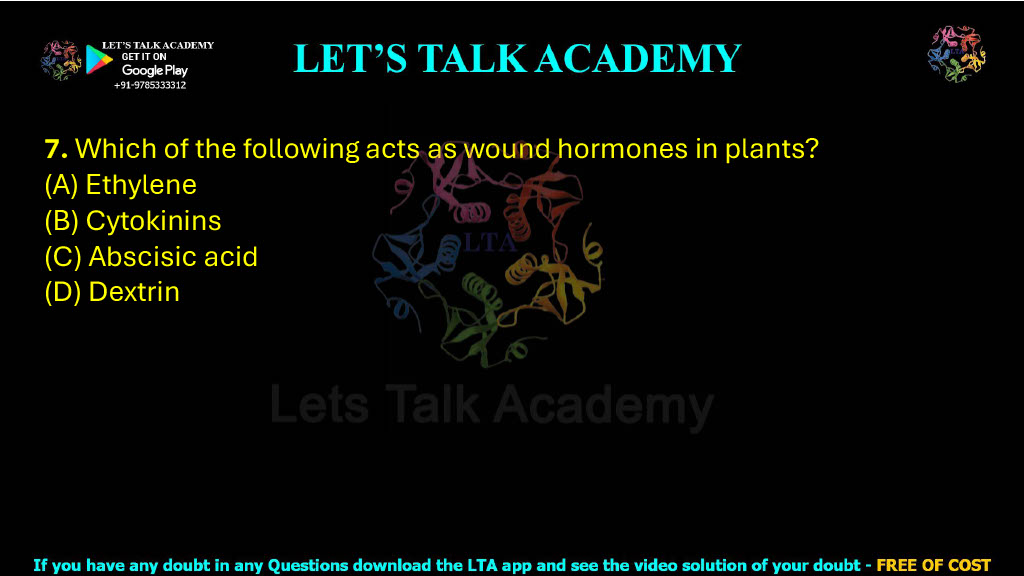
7. Which of the following acts as wound hormones in plants?
(A) Ethylene
(B) Cytokinins
(C) Abscisic acid
(D) Dextrin
Ethylene as the Wound Hormone in Plants
Introduction
Plants are constantly exposed to environmental challenges such as herbivore attack, pathogen invasion, mechanical injury, drought, flooding, and various abiotic stresses. Unlike animals, plants cannot move away from unfavorable conditions, so they have evolved sophisticated signaling systems that allow them to detect injury and activate defense responses rapidly. One of the most important signaling molecules involved in these protective mechanisms is the plant hormone ethylene.
Ethylene is a gaseous phytohormone that regulates numerous physiological processes, including fruit ripening, leaf abscission, flower senescence, seed germination, stress responses, and wound healing. Following mechanical injury or pathogen attack, ethylene production increases dramatically around the damaged tissue. This elevated ethylene level activates defense-related genes, promotes the synthesis of protective compounds, stimulates wound healing, and helps the plant resist further damage.
Correct Answer
Correct Option: (A) Ethylene
Detailed Explanation
Ethylene is a naturally occurring gaseous plant hormone synthesized primarily from the amino acid methionine through the intermediate compound ACC (1-aminocyclopropane-1-carboxylic acid). Mechanical injury, insect feeding, pathogen infection, flooding, drought, and other environmental stresses stimulate rapid ethylene production in plant tissues.
Following wounding, ethylene functions as an important signaling molecule that activates numerous defense responses. It promotes the expression of genes involved in wound repair, stimulates the production of lignin and other strengthening materials around damaged tissues, enhances the synthesis of antimicrobial proteins and phytoalexins, and coordinates interactions with other signaling molecules such as jasmonic acid and salicylic acid. These coordinated responses help seal damaged tissues, reduce water loss, and protect the plant from microbial infection.
Although several plant hormones participate in stress responses, ethylene is specifically recognized as the classical wound hormone because its synthesis increases rapidly after tissue injury and directly contributes to wound healing and defense activation.
Explanation of Each Option
Option (A): Ethylene
This option is correct. Ethylene is produced rapidly after mechanical injury and activates wound healing, defense gene expression, pathogen resistance, and stress signaling. Therefore, it is known as the wound hormone in plants.
Option (B): Cytokinins
This option is incorrect. Cytokinins mainly promote cell division, shoot formation, chloroplast development, nutrient mobilization, and delay leaf senescence. They are not classified as wound hormones.
Option (C): Abscisic Acid
This option is incorrect. Abscisic acid (ABA) functions primarily as a stress hormone involved in drought tolerance, stomatal closure, seed dormancy, and inhibition of growth. Although it participates in stress responses, it is not specifically regarded as the wound hormone.
Option (D): Dextrin
This option is incorrect. Dextrin is a carbohydrate produced during starch breakdown and has no hormonal function in plants.
Why Option (A) is Correct
Ethylene production increases immediately after mechanical damage or pathogen attack. It regulates defense signaling, promotes wound healing, induces protective compounds, and coordinates stress responses, making it the primary wound hormone in plants.
Why the Other Options are Incorrect
Why Option (B) is Incorrect
Cytokinins regulate cell division and plant growth rather than wound-induced defense mechanisms.
Why Option (C) is Incorrect
Abscisic acid is mainly associated with drought stress, stomatal closure, and seed dormancy rather than wound healing.
Why Option (D) is Incorrect
Dextrin is a carbohydrate molecule and does not function as a plant hormone.
Comparison of All Options
| Option | Molecule | Main Function | Correct or Incorrect |
|---|---|---|---|
| A | Ethylene | Wound response, stress signaling, fruit ripening | Correct |
| B | Cytokinins | Cell division and shoot development | Incorrect |
| C | Abscisic Acid | Drought response and stomatal closure | Incorrect |
| D | Dextrin | Carbohydrate reserve product | Incorrect |
Major Functions of Ethylene
| Function | Role |
|---|---|
| Fruit Ripening | Accelerates ripening in climacteric fruits |
| Leaf Abscission | Promotes shedding of leaves and fruits |
| Flower Senescence | Induces aging of flowers |
| Wound Response | Activates defense and repair mechanisms |
| Stress Signaling | Responds to flooding, drought, and pathogen attack |
Comparison of Important Plant Hormones
| Hormone | Major Function |
|---|---|
| Auxin | Cell elongation and apical dominance |
| Gibberellin | Stem elongation and seed germination |
| Cytokinin | Cell division and delay of senescence |
| Ethylene | Fruit ripening and wound response |
| Abscisic Acid | Stress tolerance and stomatal closure |
Plant Responses Triggered by Wounding
| Response | Importance |
|---|---|
| Ethylene Production | Initiates defense signaling |
| Lignin Deposition | Strengthens damaged tissues |
| Phytoalexin Production | Protects against pathogens |
| Defense Gene Activation | Enhances resistance |
| Callose Formation | Seals damaged tissues |
Biological Significance
Ethylene plays a central role in helping plants survive environmental stress. By rapidly activating defense pathways after injury, it minimizes water loss, strengthens damaged tissues, restricts pathogen invasion, and coordinates interactions with other defense hormones such as jasmonic acid and salicylic acid. Besides wound responses, ethylene regulates fruit ripening, senescence, and abscission, making it one of the most versatile phytohormones in plant biology and agriculture.
Final Answer
Correct Option: (A) Ethylene
Ethylene acts as the wound hormone in plants because its production increases rapidly after mechanical injury or pathogen attack. It activates defense genes, promotes wound healing, stimulates protective compound synthesis, and helps plants survive under stressful environmental conditions.


