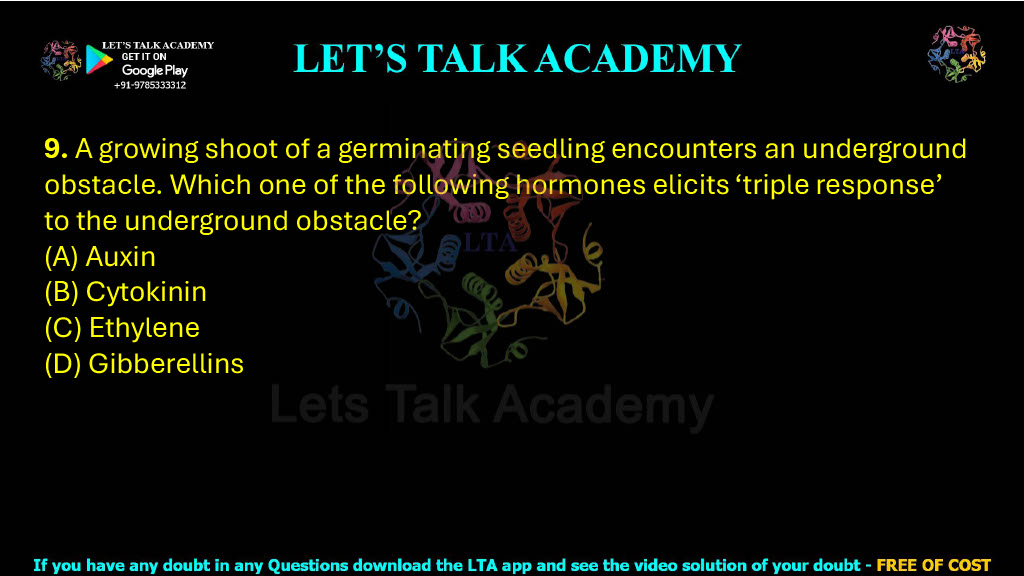
9. A growing shoot of a germinating seedling encounters an underground obstacle. Which one of the following hormones elicits ‘triple response’ to the underground obstacle?
(A) Auxin
(B) Cytokinin
(C) Ethylene
(D) Gibberellins
Ethylene and the Triple Response in Germinating Seedlings
Introduction
Plants constantly encounter environmental challenges during their growth and development. One of the most critical stages occurs immediately after seed germination, when the emerging shoot must push through compact soil and avoid underground obstacles such as stones, hard soil layers, or other physical barriers. Unlike animals, plants cannot move away from these obstacles. Instead, they rely on sophisticated hormonal signaling pathways that modify their growth pattern and enable them to navigate safely toward the soil surface.
The plant hormone ethylene plays a central role in this adaptive mechanism. When a growing shoot encounters mechanical resistance underground, ethylene production increases rapidly within the tissues. Elevated ethylene levels trigger a characteristic developmental program known as the triple response.
Correct Answer
Correct Option: (C) Ethylene
Detailed Explanation
The triple response is a well-characterized physiological response induced by ethylene in germinating seedlings when they encounter mechanical resistance while emerging through the soil. Mechanical stress stimulates ethylene biosynthesis, which alters normal shoot growth and enables the seedling to protect its shoot tip while navigating around obstacles.
The triple response consists of three characteristic growth changes:
- Inhibition of stem elongation, reducing the risk of breakage.
- Radial swelling (thickening) of the hypocotyl or stem, making the seedling stronger and more resistant to mechanical pressure.
- Enhanced formation and maintenance of the apical hook, which protects the delicate shoot apical meristem as the seedling pushes through the soil.
These coordinated changes allow the seedling to bend around obstacles rather than attempting to force its way directly through them. Once the seedling emerges into the open air and mechanical resistance decreases, ethylene production declines and normal elongation resumes.
The remaining hormones regulate different aspects of plant growth but do not specifically induce the triple response.
Explanation of Each Option
Option (A): Auxin
This option is incorrect. Auxin regulates cell elongation, apical dominance, vascular differentiation, root initiation, and tropic responses such as phototropism and gravitropism. Although auxin interacts with ethylene in many developmental processes, it does not directly produce the triple response.
Option (B): Cytokinin
This option is incorrect. Cytokinins stimulate cell division, shoot formation, chloroplast development, and delay leaf senescence. They are not responsible for the triple response observed in mechanically stressed seedlings.
Option (C): Ethylene
This option is correct. Ethylene is the hormone that induces the triple response, consisting of reduced stem elongation, increased radial swelling, and exaggerated apical hook formation in germinating seedlings encountering underground obstacles.
Option (D): Gibberellins
This option is incorrect. Gibberellins promote stem elongation, seed germination, flowering, and fruit development. Their effects are generally opposite to the inhibition of elongation observed during the ethylene-induced triple response.
Why Option (C) is Correct
Ethylene is produced in response to mechanical stress. It modifies seedling growth by suppressing elongation, increasing stem thickness, and maintaining the apical hook. These coordinated changes collectively form the triple response, allowing seedlings to survive while growing through compact soil.
Why the Other Options are Incorrect
Why Option (A) is Incorrect
Auxin mainly regulates elongation growth and directional responses rather than the mechanical stress response known as the triple response.
Why Option (B) is Incorrect
Cytokinins primarily regulate cell division and shoot development, not obstacle avoidance in germinating seedlings.
Why Option (D) is Incorrect
Gibberellins stimulate elongation growth, whereas the triple response requires inhibition of elongation.
Comparison of All Options
| Option | Hormone | Main Function | Correct or Incorrect |
|---|---|---|---|
| A | Auxin | Cell elongation, apical dominance, tropisms | Incorrect |
| B | Cytokinin | Cell division and shoot initiation | Incorrect |
| C | Ethylene | Triple response, fruit ripening, wound response | Correct |
| D | Gibberellins | Stem elongation and seed germination | Incorrect |
The Three Components of the Triple Response
| Component | Biological Importance |
|---|---|
| Reduced Stem Elongation | Prevents damage while pushing through soil |
| Radial Swelling | Strengthens the stem against mechanical resistance |
| Apical Hook Formation | Protects the shoot apical meristem from injury |
Major Functions of Ethylene
| Function | Role |
|---|---|
| Triple Response | Helps seedlings overcome underground obstacles |
| Fruit Ripening | Accelerates ripening of climacteric fruits |
| Leaf Abscission | Promotes leaf and fruit shedding |
| Flower Senescence | Accelerates aging of flowers |
| Wound Response | Activates defense mechanisms after injury |
Comparison of Major Plant Hormones
| Hormone | Primary Function |
|---|---|
| Auxin | Cell elongation and apical dominance |
| Gibberellins | Stem elongation and seed germination |
| Cytokinins | Cell division and delay of senescence |
| Ethylene | Triple response, fruit ripening and stress signaling |
| Abscisic Acid | Drought response and seed dormancy |
Biological Significance
The ethylene-induced triple response is an excellent example of how plants adapt to environmental challenges despite being immobile. By temporarily slowing elongation, increasing stem thickness, and protecting the shoot apex with a pronounced apical hook, seedlings can successfully penetrate compact soil without damaging their growing tissues. This adaptation greatly improves seedling survival and establishment under natural conditions and demonstrates the remarkable ability of plants to modify their development in response to mechanical stress.
Final Answer
Correct Option: (C) Ethylene
Ethylene elicits the triple response when a germinating seedling encounters an underground obstacle. This response includes inhibition of stem elongation, radial swelling of the stem, and formation of a pronounced apical hook, enabling the seedling to safely grow through compact soil while protecting its shoot apex.


