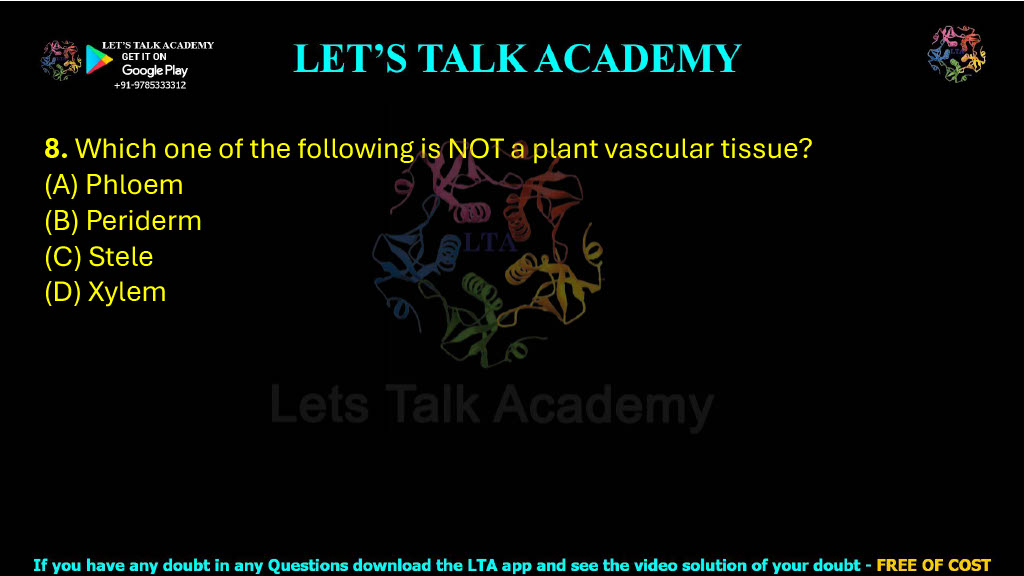
8. Which one of the following is NOT a plant vascular tissue?
(A) Phloem
(B) Periderm
(C) Stele
(D) Xylem
Plant Vascular Tissue Explained: Why Periderm is NOT a Vascular Tissue
Introduction
Vascular tissues are among the most important evolutionary innovations in higher plants because they enable efficient transport of water, minerals, and food throughout the plant body. The evolution of vascular tissues allowed plants to grow taller, colonize terrestrial environments, and develop complex organs such as roots, stems, and leaves. The two principal vascular tissues are xylem and phloem, which together form the vascular bundles responsible for long-distance transport.
Besides vascular tissues, plants also possess protective tissues such as the periderm, which develops during secondary growth. Although the periderm surrounds vascular tissues and provides protection against mechanical injury, water loss, and pathogen attack, it does not participate in the conduction of water or food. Another important anatomical term is the stele, which refers to the central vascular cylinder containing xylem, phloem, and associated tissues.
Correct Answer
Correct Option: (B) Periderm
Detailed Explanation
The vascular tissue system of higher plants consists of xylem and phloem. Xylem transports water and dissolved minerals from the roots to aerial parts of the plant, whereas phloem transports sugars and other organic nutrients from photosynthetic tissues to growing and storage organs. Together, these tissues constitute the vascular bundles responsible for long-distance transport.
The periderm is not a vascular tissue. It is a protective tissue that replaces the epidermis during secondary growth in woody stems and roots. The periderm is composed of three components: the cork cambium (phellogen), cork (phellem), and phelloderm. Its primary functions are to reduce water loss, protect against pathogens, and provide mechanical protection. Since it does not conduct water or food, it is not classified as a vascular tissue.
The stele is the central vascular cylinder of roots and stems. Although the stele itself is not a single tissue, it contains the vascular tissues—xylem and phloem—along with associated tissues such as the pericycle and, in many stems, the pith. Therefore, among the given options, the only structure that is clearly not a vascular tissue is the periderm.
Explanation of Each Option
Option (A): Phloem
This option is incorrect because phloem is one of the two principal vascular tissues. It transports sucrose, amino acids, hormones, and other organic molecules from source tissues to sink tissues.
Option (B): Periderm
This option is correct. Periderm is a protective tissue formed during secondary growth. It replaces the epidermis and does not participate in the transport of water or food.
Option (C): Stele
This option is incorrect. The stele is the central vascular cylinder containing vascular tissues such as xylem and phloem. Although it is not itself a single tissue, it represents the vascular region of the plant.
Option (D): Xylem
This option is incorrect. Xylem is a vascular tissue responsible for transporting water and minerals from roots to stems and leaves while also providing structural support.
Why Option (B) is Correct
Periderm functions as a protective outer covering during secondary growth and is composed of cork, cork cambium, and phelloderm. Unlike xylem and phloem, it has no role in long-distance transport of water, minerals, or food. Therefore, it is not classified as a vascular tissue.
Why the Other Options are Incorrect
Why Option (A) is Incorrect
Phloem is a true vascular tissue that conducts photosynthetically produced food throughout the plant.
Why Option (C) is Incorrect
The stele contains the vascular tissues and forms the central conducting cylinder of roots and stems.
Why Option (D) is Incorrect
Xylem is one of the primary vascular tissues responsible for water transport and mechanical support.
Comparison of All Options
| Option | Structure | Main Function | Vascular Tissue? |
|---|---|---|---|
| A | Phloem | Transport of food and organic nutrients | Yes |
| B | Periderm | Protection during secondary growth | No |
| C | Stele | Central vascular cylinder containing vascular tissues | Contains vascular tissues |
| D | Xylem | Transport of water and minerals | Yes |
Components of Plant Vascular Tissue
| Vascular Tissue | Major Cells | Primary Function |
|---|---|---|
| Xylem | Tracheids, vessel elements, xylem fibers, xylem parenchyma | Water and mineral transport |
| Phloem | Sieve tube elements, companion cells, phloem fibers, phloem parenchyma | Transport of sugars and other organic substances |
Structure of the Periderm
| Component | Function |
|---|---|
| Cork (Phellem) | Protects against water loss and pathogens |
| Cork Cambium (Phellogen) | Produces cork and phelloderm |
| Phelloderm | Living inner protective tissue |
Difference Between Vascular Tissue and Protective Tissue
| Feature | Vascular Tissue | Protective Tissue |
|---|---|---|
| Main Role | Transport of water and food | Protection |
| Examples | Xylem, Phloem | Epidermis, Periderm |
| Conductive Function | Present | Absent |
| Location | Vascular bundles | Outer surface of stems and roots |
Biological Significance
The coordinated activities of vascular and protective tissues ensure plant survival. Xylem and phloem maintain the transport of water, minerals, sugars, hormones, and signaling molecules throughout the plant body, whereas the periderm protects internal tissues from dehydration, mechanical damage, pathogens, and extreme environmental conditions. During secondary growth, the periderm replaces the epidermis and forms the bark, which greatly increases the durability and longevity of woody plants.
Final Answer
Correct Option: (B) Periderm
Periderm is not a plant vascular tissue. It is a protective tissue that develops during secondary growth and replaces the epidermis in woody stems and roots. The true vascular tissues responsible for long-distance transport are xylem and phloem.


