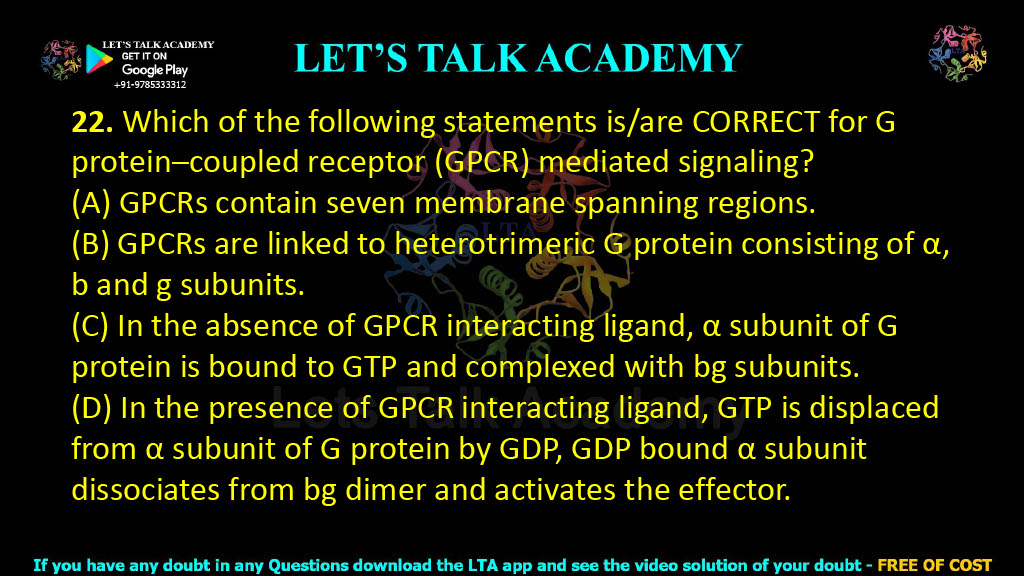
22. Which of the following statements is/are CORRECT for G protein–coupled receptor (GPCR) mediated signaling?
(A) GPCRs contain seven membrane spanning regions.
(B) GPCRs are linked to heterotrimeric G protein consisting of α, b and g subunits.
(C) In the absence of GPCR interacting ligand, α subunit of G protein is bound to GTP and complexed with bg subunits.
(D) In the presence of GPCR interacting ligand, GTP is displaced from α subunit of G protein by GDP, GDP bound α subunit dissociates from bg dimer and activates the effector.
G Protein-Coupled Receptor (GPCR) Mediated Signaling
Introduction
G protein-coupled receptors (GPCRs) represent the largest family of membrane receptors in eukaryotic cells and are responsible for transmitting extracellular signals into intracellular responses. They regulate numerous physiological processes, including vision, smell, taste, neurotransmission, immune responses, hormone action, cardiovascular regulation, metabolism, and cell growth. Nearly one-third of all clinically approved drugs target GPCRs because of their central role in cellular communication.
GPCR-mediated signaling begins when an extracellular ligand such as a hormone, neurotransmitter, chemokine, odorant, or peptide binds to the receptor embedded within the plasma membrane. Ligand binding induces a conformational change in the receptor, allowing it to interact with a nearby heterotrimeric G protein. This interaction triggers activation of intracellular signaling pathways by promoting the exchange of GDP for GTP on the Gα subunit. The activated G protein subsequently regulates downstream effectors such as adenylyl cyclase, phospholipase C, and ion channels, leading to the generation of second messengers and specific cellular responses.
Correct Answer
Correct Option: (A) and (B)
Detailed Explanation
GPCRs are integral membrane proteins characterized by seven transmembrane α-helices, making them seven-pass transmembrane receptors. On the cytoplasmic side of the membrane, GPCRs interact with heterotrimeric G proteins composed of three subunits: Gα, Gβ, and Gγ. In the inactive state, the Gα subunit is bound to GDP and remains associated with the βγ dimer.
When an extracellular ligand binds to the GPCR, the receptor undergoes a conformational change that functions as a guanine nucleotide exchange factor (GEF). This promotes the release of GDP from the Gα subunit and the binding of GTP. The GTP-bound Gα subunit dissociates from the βγ complex, and both components can independently regulate downstream effector proteins such as adenylyl cyclase, phospholipase C, phosphodiesterases, and ion channels.
Termination of signaling occurs when the intrinsic GTPase activity of the Gα subunit hydrolyzes GTP to GDP. The GDP-bound Gα reassociates with the βγ dimer, restoring the inactive heterotrimeric complex and preparing the system for another signaling cycle.
Explanation of Each Option
Option (A): GPCRs Contain Seven Membrane Spanning Regions
This statement is correct. GPCRs are also called seven-transmembrane receptors (7TM receptors) because they possess seven α-helical segments that span the plasma membrane. The extracellular domains recognize signaling molecules, while intracellular domains interact with heterotrimeric G proteins to initiate intracellular signaling.
Option (B): GPCRs are Linked to Heterotrimeric G Protein Consisting of α, β and γ Subunits
This statement is correct. The signaling partner of GPCRs is a heterotrimeric G protein composed of one α subunit and a tightly associated βγ dimer. The α subunit binds guanine nucleotides (GDP and GTP) and possesses intrinsic GTPase activity, whereas the βγ complex also participates in regulating several downstream effectors after activation.
Option (C): In the Absence of GPCR Interacting Ligand, α Subunit of G Protein is Bound to GTP and Complexed with βγ Subunits
This statement is incorrect. In the resting or inactive state, the Gα subunit is bound to GDP, not GTP. The GDP-bound Gα remains associated with the βγ dimer to form the inactive heterotrimeric G protein. Binding of GTP occurs only after ligand-induced activation of the GPCR.
Option (D): In the Presence of GPCR Interacting Ligand, GTP is Displaced from α Subunit of G Protein by GDP, GDP-Bound α Subunit Dissociates from βγ Dimer and Activates the Effector
This statement is incorrect. The sequence described is exactly opposite to the actual mechanism. Upon receptor activation, GDP is released and replaced by GTP, not vice versa. It is the GTP-bound Gα subunit, rather than the GDP-bound form, that dissociates from the βγ complex and activates downstream effector proteins.
Why Options (A) and (B) are Correct
GPCRs are universally recognized as seven-transmembrane receptors that communicate with heterotrimeric G proteins composed of α, β, and γ subunits. These structural characteristics are fundamental features of GPCR-mediated signaling and remain conserved throughout eukaryotic organisms.
Why Options (C) and (D) are Incorrect
Why Option (C) is Incorrect
The inactive Gα subunit is always associated with GDP. Binding of GTP is the activation step that occurs only after ligand binding to the GPCR.
Why Option (D) is Incorrect
Activation requires the exchange of GDP for GTP. The GTP-bound α subunit dissociates from the βγ complex and activates downstream signaling molecules. The option incorrectly reverses both the nucleotide exchange and the active form of the G protein.
Comparison of All Options
| Option | Statement | Correct or Incorrect | Reason |
|---|---|---|---|
| A | GPCRs contain seven membrane-spanning regions. | Correct | All classical GPCRs possess seven transmembrane α-helices. |
| B | GPCRs interact with heterotrimeric G proteins containing α, β and γ subunits. | Correct | These three subunits form the inactive signaling complex. |
| C | Inactive Gα is bound to GTP. | Incorrect | Inactive Gα is GDP-bound. |
| D | GTP is replaced by GDP during activation. | Incorrect | Activation requires GDP to be replaced by GTP. |
Steps of GPCR Signaling
| Step | Event |
|---|---|
| 1 | Ligand binds to GPCR. |
| 2 | GPCR undergoes a conformational change. |
| 3 | GDP dissociates from the Gα subunit. |
| 4 | GTP binds to the Gα subunit. |
| 5 | GTP-bound Gα separates from the βγ dimer. |
| 6 | Both Gα-GTP and βγ activate downstream effector proteins. |
| 7 | Intrinsic GTPase activity converts GTP to GDP. |
| 8 | Gα-GDP reassociates with the βγ dimer, terminating the signal. |
Major Downstream Effectors of GPCR Signaling
| Effector | Major Product or Function |
|---|---|
| Adenylyl Cyclase | Produces cyclic AMP (cAMP) |
| Phospholipase C (PLC) | Generates IP3 and DAG |
| Ion Channels | Regulate membrane potential and ion movement |
| Phosphodiesterases | Hydrolyze cyclic nucleotides |
Biological Significance of GPCR Signaling
GPCR signaling enables cells to respond rapidly to hormones, neurotransmitters, sensory stimuli, and environmental signals. These pathways regulate metabolism, immune responses, cardiac function, neuronal communication, endocrine signaling, smooth muscle contraction, and numerous developmental processes. Because GPCRs participate in so many physiological systems, they represent one of the largest and most important drug target families in modern medicine.
Final Answer
Correct Option: (A) and (B)
GPCRs are seven-transmembrane receptors that interact with heterotrimeric G proteins consisting of α, β, and γ subunits. In the inactive state, the Gα subunit is bound to GDP. Upon ligand binding, GDP is exchanged for GTP, allowing the GTP-bound Gα subunit and the βγ dimer to activate downstream effector proteins and initiate intracellular signaling.


