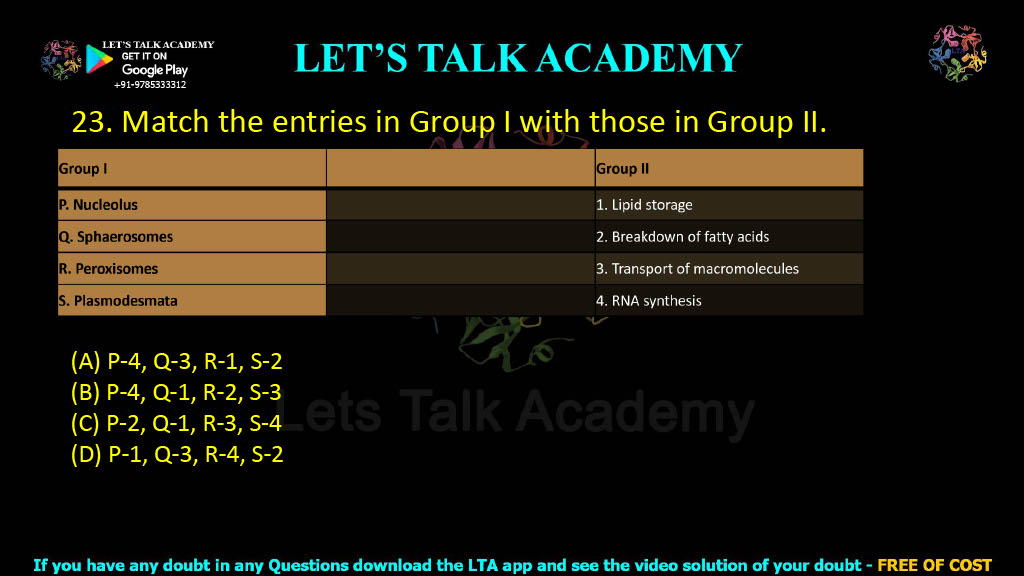
23. Match the entries in Group I with that in Group II
Group I Group II
P) Nucleolus 1) lipid storage
Q) Sphaerosomes 2) breakdown of fatty acids
R) Peroxisomes 3) transport of macromolecules
S)Plasmodesmata 4) RNA synthesis
(A) P-4, Q-3, R-1, S-2
(B) P-4, Q-1, R-2, S-3
(C) P-2, Q-1, R-3, S-4
(D) P-1, Q-3, R-4, S-2
Match the Cell Organelles with Their Functions: Nucleolus, Sphaerosomes, Peroxisomes and Plasmodesmata
Introduction
Cell organelles are specialized intracellular structures that perform distinct biochemical and physiological functions essential for cell survival. In eukaryotic cells, each organelle is designed to accomplish a specific task, such as protein synthesis, lipid metabolism, energy production, intracellular transport, or communication between neighboring cells. Understanding the structure and function of these organelles is one of the most fundamental topics in Cell Biology because it provides the basis for understanding metabolism, growth, development, and cellular organization.
Among the important organelles commonly discussed in plant and animal cell biology are the nucleolus, sphaerosomes, peroxisomes, and plasmodesmata. Each performs a unique biological function. The nucleolus is responsible for ribosomal RNA synthesis and ribosome assembly, sphaerosomes store lipids, peroxisomes participate in fatty acid oxidation and detoxification, while plasmodesmata provide cytoplasmic connections that allow movement of molecules between adjacent plant cells.
Correct Answer
Correct Option: (B) P-4, Q-1, R-2, S-3
Detailed Explanation
The correct matching is based on the primary biological functions of each cellular structure. The nucleolus is the site of ribosomal RNA (rRNA) synthesis and ribosome assembly, making it responsible for RNA synthesis. Sphaerosomes are specialized lipid-containing organelles found mainly in plant cells and function as lipid storage compartments. Peroxisomes contain oxidative enzymes that perform β-oxidation of fatty acids and detoxify hydrogen peroxide through catalase. Plasmodesmata are microscopic cytoplasmic channels connecting adjacent plant cells, allowing transport of metabolites, proteins, RNA molecules, and signaling molecules between neighboring cells.
Therefore, the correct matching is:
P → 4 (RNA synthesis)
Q → 1 (Lipid storage)
R → 2 (Breakdown of fatty acids)
S → 3 (Transport of macromolecules)
Explanation of Each Entry
P) Nucleolus → RNA Synthesis (4)
This match is correct. The nucleolus is a dense, non-membranous structure present inside the nucleus. It is the primary site of ribosomal RNA transcription, processing, and ribosomal subunit assembly. RNA polymerase I synthesizes most ribosomal RNA within the nucleolus, making it the center of ribosome biogenesis.
Q) Sphaerosomes → Lipid Storage (1)
This match is correct. Sphaerosomes are small, single membrane-bound organelles found predominantly in plant cells. They store neutral lipids, phospholipids, and triglycerides and participate in lipid metabolism. Because of their lipid-rich nature, they are often regarded as plant lipid bodies.
R) Peroxisomes → Breakdown of Fatty Acids (2)
This match is correct. Peroxisomes contain oxidases and catalase enzymes that catalyze β-oxidation of very-long-chain fatty acids. During this process, hydrogen peroxide is produced and subsequently decomposed by catalase into water and oxygen, protecting cells from oxidative damage.
S) Plasmodesmata → Transport of Macromolecules (3)
This match is correct. Plasmodesmata are microscopic channels that traverse plant cell walls, connecting the cytoplasm of neighboring cells. They facilitate movement of sugars, amino acids, proteins, messenger RNAs, transcription factors, signaling molecules, and other macromolecules, thereby enabling intercellular communication and coordinated development.
Explanation of Each Option
Option (A): P-4, Q-3, R-1, S-2
This option is incorrect. Although the nucleolus is correctly matched with RNA synthesis, sphaerosomes do not transport macromolecules, peroxisomes do not function in lipid storage, and plasmodesmata are not involved in fatty acid breakdown.
Option (B): P-4, Q-1, R-2, S-3
This option is correct. Every organelle is matched accurately with its principal biological function. This represents the accepted functional relationship used in Cell Biology and Plant Biology.
Option (C): P-2, Q-1, R-3, S-4
This option is incorrect. The nucleolus does not degrade fatty acids, peroxisomes are not responsible for transport of macromolecules, and plasmodesmata do not synthesize RNA.
Option (D): P-1, Q-3, R-4, S-2
This option is incorrect. None of these matches corresponds to the primary functions of the listed organelles.
Why Option (B) is Correct
Option (B) correctly associates every organelle with its principal cellular function: the nucleolus synthesizes ribosomal RNA, sphaerosomes store lipids, peroxisomes oxidize fatty acids, and plasmodesmata transport macromolecules between adjacent plant cells. These functions are well established and frequently tested in competitive examinations.
Comparison of All Organelles
| Organelle | Main Function | Occurrence |
|---|---|---|
| Nucleolus | Ribosomal RNA synthesis and ribosome assembly | Eukaryotic nucleus |
| Sphaerosomes | Lipid storage | Plant cells |
| Peroxisomes | β-oxidation of fatty acids and detoxification | Plant and animal cells |
| Plasmodesmata | Transport and communication between adjacent cells | Plant cells |
Comparison of the Correct Matching
| Group I | Correct Match | Function |
|---|---|---|
| P) Nucleolus | 4 | RNA synthesis |
| Q) Sphaerosomes | 1 | Lipid storage |
| R) Peroxisomes | 2 | Breakdown of fatty acids |
| S) Plasmodesmata | 3 | Transport of macromolecules |
Biological Significance of These Organelles
Each of these structures contributes to normal cellular physiology in a unique way. The nucleolus ensures continuous ribosome production for protein synthesis. Sphaerosomes act as lipid reservoirs that supply energy and membrane components during growth and seed germination. Peroxisomes maintain lipid metabolism and protect cells against oxidative stress by degrading hydrogen peroxide. Plasmodesmata establish direct cytoplasmic continuity between neighboring plant cells, allowing coordinated growth, nutrient distribution, and signaling throughout plant tissues.
Final Answer
Correct Option: (B) P-4, Q-1, R-2, S-3
The correct matching is Nucleolus → RNA synthesis, Sphaerosomes → Lipid storage, Peroxisomes → Breakdown of fatty acids, and Plasmodesmata → Transport of macromolecules. These functions are essential for gene expression, lipid metabolism, cellular detoxification, and intercellular communication in eukaryotic cells.


