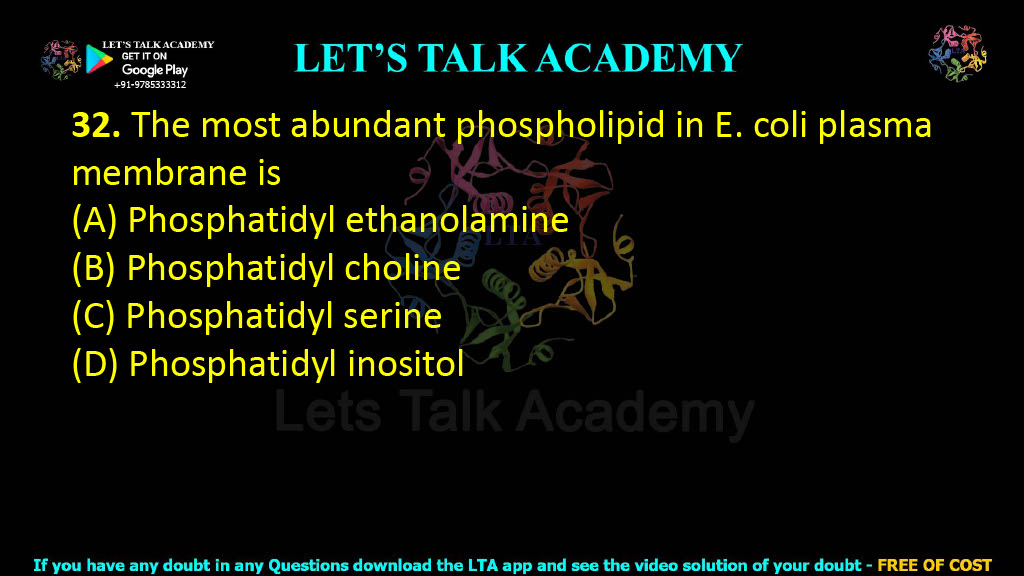
32. The most abundant phospholipid in E. coli plasma membrane is
(A) Phosphatidyl ethanolamine
(B) Phosphatidyl choline
(C) Phosphatidyl serine
(D) Phosphatidyl inositol
Most Abundant Phospholipid in E. coli Plasma Membrane
Introduction
The plasma membrane of bacteria is a highly organized phospholipid bilayer that functions as a selective permeability barrier and serves as the site for numerous metabolic activities. Unlike eukaryotic cells, bacterial cells lack membrane-bound organelles, making the plasma membrane essential for energy production, nutrient transport, secretion, signal transduction, and maintenance of cellular homeostasis. In bacteria such as Escherichia coli (E. coli), the plasma membrane also houses the electron transport chain and ATP synthase, making it functionally analogous to the inner mitochondrial membrane of eukaryotic cells.
The phospholipid composition of the bacterial membrane differs significantly from that of animal cells. The predominant phospholipid in the plasma membrane of E. coli is phosphatidylethanolamine (PE), which accounts for approximately 70–80% of the total membrane phospholipids. Other important phospholipids include phosphatidylglycerol (PG) and cardiolipin (CL), whereas phosphatidylcholine and phosphatidylinositol are generally absent or present only in trace amounts in most bacteria.
Correct Answer
Correct Option: (A) Phosphatidyl Ethanolamine
Detailed Explanation
The plasma membrane of E. coli is composed primarily of phospholipids that provide membrane integrity, fluidity, and proper functioning of membrane proteins. Among these phospholipids, phosphatidylethanolamine (PE) is by far the most abundant, constituting nearly three-fourths of the total membrane phospholipids.
Phosphatidylethanolamine is a zwitterionic phospholipid that contributes to membrane curvature, flexibility, and proper folding of membrane proteins. It is also essential for cell division, membrane fusion, transport processes, and assembly of membrane-associated protein complexes. Besides phosphatidylethanolamine, the E. coli membrane contains smaller amounts of phosphatidylglycerol (PG) and cardiolipin (CL), both of which play important roles in membrane stability and energy metabolism.
Unlike animal cells, E. coli generally lacks phosphatidylcholine as a major membrane component. Similarly, phosphatidylserine serves mainly as a biosynthetic intermediate in phosphatidylethanolamine synthesis, while phosphatidylinositol is characteristic of eukaryotic membranes rather than bacterial membranes.
Explanation of Each Option
Option (A): Phosphatidyl Ethanolamine
This statement is correct. Phosphatidylethanolamine is the predominant phospholipid in the plasma membrane of E. coli, accounting for approximately 70–80% of total membrane phospholipids. It maintains membrane structure, supports membrane protein folding, contributes to membrane curvature, and participates in several essential physiological processes.
Option (B): Phosphatidyl Choline
This statement is incorrect. Phosphatidylcholine is one of the major phospholipids of animal cell membranes and many eukaryotic organisms. However, it is generally absent from the plasma membrane of E. coli. Only a limited number of bacterial species synthesize phosphatidylcholine, and it is not a characteristic lipid of E. coli.
Option (C): Phosphatidyl Serine
This statement is incorrect. Phosphatidylserine is present only in very small quantities in E. coli. It mainly serves as an intermediate in the biosynthetic pathway leading to phosphatidylethanolamine formation. Consequently, it is not the predominant membrane phospholipid.
Option (D): Phosphatidyl Inositol
This statement is incorrect. Phosphatidylinositol is a major phospholipid in many eukaryotic cells where it participates in signal transduction through phosphoinositide pathways. It is generally absent in E. coli and is therefore not a major bacterial membrane phospholipid.
Why Option (A) is Correct
Phosphatidylethanolamine is the major structural phospholipid of the E. coli plasma membrane. Its high abundance supports membrane stability, flexibility, protein folding, membrane curvature, and proper functioning of numerous membrane-associated enzymes and transport proteins. Because it represents the largest fraction of membrane phospholipids, it is correctly identified as the most abundant phospholipid.
Why the Other Options are Incorrect
Why Option (B) is Incorrect
Phosphatidylcholine predominates in animal cell membranes but is not a major phospholipid of E. coli.
Why Option (C) is Incorrect
Phosphatidylserine is only a minor phospholipid and primarily functions as a precursor for phosphatidylethanolamine biosynthesis.
Why Option (D) is Incorrect
Phosphatidylinositol is primarily found in eukaryotic membranes and participates in intracellular signaling rather than bacterial membrane organization.
Comparison of All Options
| Option | Phospholipid | Correct or Incorrect | Reason |
|---|---|---|---|
| A | Phosphatidyl Ethanolamine | Correct | Major phospholipid of the E. coli plasma membrane. |
| B | Phosphatidyl Choline | Incorrect | Predominantly found in eukaryotic membranes. |
| C | Phosphatidyl Serine | Incorrect | Minor phospholipid and biosynthetic intermediate. |
| D | Phosphatidyl Inositol | Incorrect | Mainly present in eukaryotic cell membranes. |
Major Phospholipids of the E. coli Plasma Membrane
| Phospholipid | Approximate Abundance | Major Function |
|---|---|---|
| Phosphatidylethanolamine (PE) | 70–80% | Membrane structure, protein folding, membrane curvature |
| Phosphatidylglycerol (PG) | 15–25% | Membrane stability and transport functions |
| Cardiolipin (CL) | 5–10% | Energy metabolism and stabilization of membrane proteins |
Comparison Between Bacterial and Animal Cell Membrane Phospholipids
| Feature | E. coli Membrane | Animal Cell Membrane |
|---|---|---|
| Major Phospholipid | Phosphatidylethanolamine | Phosphatidylcholine |
| Cholesterol | Absent | Present |
| Electron Transport Chain | Located in plasma membrane | Located in inner mitochondrial membrane |
| Membrane-Bound Organelles | Absent | Present |
Biological Significance of Phosphatidylethanolamine
Phosphatidylethanolamine is essential for maintaining the physical properties of bacterial membranes. It regulates membrane fluidity, facilitates membrane protein insertion and folding, supports membrane fusion and cell division, and contributes to proper localization of membrane proteins. Mutations affecting phosphatidylethanolamine biosynthesis impair bacterial growth, membrane integrity, and cell viability, demonstrating its indispensable role in bacterial physiology.
Final Answer
Correct Option: (A) Phosphatidyl Ethanolamine
The plasma membrane of E. coli contains phosphatidylethanolamine as its most abundant phospholipid, accounting for nearly 70–80% of the total membrane phospholipids. This lipid is essential for membrane integrity, protein folding, membrane curvature, and numerous cellular functions, making it the characteristic phospholipid of the E. coli plasma membrane.


