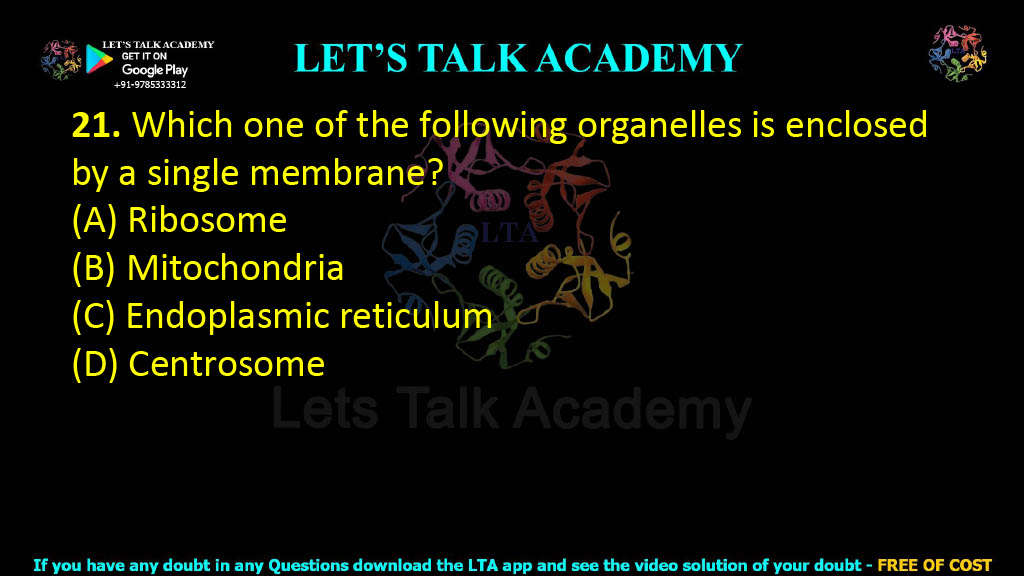
21. Which one of the following organelles is enclosed by a single membrane?
(A) Ribosome
(B) Mitochondria
(C) Endoplasmic reticulum
(D) Centrosome
Single Membrane-Bound Organelles in Eukaryotic Cells: Endoplasmic Reticulum
Introduction
Eukaryotic cells contain numerous specialized organelles, each performing distinct biological functions essential for cell survival. One of the most important methods of classifying these organelles is based on the number of surrounding membranes. Some organelles are enclosed by a single membrane, some possess a double membrane, while others are non-membranous. This classification is fundamental in Cell Biology because it reflects both the evolutionary origin and functional specialization of each organelle.
The endoplasmic reticulum, Golgi apparatus, lysosomes, vacuoles, peroxisomes, and endosomes are examples of single membrane-bound organelles. In contrast, mitochondria and chloroplasts possess double membranes, whereas ribosomes, centrosomes, nucleoli, and cytoskeletal elements are not surrounded by membranes.
Correct Answer
Correct Option: (C) Endoplasmic Reticulum
Detailed Explanation
The endoplasmic reticulum (ER) is an extensive network of interconnected membrane-bound tubules and flattened sacs known as cisternae. It extends throughout the cytoplasm and is continuous with the outer membrane of the nuclear envelope. Since the ER is enclosed by only one phospholipid bilayer, it is classified as a single membrane-bound organelle.
The endoplasmic reticulum exists in two structurally and functionally distinct forms. The rough endoplasmic reticulum (RER) contains ribosomes attached to its cytoplasmic surface and is primarily responsible for synthesis, folding, and initial modification of secretory proteins, membrane proteins, and lysosomal proteins. The smooth endoplasmic reticulum (SER) lacks ribosomes and functions in lipid synthesis, steroid hormone production, detoxification of drugs, glycogen metabolism, and intracellular calcium storage.
Because the ER performs diverse metabolic functions while being enclosed by only a single membrane, it is the correct answer.
Explanation of Each Option
Option (A): Ribosome
This statement is incorrect. Ribosomes are not membrane-bound organelles. They are ribonucleoprotein complexes composed of ribosomal RNA (rRNA) and proteins that carry out protein synthesis. Ribosomes may exist freely in the cytoplasm or be attached to the rough endoplasmic reticulum, but they are never enclosed by any membrane. Therefore, ribosomes are classified as non-membranous organelles.
Option (B): Mitochondria
This statement is incorrect. Mitochondria are surrounded by two membranes: an outer mitochondrial membrane and a highly folded inner mitochondrial membrane that forms cristae. The electron transport chain and ATP synthase are located on the inner membrane, making mitochondria double membrane-bound organelles. Consequently, mitochondria cannot be classified as single membrane-bound organelles.
Option (C): Endoplasmic Reticulum
This statement is correct. The endoplasmic reticulum is surrounded by a single membrane and forms an interconnected network throughout the cytoplasm. Rough ER synthesizes proteins destined for secretion or membranes, whereas Smooth ER is involved in lipid synthesis, detoxification, carbohydrate metabolism, and calcium storage. Because it possesses only one surrounding membrane, the endoplasmic reticulum is correctly classified as a single membrane-bound organelle.
Option (D): Centrosome
This statement is incorrect. The centrosome is the primary microtubule-organizing center (MTOC) of animal cells and consists of two centrioles embedded within the pericentriolar matrix. Centrosomes are entirely non-membranous structures composed mainly of microtubule proteins. They organize spindle fibers during mitosis but are not enclosed by any membrane.
Why Option (C) is Correct
The endoplasmic reticulum possesses a single phospholipid membrane surrounding its lumen and forms a continuous intracellular membrane network. Unlike mitochondria, which have two membranes, or ribosomes and centrosomes, which lack membranes altogether, the ER is correctly classified as a single membrane-bound organelle.
Why the Other Options are Incorrect
Why Option (A) is Incorrect
Ribosomes are non-membranous ribonucleoprotein particles responsible for protein synthesis and are not enclosed by any membrane.
Why Option (B) is Incorrect
Mitochondria possess both an outer membrane and an inner membrane, making them double membrane-bound organelles.
Why Option (D) is Incorrect
Centrosomes consist of centrioles and pericentriolar material without any surrounding membrane and therefore belong to the category of non-membranous organelles.
Comparison of All Options
| Option | Organelle | Membrane Type | Correct or Incorrect |
|---|---|---|---|
| A | Ribosome | No membrane | Incorrect |
| B | Mitochondria | Double membrane | Incorrect |
| C | Endoplasmic Reticulum | Single membrane | Correct |
| D | Centrosome | No membrane | Incorrect |
Classification of Eukaryotic Organelles Based on Membranes
| Category | Examples |
|---|---|
| Single Membrane-Bound Organelles | Endoplasmic Reticulum, Golgi Apparatus, Lysosomes, Peroxisomes, Vacuoles, Endosomes |
| Double Membrane-Bound Organelles | Nucleus, Mitochondria, Chloroplasts |
| Non-Membranous Organelles | Ribosomes, Centrosomes, Centrioles, Nucleolus, Cytoskeleton |
Functions of the Endoplasmic Reticulum
| Region | Major Function |
|---|---|
| Rough Endoplasmic Reticulum | Protein synthesis, protein folding, glycosylation, membrane protein production |
| Smooth Endoplasmic Reticulum | Lipid synthesis, steroid hormone synthesis, detoxification, glycogen metabolism, calcium storage |
Biological Significance of the Endoplasmic Reticulum
The endoplasmic reticulum is one of the largest organelles in eukaryotic cells and serves as the central hub for biosynthesis and intracellular transport. The rough ER ensures proper synthesis and folding of secretory and membrane proteins, whereas the smooth ER regulates lipid metabolism, steroid hormone production, detoxification of harmful compounds, and calcium homeostasis. The ER also communicates extensively with the Golgi apparatus, lysosomes, mitochondria, and plasma membrane, making it indispensable for normal cellular function.
Final Answer
Correct Option: (C) Endoplasmic Reticulum
The endoplasmic reticulum is a single membrane-bound organelle that functions in protein synthesis, lipid synthesis, intracellular transport, detoxification, and calcium storage. Ribosomes and centrosomes are non-membranous structures, whereas mitochondria are enclosed by a double membrane.


