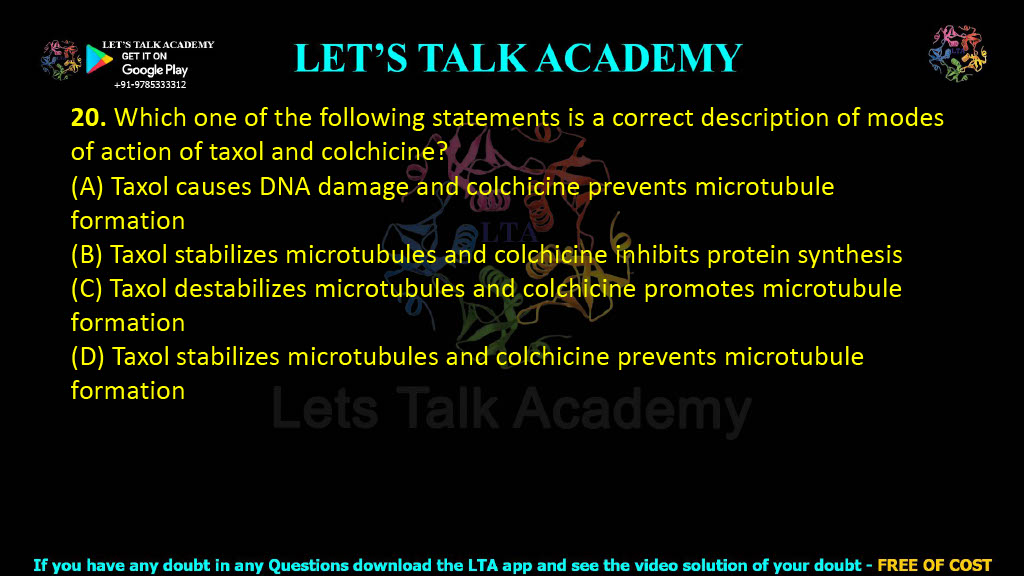
20. Which one of the following statements is a correct description of modes of action of taxol and colchicine?
(A) Taxol causes DNA damage and colchicine prevents microtubule formation
(B) Taxol stabilizes microtubules and colchicine inhibits protein synthesis
(C) Taxol destabilizes microtubules and colchicine promotes microtubule formation
(D) Taxol stabilizes microtubules and colchicine prevents microtubule formation
Taxol and Colchicine: Mechanism of Action on Microtubules
Introduction
Microtubules are one of the three major components of the eukaryotic cytoskeleton and play essential roles in maintaining cell shape, intracellular transport, chromosome segregation, cilia and flagella movement, and mitosis. They are dynamic structures composed of α-tubulin and β-tubulin heterodimers that continuously undergo polymerization and depolymerization, a phenomenon known as dynamic instability. This constant remodeling is especially important during mitosis, where spindle microtubules assemble and disassemble to accurately separate chromosomes into daughter cells.
Several natural compounds interfere with microtubule dynamics and are widely used in medicine and biological research. Two of the most important are Taxol (Paclitaxel) and Colchicine. Although both inhibit cell division, they act through completely different mechanisms. Taxol stabilizes existing microtubules and prevents their depolymerization, whereas Colchicine binds to free tubulin dimers and prevents their polymerization into microtubules.
Correct Answer
Correct Option: (D) Taxol stabilizes microtubules and Colchicine prevents microtubule formation.
Detailed Explanation
Successful mitosis depends on the continuous assembly and disassembly of spindle microtubules. Microtubules must polymerize to capture chromosomes and later depolymerize to pull sister chromatids toward opposite poles. Drugs that interfere with these dynamic processes block chromosome segregation and arrest cells in mitosis.
Taxol, also known as Paclitaxel, binds specifically to β-tubulin within already assembled microtubules. Instead of allowing normal depolymerization, Taxol stabilizes the microtubules and prevents their breakdown. Because spindle microtubules become excessively stable, they lose their normal dynamic behavior, preventing proper chromosome movement during mitosis. As a result, cells become arrested at the metaphase-anaphase transition and eventually undergo apoptosis.
Colchicine acts through the opposite mechanism. It binds to free α/β-tubulin heterodimers before they become incorporated into growing microtubules. This prevents tubulin polymerization and therefore inhibits formation of new spindle microtubules. Without a functional mitotic spindle, chromosomes cannot align properly or segregate during mitosis, leading to cell cycle arrest.
Although both drugs inhibit mitosis, Taxol stabilizes existing microtubules whereas Colchicine prevents their formation. This difference forms the basis of the correct answer.
Explanation of Each Option
Option (A): Taxol Causes DNA Damage and Colchicine Prevents Microtubule Formation
This statement is incorrect. Colchicine does prevent microtubule formation by inhibiting tubulin polymerization. However, Taxol does not directly damage DNA. Instead, Taxol acts on the cytoskeleton by stabilizing spindle microtubules and preventing their depolymerization. DNA-damaging agents include drugs such as cisplatin, doxorubicin, bleomycin, and ionizing radiation, not Taxol.
Option (B): Taxol Stabilizes Microtubules and Colchicine Inhibits Protein Synthesis
This statement is incorrect. The first part is correct because Taxol stabilizes microtubules. However, Colchicine does not inhibit protein synthesis. Protein synthesis inhibitors include cycloheximide, chloramphenicol, tetracycline, erythromycin, and puromycin. Colchicine specifically targets tubulin polymerization rather than ribosomes.
Option (C): Taxol Destabilizes Microtubules and Colchicine Promotes Microtubule Formation
This statement is incorrect. This option completely reverses the actual mechanisms. Taxol stabilizes rather than destabilizes microtubules, while Colchicine inhibits rather than promotes microtubule polymerization.
Option (D): Taxol Stabilizes Microtubules and Colchicine Prevents Microtubule Formation
This statement is correct. Taxol binds to assembled microtubules and prevents their depolymerization, whereas Colchicine binds free tubulin dimers and prevents polymerization. Both interfere with spindle function, arrest mitosis, and inhibit cell division, but they do so through opposite effects on microtubule dynamics.
Why Option (D) is Correct
The key concept is that both drugs target microtubules but act differently. Taxol locks microtubules in a stable polymerized state, preventing their normal disassembly, while Colchicine prevents tubulin molecules from assembling into microtubules. Since both mechanisms disrupt spindle dynamics and block mitosis, Option (D) accurately describes their modes of action.
Why the Other Options are Incorrect
Why Option (A) is Incorrect
Taxol is not a DNA-damaging agent. Its primary target is β-tubulin within microtubules.
Why Option (B) is Incorrect
Colchicine affects microtubules, not ribosomes. Therefore, it does not inhibit protein synthesis.
Why Option (C) is Incorrect
This option incorrectly reverses the mechanisms of both drugs. Taxol stabilizes microtubules, whereas Colchicine inhibits their assembly.
Comparison of All Options
| Option | Statement | Correct or Incorrect | Reason |
|---|---|---|---|
| A | Taxol causes DNA damage | Incorrect | Taxol targets microtubules, not DNA. |
| B | Colchicine inhibits protein synthesis | Incorrect | Colchicine inhibits tubulin polymerization. |
| C | Taxol destabilizes microtubules | Incorrect | Taxol actually stabilizes microtubules. |
| D | Taxol stabilizes microtubules and Colchicine prevents microtubule formation | Correct | Accurately describes the mechanism of both drugs. |
Comparison Between Taxol and Colchicine
| Feature | Taxol (Paclitaxel) | Colchicine |
|---|---|---|
| Primary Target | Polymerized microtubules | Free tubulin dimers |
| Effect on Microtubules | Stabilizes microtubules | Prevents polymerization |
| Microtubule Dynamics | Blocks depolymerization | Blocks polymerization |
| Mitotic Effect | Metaphase arrest | Metaphase arrest |
| Major Clinical Use | Anticancer chemotherapy | Gout treatment and research; limited anticancer applications |
Importance of Microtubule Dynamics During Mitosis
Microtubules exhibit continuous growth and shrinkage, allowing spindle fibers to attach to kinetochores, align chromosomes at the metaphase plate, and separate sister chromatids during anaphase. Both excessive stabilization and complete inhibition of polymerization disrupt spindle function, preventing chromosome segregation and activating the spindle assembly checkpoint. This ultimately results in mitotic arrest and programmed cell death, explaining why microtubule-targeting drugs are highly effective against rapidly dividing cancer cells.
Biological Significance
Microtubule-targeting drugs are among the most successful chemotherapeutic agents because cancer cells divide much more rapidly than normal cells. By disrupting spindle function, these drugs selectively inhibit proliferation of tumor cells. Understanding the distinct mechanisms of Taxol and Colchicine has also contributed significantly to our knowledge of cytoskeletal dynamics, chromosome segregation, and cell cycle regulation.
Final Answer
Correct Option: (D) Taxol stabilizes microtubules and Colchicine prevents microtubule formation.
Taxol binds to assembled microtubules and prevents their depolymerization, producing highly stable spindle fibers. In contrast, Colchicine binds free tubulin dimers and prevents microtubule polymerization. Although both drugs arrest mitosis, they act through opposite effects on microtubule dynamics.


