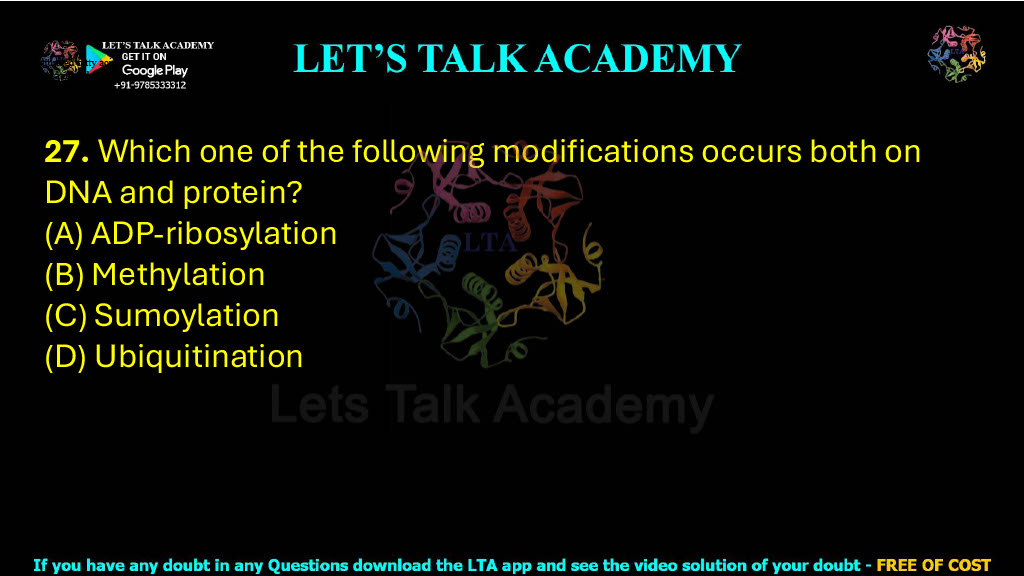
27. Which one of the following modifications occurs both on DNA and protein?
(A) ADP-ribosylation
(B) Methylation
(C) Sumoylation
(D) Ubiquitination
DNA and Protein Modification That Occurs in Both Molecules | Explanation with Epigenetics and Post-Translational Modifications
Correct Answer
(B) Methylation
Introduction
Cells constantly regulate gene expression, protein function, and genome stability through a variety of chemical modifications. These modifications may occur either directly on DNA or on proteins after they are synthesized. DNA modifications mainly regulate gene expression and epigenetic inheritance, whereas protein modifications regulate enzyme activity, protein stability, intracellular localization, and protein–protein interactions. Together, these molecular changes allow cells to respond rapidly to developmental signals and environmental stimuli without altering the underlying DNA sequence.
Among the numerous biochemical modifications identified in living organisms, methylation is unique because it occurs on both DNA and proteins. DNA methylation serves as one of the most important epigenetic mechanisms controlling gene expression, while protein methylation regulates the activity and interactions of histones and numerous non-histone proteins.
Understanding the Concept Behind the Question
The question asks which biochemical modification occurs on both DNA and proteins.
DNA undergoes several chemical modifications, but the most common and biologically significant one is methylation, in which a methyl group (-CH₃) is added to specific DNA bases, particularly cytosine residues. This modification regulates transcription, genomic imprinting, X-chromosome inactivation, and genome stability.
Proteins also undergo methylation, especially on lysine and arginine residues. Histone methylation plays a major role in chromatin organization and epigenetic regulation, while methylation of non-histone proteins influences signaling pathways, transcription factor activity, and protein interactions.
The other modifications listed in the question—ADP-ribosylation, sumoylation, and ubiquitination—primarily occur on proteins and are generally classified as post-translational modifications.
Therefore, methylation is the only modification among the given options that naturally occurs on both DNA and proteins.
Hence, the correct answer is Option (B).
Why Option (A) Is Incorrect
ADP-ribosylation
ADP-ribosylation is a post-translational modification in which one or more ADP-ribose groups are transferred from NAD⁺ to target proteins by enzymes known as ADP-ribosyltransferases. This modification regulates DNA repair, chromatin remodeling, transcription, apoptosis, and cellular stress responses.
One of the best-known enzymes involved in this process is PARP (Poly ADP-ribose Polymerase), which modifies itself and several DNA-associated proteins during DNA damage repair. Although ADP-ribosylation participates in DNA repair pathways, the modification itself occurs primarily on proteins rather than DNA.
Therefore, ADP-ribosylation is not considered a common modification of DNA.
Hence, Option (A) is incorrect.
Why Option (B) Is Correct
Methylation
Methylation is one of the most widespread biochemical modifications found in living organisms because it occurs on both DNA and proteins.
In DNA, methylation typically involves the addition of a methyl group to the 5th carbon of cytosine, producing 5-methylcytosine. DNA methylation is catalyzed by DNA methyltransferases (DNMTs) and serves as an important epigenetic mechanism controlling gene expression, transposon silencing, genomic imprinting, and X-chromosome inactivation.
Proteins also undergo methylation, particularly on the side chains of lysine and arginine residues. Histone methylation regulates chromatin structure and determines whether genes remain transcriptionally active or inactive. Non-histone proteins such as transcription factors and signaling molecules are likewise methylated to regulate their biological activity.
Since methylation occurs naturally on both DNA and proteins, it is the only modification among the options that satisfies the conditions of the question.
Therefore, Option (B) is correct.
Why Option (C) Is Incorrect
Sumoylation
Sumoylation is a post-translational modification in which a small protein known as SUMO (Small Ubiquitin-like Modifier) is covalently attached to lysine residues of target proteins.
Unlike ubiquitination, sumoylation generally does not promote protein degradation. Instead, it regulates protein localization, nuclear transport, transcriptional regulation, chromosome segregation, and DNA repair.
Although many proteins involved in chromatin regulation become sumoylated, DNA itself is not modified by SUMO proteins.
Therefore, Option (C) is incorrect.
Why Option (D) Is Incorrect
Ubiquitination
Ubiquitination is another important post-translational modification in which the small protein ubiquitin is covalently attached to lysine residues of target proteins through the coordinated action of E1, E2, and E3 enzymes.
Polyubiquitination commonly targets proteins for degradation by the 26S proteasome, whereas monoubiquitination regulates transcription, endocytosis, DNA repair, and intracellular trafficking.
Despite its diverse biological roles, ubiquitination occurs exclusively on proteins and does not modify DNA molecules.
Therefore, Option (D) is incorrect.
DNA Methylation
DNA methylation represents one of the most important epigenetic modifications in eukaryotic cells. The process involves the transfer of a methyl group from S-adenosyl methionine (SAM) to cytosine residues, primarily within CpG dinucleotides.
DNA methylation generally suppresses gene expression by preventing transcription factor binding or by recruiting proteins that compact chromatin into transcriptionally inactive heterochromatin.
Important biological functions include:
- Regulation of gene expression
- Genomic imprinting
- X-chromosome inactivation
- Suppression of transposable elements
- Maintenance of genome stability
Abnormal DNA methylation patterns are associated with numerous diseases, including cancer.
Protein Methylation
Protein methylation most commonly occurs on the amino acids lysine and arginine. The enzymes responsible are known as protein methyltransferases, which also use S-adenosyl methionine (SAM) as the methyl donor.
Histone methylation is particularly important because it influences chromatin organization and transcriptional activity. Depending on the specific amino acid residue and the number of methyl groups added, histone methylation can either activate or repress gene expression.
Examples include:
- H3K4 methylation → Gene activation
- H3K9 methylation → Gene repression
- H3K27 methylation → Chromatin silencing
Thus, methylation functions as both a DNA modification and a protein modification.
Comparison of the Given Modifications
| Modification | Occurs on DNA | Occurs on Protein | Primary Function |
|---|---|---|---|
| ADP-ribosylation | No | Yes | DNA repair, signaling |
| Methylation | Yes | Yes | Epigenetic regulation |
| Sumoylation | No | Yes | Protein localization and regulation |
| Ubiquitination | No | Yes | Protein degradation and signaling |
Biological Importance of Methylation
Methylation is fundamental to cellular identity because it regulates which genes remain active and which remain silent. During embryonic development, tissue-specific DNA methylation patterns establish distinct gene expression profiles that determine cell fate. Protein methylation further fine-tunes cellular function by regulating chromatin organization, transcription factors, and numerous signaling proteins.
Disruption of methylation patterns has been implicated in cancer, neurological disorders, developmental abnormalities, autoimmune diseases, and aging. Consequently, methylation has become one of the most extensively studied regulatory mechanisms in modern molecular biology.
High-Yield Points
- DNA methylation occurs primarily at cytosine (CpG islands).
- DNA methyltransferases use SAM as the methyl donor.
- Protein methylation commonly occurs on lysine and arginine.
- Histone methylation regulates chromatin organization.
- Sumoylation and ubiquitination are protein-specific modifications.
- Methylation is the only modification listed that occurs on both DNA and proteins.
Frequently Asked Questions
Does DNA undergo methylation?
Yes. DNA methylation primarily occurs at the 5th carbon of cytosine residues within CpG dinucleotides and regulates gene expression through epigenetic mechanisms.
Which amino acids undergo protein methylation?
Protein methylation most commonly occurs on the side chains of lysine and arginine residues.
Why are ubiquitination and sumoylation incorrect?
Both modifications occur only on proteins as post-translational modifications. They do not chemically modify DNA.
Key Takeaways
Methylation is a versatile biochemical modification that occurs on both DNA and proteins, making it unique among the options given. DNA methylation regulates gene expression, genomic imprinting, and chromatin organization, whereas protein methylation influences histone function, transcription, and cellular signaling. In contrast, ADP-ribosylation, sumoylation, and ubiquitination are primarily protein-specific post-translational modifications. Understanding this distinction is fundamental to molecular biology, epigenetics, and competitive examination preparation.
Final Answer
Correct Option: (B) Methylation
Explanation
Methylation is the only modification among the given options that occurs on both DNA and proteins. In DNA, methyl groups are added mainly to cytosine residues by DNA methyltransferases, regulating gene expression through epigenetic mechanisms. In proteins, methylation occurs primarily on lysine and arginine residues, particularly in histones, where it controls chromatin structure and transcriptional activity. ADP-ribosylation, sumoylation, and ubiquitination are predominantly post-translational modifications of proteins and do not serve as common modifications of DNA. Therefore, the correct answer is Option (B) – Methylation.


