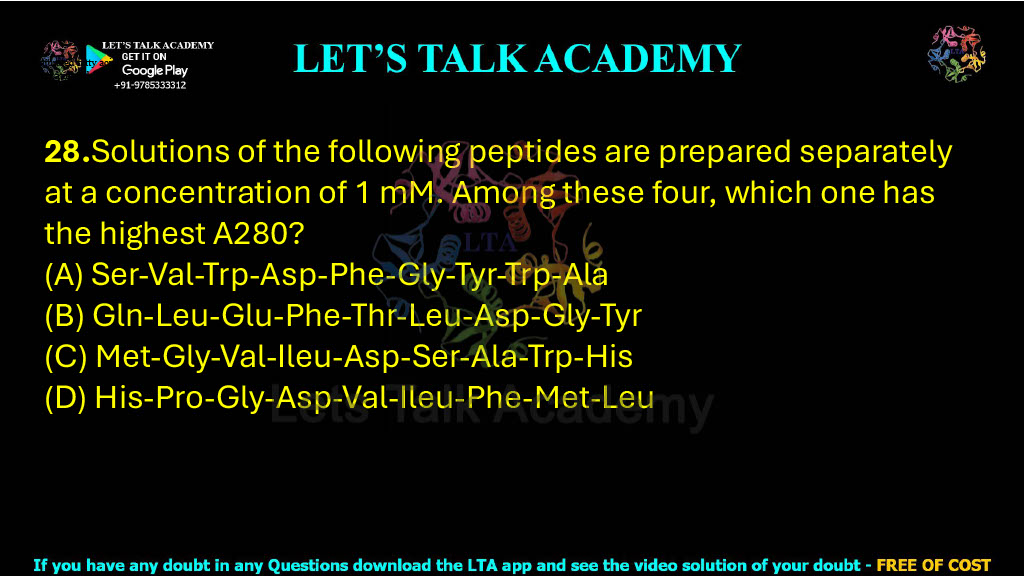
28.Solutions of the following peptides are prepared separately at a concentration of 1 mM. Among these four, which one has the highest A280?
(A) Ser-Val-Trp-Asp-Phe-Gly-Tyr-Trp-Ala
(B) Gln-Leu-Glu-Phe-Thr-Leu-Asp-Gly-Tyr
(C) Met-Gly-Val-Ileu-Asp-Ser-Ala-Trp-His
(D) His-Pro-Gly-Asp-Val-Ileu-Phe-Met-Leu
Which Peptide Has the Highest Absorbance at 280 nm (A280)? | Complete UV Spectroscopy
Correct Answer
(A) Ser–Val–Trp–Asp–Phe–Gly–Tyr–Trp–Ala
Introduction
Ultraviolet (UV) spectroscopy is one of the most widely used analytical techniques in biochemistry for determining the concentration and purity of proteins. Most proteins absorb ultraviolet light strongly at 280 nm (A280) because certain aromatic amino acids contain conjugated ring structures capable of absorbing UV radiation. This property allows researchers to estimate protein concentration rapidly without requiring additional chemical reagents.
Among the twenty standard amino acids, tryptophan (Trp) contributes the greatest absorbance at 280 nm, followed by tyrosine (Tyr). Phenylalanine (Phe) absorbs only weakly at this wavelength and contributes very little to the overall absorbance. Consequently, the absorbance of a peptide depends primarily on the number of tryptophan and tyrosine residues present in its sequence. Questions based on A280 are frequently asked in CSIR NET Life Sciences, GATE Biotechnology, IIT JAM, CUET PG, NEET PG, and university examinations because they test both protein chemistry and UV spectroscopy concepts.
Understanding the Concept Behind the Question
The question states that all peptide solutions are prepared at the same concentration (1 mM). Therefore, concentration is identical for every peptide, and the only factor determining the absorbance is the number and type of aromatic amino acids capable of absorbing UV light.
The relative contribution of aromatic amino acids to absorbance at 280 nm is approximately:
- Tryptophan (Trp) → Very high absorbance
- Tyrosine (Tyr) → Moderate absorbance
- Phenylalanine (Phe) → Very weak absorbance
Thus, peptides containing more tryptophan residues will exhibit higher A280 values than peptides containing only tyrosine or phenylalanine.
Why Option (A) Is Correct
Ser–Val–Trp–Asp–Phe–Gly–Tyr–Trp–Ala
This peptide contains:
- 2 Tryptophan (Trp)
- 1 Tyrosine (Tyr)
- 1 Phenylalanine (Phe)
Among these aromatic amino acids, tryptophan contributes the largest extinction coefficient at 280 nm. Since this peptide contains two tryptophan residues, it absorbs significantly more ultraviolet light than any other option.
The presence of one tyrosine residue further increases its absorbance, while phenylalanine contributes only minimally.
Because this peptide possesses the largest total aromatic absorbance, it exhibits the highest A280.
Therefore,
Option (A) is correct.
Why Option (B) Is Incorrect
Gln–Leu–Glu–Phe–Thr–Leu–Asp–Gly–Tyr
This peptide contains:
- 0 Tryptophan
- 1 Tyrosine
- 1 Phenylalanine
Although tyrosine contributes moderate absorbance, the absence of tryptophan greatly reduces the overall A280.
Since tryptophan is the dominant contributor to protein absorbance at 280 nm, this peptide cannot compete with Option (A), which contains two tryptophan residues.
Therefore,
Option (B) is incorrect.
Why Option (C) Is Incorrect
Met–Gly–Val–Ile–Asp–Ser–Ala–Trp–His
This peptide contains:
- 1 Tryptophan
- 0 Tyrosine
- 0 Phenylalanine
The single tryptophan residue contributes strongly to UV absorption, making this peptide more absorbent than peptides lacking tryptophan.
However, Option (A) contains two tryptophan residues and one tyrosine, giving it a substantially larger extinction coefficient.
Therefore,
Option (C) is incorrect.
Why Option (D) Is Incorrect
His–Pro–Gly–Asp–Val–Ile–Phe–Met–Leu
This peptide contains:
- 0 Tryptophan
- 0 Tyrosine
- 1 Phenylalanine
Phenylalanine absorbs only weakly at 280 nm because its aromatic ring has a much lower extinction coefficient than tryptophan or tyrosine.
Consequently, this peptide exhibits the lowest absorbance among the four options.
Therefore,
Option (D) is incorrect.
Relative UV Absorbance of Aromatic Amino Acids
The ability of aromatic amino acids to absorb ultraviolet light depends on their conjugated ring systems.
| Amino Acid | Relative Absorbance at 280 nm |
|---|---|
| Tryptophan (Trp) | Very High |
| Tyrosine (Tyr) | Moderate |
| Phenylalanine (Phe) | Very Low |
Thus,
Trp >> Tyr >> Phe
This order is one of the highest-yield facts in protein chemistry.
Comparison of the Four Peptides
| Option | Trp | Tyr | Phe | Relative A280 |
|---|---|---|---|---|
| A | 2 | 1 | 1 | Highest |
| B | 0 | 1 | 1 | Moderate |
| C | 1 | 0 | 0 | High |
| D | 0 | 0 | 1 | Lowest |
Option A clearly contains the greatest number of UV-absorbing aromatic residues, especially two tryptophan molecules, making it the peptide with the highest absorbance.
Biological Importance of A280 Measurements
Measurement of absorbance at 280 nm is one of the simplest and fastest methods for estimating protein concentration in biochemical laboratories. According to the Beer–Lambert law, absorbance is directly proportional to protein concentration, provided the extinction coefficient is known.
Because tryptophan and tyrosine dominate UV absorption, proteins rich in these residues exhibit higher absorbance than proteins containing few aromatic amino acids. Researchers routinely use spectrophotometers to determine protein concentration during enzyme purification, recombinant protein production, structural biology, and pharmaceutical research.
Beer–Lambert Law
Protein absorbance follows the Beer–Lambert equation:
A = εcl
where:
- A = Absorbance
- ε = Molar extinction coefficient
- c = Concentration
- l = Path length
Since all peptide solutions have the same concentration (1 mM) and are measured using the same cuvette, the only variable affecting absorbance is the extinction coefficient, which depends on aromatic amino acid composition.
High-Yield Points
- Proteins are commonly quantified at 280 nm.
- Tryptophan is the strongest UV absorber.
- Tyrosine contributes moderate absorbance.
- Phenylalanine contributes only weak absorbance.
- Histidine is not considered a major contributor to A280.
-
Beer–Lambert Law:
A = εcl
Frequently Asked Questions
Why does tryptophan absorb more strongly than tyrosine?
Tryptophan possesses a larger conjugated indole ring system, resulting in a much higher molar extinction coefficient at 280 nm than tyrosine or phenylalanine.
Why isn’t phenylalanine a major contributor?
Although phenylalanine contains an aromatic benzene ring, its extinction coefficient at 280 nm is very low compared with tryptophan and tyrosine.
Why are all peptide concentrations given as 1 mM?
Keeping the concentration constant ensures that differences in absorbance arise solely from differences in amino acid composition rather than sample concentration.
Key Takeaways
Protein absorbance at 280 nm depends primarily on the presence of tryptophan and, to a lesser extent, tyrosine. Phenylalanine contributes only weakly to UV absorption. Since all peptide solutions are prepared at the same concentration, the peptide containing the greatest number of tryptophan residues will exhibit the highest A280. Among the given sequences, Option (A) contains two tryptophan residues, one tyrosine, and one phenylalanine, giving it the largest overall extinction coefficient and the highest absorbance.
Final Answer
Correct Option: (A) Ser–Val–Trp–Asp–Phe–Gly–Tyr–Trp–Ala
Explanation
The absorbance of proteins at 280 nm (A280) depends mainly on the aromatic amino acids tryptophan, tyrosine, and to a much lesser extent phenylalanine. Tryptophan has the highest molar extinction coefficient, followed by tyrosine, while phenylalanine contributes only minimally. Among the given peptides, Option (A) contains two tryptophan residues, one tyrosine, and one phenylalanine, giving it the greatest total UV absorbance. Since all peptide solutions are present at the same concentration (1 mM), the peptide with the largest number of strongly absorbing aromatic residues will have the highest A280. Therefore, Option (A) is the correct answer.


