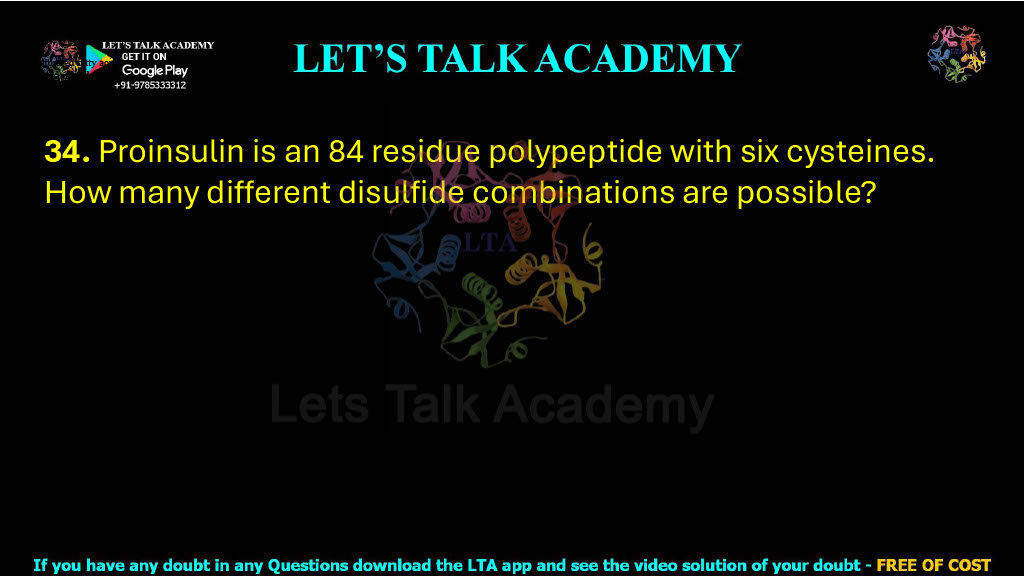
34. Proinsulin is an 84 residue polypeptide with six cysteines. How many different disulfide combinations are possible?
How Many Different Disulfide Bond Combinations Are Possible in Proinsulin? | Complete Combinatorial Biochemistry
Correct Answer
15 different disulfide bond combinations
Introduction
Disulfide bonds are among the most important covalent interactions responsible for stabilizing the three-dimensional structure of proteins. They are formed by the oxidation of the sulfhydryl (-SH) groups of two cysteine residues, producing a covalent disulfide bridge (-S-S-). These bonds play a crucial role in maintaining protein stability, facilitating proper folding, and preserving biological activity under both intracellular and extracellular conditions.
One of the best-known proteins containing disulfide bonds is insulin. During its biosynthesis, insulin is first synthesized as proinsulin, an 84-amino acid precursor containing six cysteine residues. These six cysteines ultimately form three disulfide bonds, two of which remain in mature insulin after removal of the connecting C-peptide.
Understanding the Concept Behind the Question
Each disulfide bond requires two cysteine residues.
Since proinsulin contains:
6 cysteine residues
the total number of disulfide bonds formed is:
6 ÷ 2 = 3 disulfide bonds
The question asks for the number of different possible pairing arrangements, not the number of bonds.
This is a standard combinatorial problem.
The number of ways to pair 2n objects into n pairs is given by:
Number of pairings = (2n)! / [2ⁿ × n!]
For six cysteines,
n = 3
Therefore,
Number of combinations = 6! / (2³ × 3!)
Step-by-Step Calculation
Step 1. Write the formula
Number of disulfide combinations = (2n)! / [2ⁿ × n!]
Step 2. Substitute the values
Since there are 6 cysteines,
n = 3
Therefore,
Number of combinations = 6! / (2³ × 3!)
Step 3. Expand factorials
6! = 720
2³ = 8
3! = 6
Substituting,
Number of combinations = 720 / (8 × 6)
Step 4. Simplify
8 × 6 = 48
Therefore,
Number of combinations = 720 / 48
= 15
Final Calculation
Number of possible disulfide bond combinations = 15
Why Is This Formula Used?
The formula
(2n)! / [2ⁿ × n!]
counts the number of unique ways of dividing 2n objects into n unordered pairs.
The denominator removes duplicate counting because:
- Each pair can be written in two orders.
- The order of different pairs does not matter.
Thus, every unique disulfide bonding arrangement is counted exactly once.
Biological Importance of Disulfide Bonds
Disulfide bridges stabilize the tertiary and quaternary structures of proteins by covalently linking different regions of the polypeptide chain or even different protein chains. These bonds are especially common in extracellular proteins because the oxidizing extracellular environment favors their formation.
In proinsulin, six cysteine residues form three disulfide bridges during protein folding. Proper disulfide bond formation is essential because incorrect pairing results in misfolded proteins that lose biological activity. Molecular chaperones and protein disulfide isomerase (PDI) help ensure that the correct disulfide bonds form during protein maturation in the endoplasmic reticulum.
Proinsulin and Mature Insulin
Proinsulin consists of:
- A-chain
- B-chain
- Connecting peptide (C-peptide)
After folding:
- Three disulfide bonds are formed.
- The C-peptide is removed.
- Mature insulin retains:
- Two interchain disulfide bonds
- One intrachain disulfide bond
Thus, although fifteen theoretical pairing combinations are possible, only one specific arrangement produces biologically active insulin.
General Formula for Disulfide Pairing
| Number of Cysteines | Possible Pairings |
|---|---|
| 2 | 1 |
| 4 | 3 |
| 6 | 15 |
| 8 | 105 |
| 10 | 945 |
This sequence is frequently tested in competitive examinations.
High-Yield Points
- Disulfide bonds form only between cysteine residues.
- Six cysteines produce three disulfide bonds.
-
Number of pairing combinations:
(2n)! / [2ⁿ × n!]
-
For six cysteines:
15 possible pairings
- Mature insulin contains three disulfide bridges.
- Protein Disulfide Isomerase (PDI) assists correct bond formation.
Frequently Asked Questions
Why are there 15 combinations and not 3?
Three is the number of disulfide bonds formed, whereas fifteen is the number of possible ways the six cysteine residues can pair to form those three bonds.
Why is only one arrangement found in insulin?
Although many theoretical combinations exist, protein folding and enzymatic assistance ensure that only the biologically functional disulfide pattern is formed during insulin maturation.
Which enzyme helps form correct disulfide bonds?
Protein Disulfide Isomerase (PDI) catalyzes the formation, breakage, and rearrangement of disulfide bonds in the endoplasmic reticulum.
Key Takeaways
Proinsulin contains six cysteine residues, which pair to form three disulfide bridges. However, the number of possible pairing arrangements is determined using the combinatorial formula (2n)! / [2ⁿ × n!], where n is the number of disulfide bonds. Substituting n = 3 gives 15 possible disulfide bond combinations. Although only one arrangement yields biologically active insulin, understanding this combinatorial calculation is essential for protein chemistry and competitive examinations.
Final Answer
Correct Answer: 15
Explanation
Proinsulin contains six cysteine residues, and every disulfide bond requires two cysteines, resulting in three disulfide bridges. The number of different ways to pair six cysteines into three disulfide bonds is calculated using the formula:
Number of pairings = (2n)! / [2ⁿ × n!]
where n = 3.
Therefore,
Number of pairings = 6! / (2³ × 3!)
= 720 / (8 × 6)
= 720 / 48
= 15
Thus, 15 different disulfide bond combinations are theoretically possible, making 15 the correct answer.


