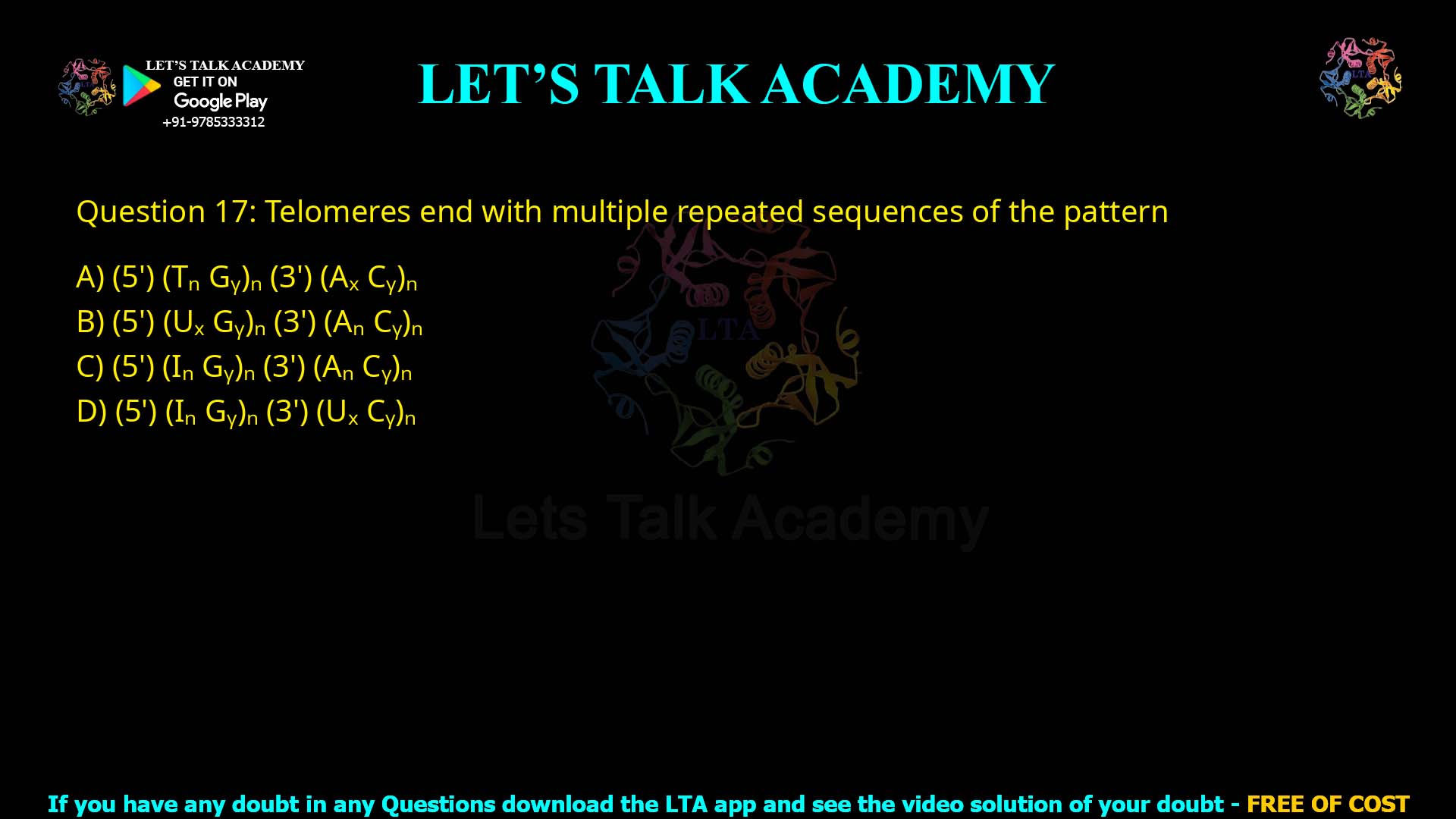
Q.17 Telomeres end with multiple repeated sequences of the pattern
(5‘) (Tn Gy)n
(3‘) (Ax Cy)n
(5‘) (Ux Gy)n
(3‘) (An Cy)n
(5‘) (In Gy)n
(3‘) (An Cy)n
(5‘) (In Gy)n
(3‘) (Ux Cy)n
Telomeres end with multiple repeated sequences of the pattern (5′) (TTGGGG)n / (3′) (AACCCC)n, but among options, (1) (5′) (Tn Gy)n / (3′) (Ax Cy)n matches the standard notation where T=Tthymine, G=guanine, A=adenine, C=cytosine. Human telomeres specifically repeat 5′-TTAGGG-3′ on the G-rich strand (3′-AATCCC-5′ complementary), fitting the T/G and A/C pattern generally across eukaryotes.
Option Analysis
-
(1) (5′) (Tn Gy)n / (3′) (Ax Cy)n: Correct—Standard telomere notation: G-rich strand (5′-T/G repeats), C-rich complementary (3′-A/C repeats). Human: TTAGGG/AATCCC; Tetrahymena: TTGGGG/AAACCC; Arabidopsis: TTTAGGG/AATCCC.
-
(2) (5′) (Ux Gy)n / (3′) (An Cy)n: Wrong—U=uracil belongs to RNA, not DNA telomeres which use T=thymine.
-
(3) (5′) (In Gy)n / (3′) (An Cy)n: Wrong—I=inosine (deaminated base) not found in natural telomere repeats.
-
(4) (5′) (In Gy)n / (3′) (Ux Cy)n: Wrong—Combines nonexistent inosine (I) with RNA uracil (U).
Answer: (1).
Introduction to Telomere Sequence Pattern
Telomeres end with multiple repeated sequences of the pattern (5′) (Tn Gy)n on G-rich strand, (3′) (Ax Cy)n on C-rich strand. Humans: 5,000-15,000 TTAGGG repeats protect chromosome ends from erosion and fusion.
Universal Telomere Repeats Explained
-
Human/mammals: 5′-TTAGGG-3’n (G-rich); 3′-AATCCC-5’n (C-rich)
-
Yeast: TG(1-3)
-
Tetrahymena: TTGGGG/AAACCC
All follow T-rich/G-rich and complementary A-rich/C-rich pattern, option (1).
Why Other Options Fail
U=uracil (RNA-specific), I=inosine (rare, modified base)—neither occurs in genomic telomere DNA. Only DNA bases T/A/G/C fit natural repeats.
GATE Molecular Biology Relevance
Tests telomere structure recognition: TnGy/AxCy notation vs. RNA confusers. Essential for chromosome end-replication problem, telomerase questions.


