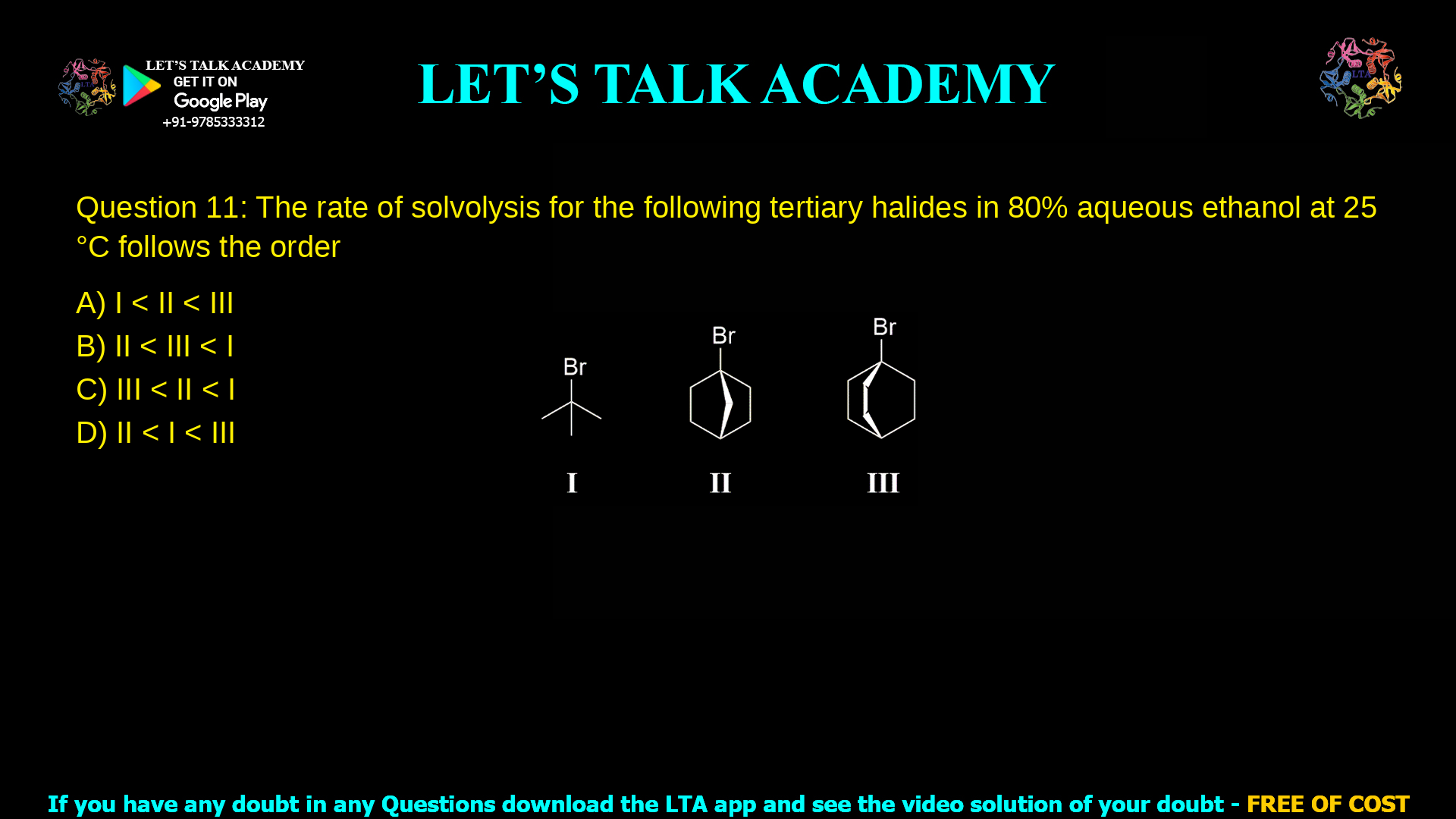
Q.11 The rate of solvolysis for the following tertiary halides in 80% aqueous ethanol at
25 °C follows the order
(A) I < II < III
(B) II < III < I
(C) III < II < I
(D) II < I < III
The rate of solvolysis of the three tertiary bromides in 80% aqueous ethanol at 25 °C follows the order II < III < I, so the correct option is (B).
Introduction
Solvolysis of tertiary halides in 80% aqueous ethanol is a classic SN1 reaction where the rate is governed by the stability of the carbocation formed after loss of the halide ion. In this question the three tertiary bromides are tert‑butyl bromide (I), endo‑2‑bromonorbornane (II), and exo‑2‑bromonorbornane (III), and comparing their solvolysis rates illustrates how structure, bridgehead geometry, and anchimeric assistance control SN1 kinetics.
Structures and carbocations formed
-
Compound I – tert‑butyl bromide:
-
On ionization it forms a classical tertiary carbocation (CH3)3C+, which is highly stabilized by strong +I effect and extensive hyperconjugation from three methyl groups.
-
-
Compound II – endo‑2‑bromonorbornane:
-
C–Br is at a bridgehead carbon pointing toward the “endo” side; ionization would give a bridgehead carbocation that violates Bredt’s rule and is strongly destabilized.
-
-
Compound III – exo‑2‑bromonorbornane:
-
C–Br is at the bridgehead but points “exo”; ionization leads toward the famous 2‑norbornyl cation where the neighboring C–C bonds can offer partial anchimeric assistance, making it more stable than the endo cation but still less stable than tert‑butyl.
-
Because solvolysis in aqueous ethanol proceeds by an SN1 pathway, the rate‑determining step is carbocation formation; hence more stable carbocations give faster solvolysis.
Correct order: II < III < I (Option B)
-
Slowest – II (endo‑2‑bromonorbornane):
-
Formation of a bridgehead carbocation without effective neighboring‑group participation is highly unfavorable, so ionization is extremely slow and solvolysis rate is the lowest.
-
-
Intermediate – III (exo‑2‑bromonorbornane):
-
Exo geometry allows better overlap of the C1–C2 and C2–C6 bonds with the empty p‑orbital, giving some anchimeric assistance and a more delocalized 2‑norbornyl cation, so solvolysis is faster than II but still slower than an ordinary tertiary carbocation.
-
-
Fastest – I (tert‑butyl bromide):
-
Generates the most stable classical tertiary carbocation with strong hyperconjugative and inductive stabilization, so it solvolyzes the fastest in 80% aqueous ethanol.
-
Therefore, the observed rate order is II < III < I, matching Option (B).
Why the other options are wrong
-
Option (A) I < II < III:
-
Claims tert‑butyl bromide is slowest, which contradicts the high stability of its tertiary carbocation and abundant kinetic data showing it solvolyzes very rapidly in polar protic solvents.
-
-
Option (C) III < II < I:
-
Places exo‑norbornyl slower than endo, but anchimeric assistance makes the exo isomer significantly faster; experimentally, exo derivatives solvolyze much more rapidly than corresponding endo derivatives.
-
-
Option (D) II < I < III:
-
Suggests exo is fastest, but even with neighboring‑group participation the bridged 2‑norbornyl cation is less stabilized than the simple tert‑butyl tertiary carbocation, so III cannot outrun I in 80% aqueous ethanol.
-
Key takeaway for exam preparation
When comparing rates of solvolysis of tertiary halides in 80% aqueous ethanol, always:
-
Identify the carbocation generated in the SN1 step and rank its stability via hyperconjugation, inductive effects, resonance, and ring strain.
-
Remember that bridged systems like norbornyl may show anchimeric assistance, but highly strained bridgehead carbocations (especially endo) are still less stable than ordinary tertiary carbocations, giving the characteristic order endo < exo < simple tertiary as seen here (II < III < I).


