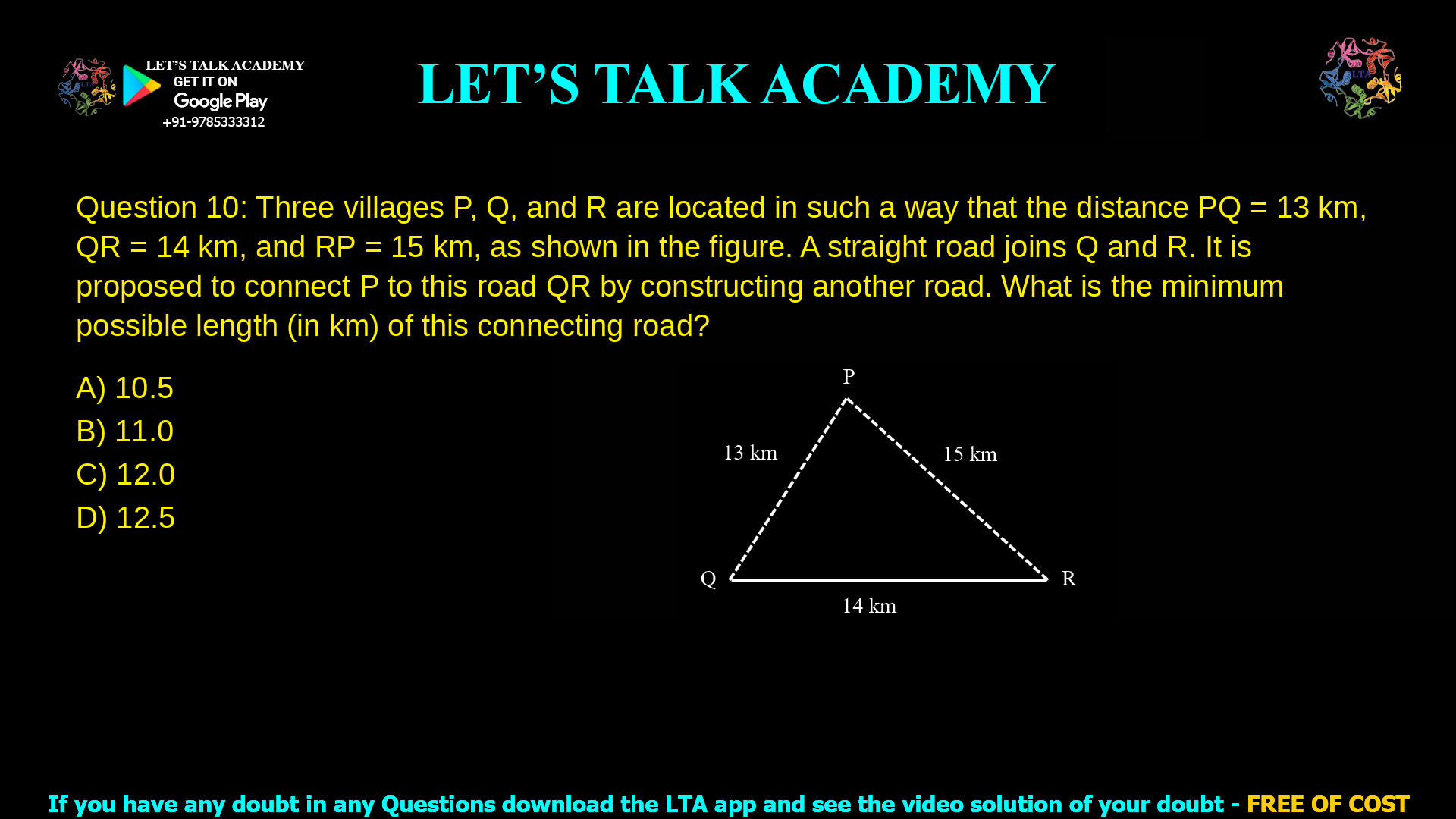
Q.10 Three villages P, Q, and R are located in such a way that the distance PQ = 13 km,
QR = 14 km, and RP = 15 km, as shown in the figure. A straight road joins Q and
R. It is proposed to connect P to this road QR by constructing another road. What
is the minimum possible length (in km) of this connecting road?
Note: The figure shown is representative.
(A) 10.5
(B) 11.0
(C) 12.0
(D) 12.5
Triangle data and strategy
- Sides of triangle PQR: PQ = 13 km, QR = 14 km, PR = 15 km.
- A straight road already exists along segment QR; the shortest road from P to this line is the perpendicular from P to QR.
- The problem reduces to finding the altitude from P to side QR in a triangle with sides 13, 14, and 15.
Step 1 – Area of triangle PQR (Heron’s formula)
- Semi‑perimeter:
\( s = \frac{13 + 14 + 15}{2} = 21 \) - Area using Heron’s formula:
\( \Delta = \sqrt{21(21-13)(21-14)(21-15)} = \sqrt{21 \times 8 \times 7 \times 6} = \sqrt{7056} = 84\ \text{km}^2 \)
The area of triangle PQR is therefore 84 square kilometres.
Step 2 – Altitude from P to QR
Let \( h \) be the perpendicular distance from P to QR, i.e., the length of the proposed connecting road.
- Area in terms of base QR and height \( h \):
\( \Delta = \frac{1}{2} \times 14 \times h = 7h \) - Equating with the known area 84 km²:
\( 7h = 84 \Rightarrow h = 12\ \text{km} \)
Hence, the minimum possible length of the connecting road from P to QR is 12 km.
Explanation of every option
- (A) 10.5 km – Too small. Area would be \( \frac{1}{2} \times 14 \times 10.5 = 73.5\ \text{km}^2 \), which is less than the required 84 km².
- (B) 11.0 km – Also too small. Area would be \( \frac{1}{2} \times 14 \times 11 = 77\ \text{km}^2 \).
- (C) 12.0 km – Correct. Area is \( \frac{1}{2} \times 14 \times 12 = 84\ \text{km}^2 \), matching the Heron’s‑formula area.
- (D) 12.5 km – Too large. Area would be \( \frac{1}{2} \times 14 \times 12.5 = 87.5\ \text{km}^2 \), impossible for sides 13, 14, 15.
Introduction (SEO optimized)
Competitive exams like CSIR NET, GATE, and other aptitude tests frequently ask geometry questions based on triangles, distances, and optimization, such as finding the minimum length of connecting road in triangle with sides 13 14 15. Understanding how to use Heron’s formula and the relation between area, base, and height makes these problems straightforward and highly scoring.
Conceptual takeaways for exams
- In optimization problems involving distances from a point to a line segment, always consider the perpendicular distance as the minimum.
- For a triangle with known side lengths, combining Heron’s formula with the base–height relation is a powerful way to find altitudes without trigonometry.
- The 13–14–15 triangle is a classic non‑right‑angled triangle used in aptitude exams, so remembering that its area is 84 can save time in calculations.


1 Comment
Bhanwar
January 20, 2026QR is 12 km☑️