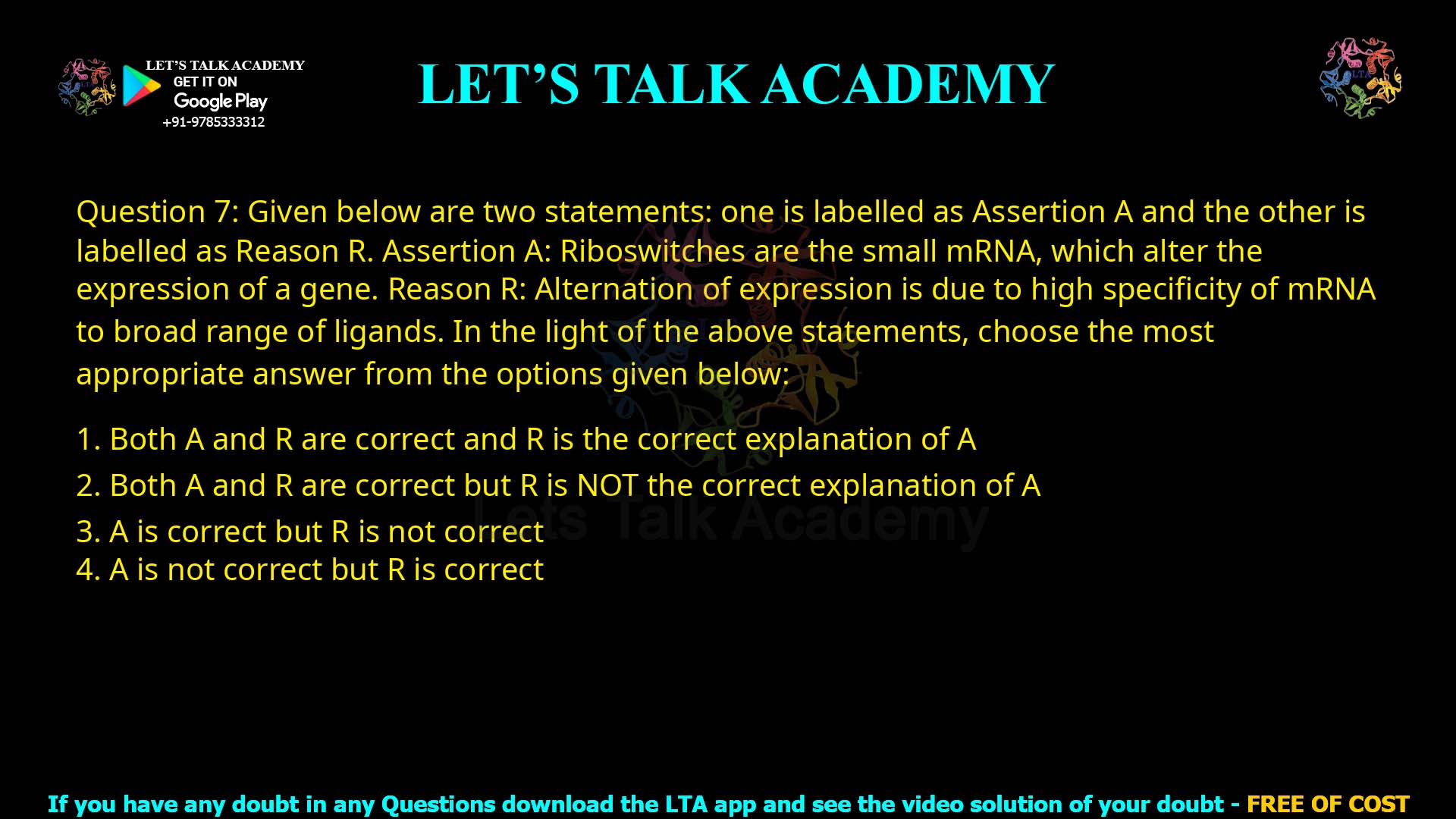
A is correct but R is not correct. Riboswitches are structured mRNA elements that regulate gene expression by binding specific ligands, but their high specificity targets individual metabolites, not a broad range.
Question Breakdown
This assertion-reason question evaluates riboswitch mechanism understanding. Assertion A describes their function accurately, while Reason R misstates ligand specificity – riboswitches bind one cognate ligand with high precision, causing conformational switches (aptamer + expression platform) for transcription/translation control.
Option Analysis
Both A and R correct, R explains A
Incorrect. While A holds, R’s “broad range of ligands” contradicts riboswitch specificity (e.g., TPP riboswitch binds only thiamine pyrophosphate).
Both A and R correct, but R not explanation
Incorrect. R is factually wrong; riboswitches evolved narrow specificity for single metabolites like SAM, FMN, or glycine.
A correct but R not correct
Correct. A matches riboswitch definition (mRNA elements altering gene expression via ligand-induced folding). R fails as specificity is to specific ligands, not broad ones; broad binding would abolish regulation.
A not correct but R correct
Incorrect. A is accurate; R is not.
Riboswitches assertion reason questions test if mRNA elements regulating genes via specific ligand binding are understood. Assertion A correctly identifies riboswitches as structured mRNAs altering expression, but Reason R wrongly claims broad ligand specificity.
Riboswitch Mechanism
Riboswitches comprise aptamer (ligand-binding) and expression platform domains:
-
Ligand binds aptamer → Conformational switch.
-
High specificity to one metabolite (e.g., TPP, c-di-GMP).
-
Regulates via termination, RBS sequestration, or splicing.
Broad binding (per R) would prevent precise feedback; evolution selected narrow pockets.
Why R Fails
Specificity ensures metabolic homeostasis (e.g., TPP riboswitch shuts off biosynthesis at high TPP). Broad range would mimic promiscuous aptamers, useless for regulation.
| Option |
Status |
Explanation |
| 1. Both correct, R explains |
Wrong |
R contradicts specificity |
| 2. Both correct, R not explains |
Wrong |
R factually false |
| 3. A correct, R not |
Correct |
Matches mechanism |
| 4. A wrong, R correct |
Wrong |
A accurate |