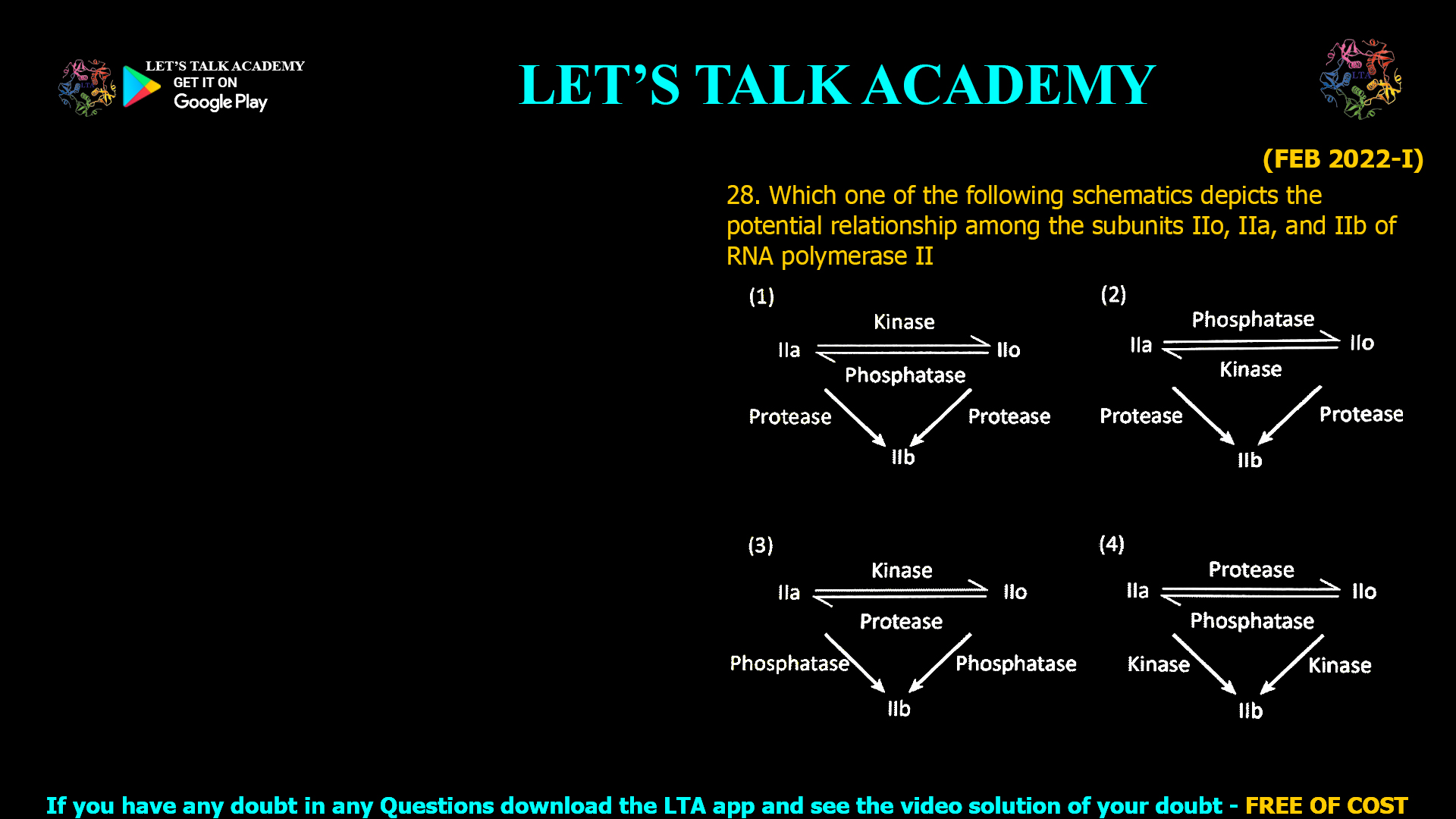
Which one of the following schematics depicts the potential relationship among the subunits IIo, IIa, and IIb of RNA polymerase II

Relationship Among RNA Polymerase II Subunits IIo, IIa, and IIb
Correct is One :
-
RNA polymerase II exists in multiple forms distinguished by the phosphorylation status and structural integrity of the largest subunit (RPB1), particularly its C-terminal domain (CTD).
-
The three forms—IIa, IIo, and IIb—are related as follows:
-
IIa: The unphosphorylated form of RNA polymerase II, containing the full-length CTD.
-
IIo: The phosphorylated form of RNA polymerase II, generated from IIa by the action of kinases that phosphorylate serine residues in the CTD heptapeptide repeats. This phosphorylation is crucial for transcription initiation and elongation.
-
IIb: A form lacking the CTD, produced by proteolytic cleavage (protease action) of either IIa or IIo, resulting in removal of the repetitive CTD region.
-
-
The conversions are reversible between IIa and IIo via kinases and phosphatases, while IIb formation is irreversible proteolytic cleavage.
Summary of the Relationship:
| Form | Description | Conversion Mechanism |
|---|---|---|
| IIa | Unphosphorylated RNA Pol II | Phosphorylated by kinases → IIo |
| IIo | Phosphorylated RNA Pol II | Dephosphorylated by phosphatases → IIa |
| IIb | CTD-truncated RNA Pol II | Proteolytic cleavage of IIa or IIo → IIb |
Why This Is Important:
-
The phosphorylation state of the CTD regulates RNA polymerase II activity during transcription cycles.
-
The CTD is essential for recruiting RNA processing factors and coordinating transcription with RNA processing.
-
Removal of the CTD (IIb form) alters polymerase function and is typically observed under specific in vitro conditions.
References Supporting This Explanation:
-
The largest subunit of RNA polymerase II contains a CTD that is unphosphorylated in IIa, phosphorylated in IIo, and absent in IIb.
-
Kinases phosphorylate IIa to form IIo; phosphatases reverse this. Proteases cleave IIa or IIo to form IIb .
-
The three forms are products of a single gene, differing by post-translational modifications and proteolysis.
Conclusion
The potential relationship among RNA polymerase II subunits IIo, IIa, and IIb is that IIa and IIo differ by phosphorylation of the CTD, interconverted by kinases and phosphatases, while IIb is a truncated form lacking the CTD produced by proteolytic cleavage of IIa or IIo.


17 Comments
Suman bhakar
June 2, 2025Done sir ✅
Lokesh kumawat
June 2, 2025Done
Neelam Sharma
October 31, 2025IIa dephosphorylated usko IIo change krta h phosphatase by
IIa se IIo me change hota h by kinase
IIb is cleavase
Santosh Saini
November 3, 2025IIa ( unphosphorylated RNA polymerase II) convert into II0 in the presence of kinase, and II0( phosphorylated RNA polymerase II) convert into IIa in the presence of phosphatase , while IIb (CTD truncate RNA polymerase II) is irreversible proteolytic cleavage formed by IIa and II0
MOHIT AKHAND
November 3, 2025Option (A) : The inactive form of RNA polymerase II (IIa) is activated by phosphorylation at carboxyl terminal domain by kinase to form RNA polymerase IIo. This active form is again converted to inactive form by De-phoshorylation using phosphatase.These both complexes can be degraded by proteases.
Divya rani
November 3, 20251st is correct because lla is a unphosphorylated form of RNA pol ll .
IIo is phosphorylated form and it generated from IIa by the kinase .
IIb is produced by protease action of either lla or L lo resulting in removal of the repetitive CTD regions.
Rishita
November 3, 2025Done sir 👍🏻… 1 st is correct answer
Sakshi yadav
November 3, 20251.is correct
Sonam Saini
November 3, 2025Right answer A
Dipti Sharma
November 3, 2025RNA polymerase II exists in multiple forms :
lla is unphosphorylated form
ll0 is phosphorylated form
llb forms from proteolytic cleavage
Shivani
November 3, 2025lla is unphosphorylated form
ll0 is phosphorylated form
llb forms from proteolytic cleavage of lla and llo
Neha Yadav
November 3, 2025lla is unphosphorylated form
ll0 is phosphorylated form
llb forms from proteolytic cleavage of lla and llo
Anjali sharma
November 4, 2025Option a is correct
Preeti sharma
November 4, 2025Option 1st is correct
Deepika Sheoran
November 4, 2025Option A is correct answer .
Sakshi Kanwar
November 7, 2025lla is unphosphorylated form so here kinase is used
ll0 is phosphorylated form so here phosphatase is used
llb forms from proteolytic cleavage of lla
Muskan Yadav
November 12, 2025Ia and IIo differ by phosphorylation of the CTD, interconverted by kinases and phosphatases, while IIb is a truncated form lacking the CTD produced by proteolytic cleavage of IIa or IIo.