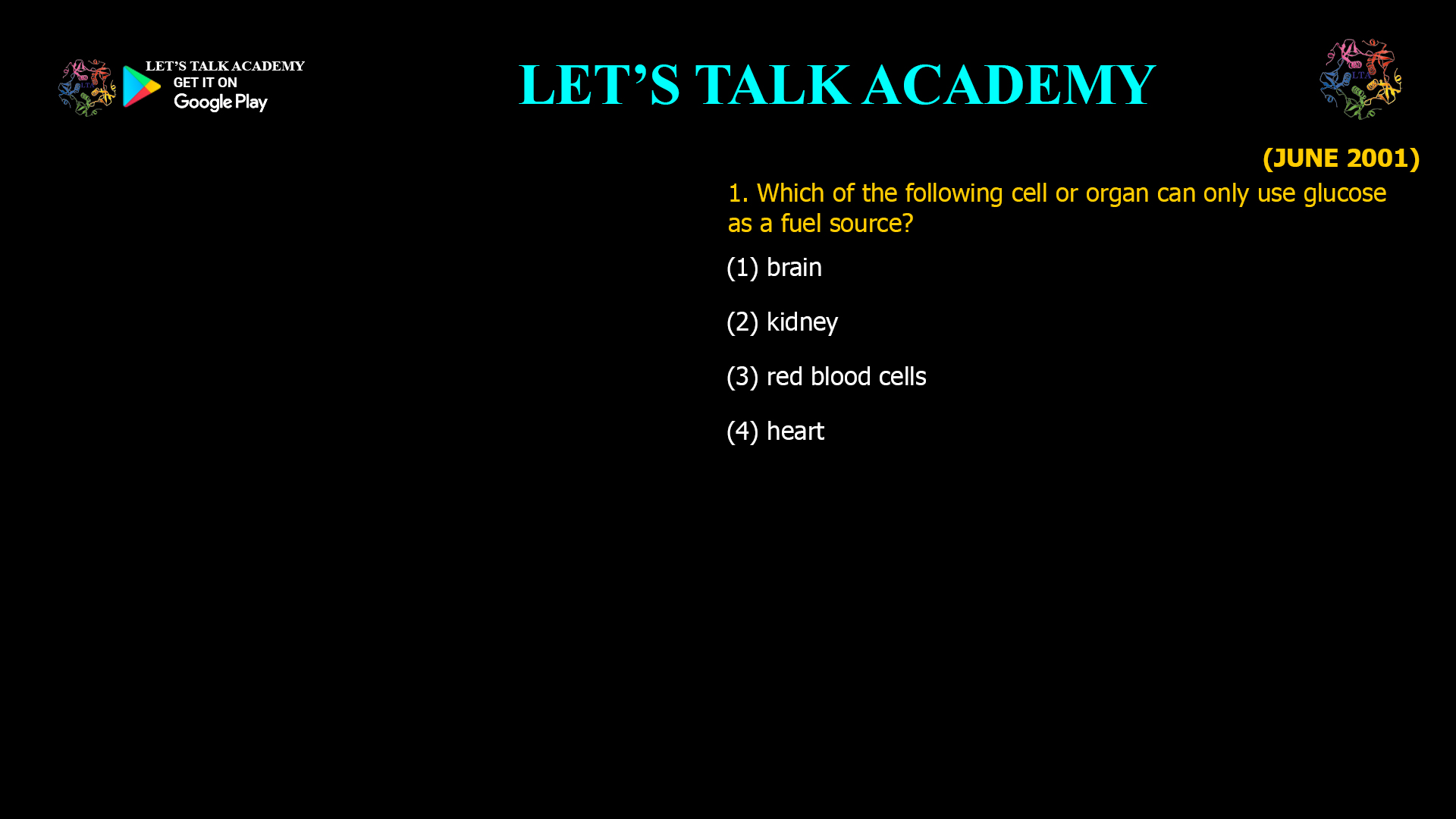
- Which of the following cell or organ can only use glucose as a fuel source?
(1) brain (2) kidney
(3) red blood cells (4) heart
Energy metabolism varies widely among different cells and organs in the human body. While many tissues can utilize a variety of substrates such as glucose, fatty acids, and ketone bodies, some cells have a strict dependency on a single fuel source. Among these, red blood cells (RBCs) are unique in their exclusive reliance on glucose for energy production. This article explores why RBCs depend solely on glucose, how they metabolize it, and contrasts this with the metabolic flexibility of other organs like the brain, kidney, and heart.
Why Do Red Blood Cells Use Only Glucose?
Red blood cells are highly specialized cells whose primary function is to transport oxygen throughout the body. To maintain their shape, flexibility, and function, RBCs require a steady supply of energy. However, unlike most other cells, mature human red blood cells lack mitochondria. This absence is critical because mitochondria are the site of oxidative phosphorylation, where most ATP is generated from various substrates including fatty acids and ketone bodies.
Without mitochondria, RBCs cannot perform aerobic respiration or oxidize fatty acids and ketones. Instead, they rely exclusively on anaerobic glycolysis, a pathway that metabolizes glucose to lactate, generating ATP without the need for oxygen or mitochondria.
Glucose Metabolism in Red Blood Cells
The metabolism of glucose in RBCs involves two main pathways:
-
Embden-Meyerhof Pathway (Glycolysis):
The primary route where glucose is converted into pyruvate and then lactate, producing 2 ATP molecules per glucose molecule. This anaerobic pathway supplies the energy needed for RBC functions such as maintaining membrane integrity, ion balance, and hemoglobin function. -
Pentose Phosphate Pathway (PPP):
A secondary pathway that oxidizes glucose to generate NADPH, which is essential for protecting RBCs against oxidative damage. NADPH maintains glutathione in its reduced form, a critical antioxidant defense mechanism.
Approximately 90% of glucose entering RBCs is metabolized via glycolysis, while 10% is shunted through the PPP to support antioxidant functions.
Importance of Exclusive Glucose Use in RBCs
-
Energy Production Without Oxygen:
Since RBCs transport oxygen, it is paradoxical but essential that they do not consume oxygen themselves for energy. Anaerobic glycolysis allows RBCs to generate ATP without using the oxygen they carry. -
Maintenance of Cell Shape and Flexibility:
ATP produced from glycolysis powers ion pumps and cytoskeletal proteins, preserving the biconcave shape and deformability of RBCs necessary for navigating narrow capillaries. -
Protection Against Oxidative Stress:
The PPP provides NADPH to combat reactive oxygen species generated during oxygen transport, preventing damage to hemoglobin and the cell membrane.
Metabolic Flexibility of Other Organs
Unlike RBCs, organs such as the brain, kidney, and heart can utilize multiple fuel sources depending on availability and physiological conditions:
-
Brain:
Primarily uses glucose under normal conditions but can switch to ketone bodies during prolonged fasting or starvation. -
Kidney:
Uses glucose, fatty acids, and amino acids for energy, showing metabolic adaptability. -
Heart:
Prefers fatty acids but can also oxidize glucose and lactate; its metabolism changes with workload and oxygen availability.
This metabolic flexibility allows these organs to maintain function during varying nutritional and physiological states.
Glucose Transport in Red Blood Cells
RBCs express high levels of GLUT1, a glucose transporter that facilitates rapid glucose uptake even at low blood glucose concentrations. This ensures a continuous supply of glucose to meet their energy demands.
Summary Table: Fuel Utilization by Cells/Organs
Cell/Organ Fuel Source(s) Mitochondria Present Notes Red Blood Cells Glucose only No Anaerobic glycolysis only Brain Glucose (primary), ketone bodies Yes Can adapt to ketones during fasting Kidney Glucose, fatty acids, amino acids Yes Metabolically flexible Heart Fatty acids, glucose, lactate Yes Prefers fatty acids, adaptable
Conclusion
Among the options of brain, kidney, red blood cells, and heart, red blood cells are the only cells that exclusively use glucose as a fuel source. Their lack of mitochondria confines them to anaerobic glycolysis and the pentose phosphate pathway for ATP production and antioxidant defense. This specialization supports their critical role in oxygen transport without consuming the oxygen they carry.
Understanding this unique metabolic characteristic of RBCs highlights the diversity of energy metabolism strategies employed by different cell types to meet their physiological functions.
Final Answer:
(3) red blood cells -


43 Comments
Kirti Agarwal
September 18, 2025Only glucose is used by RBC because only RBC allows to generate ATP WITHOUT oxygen
Aakansha sharma Sharma
September 19, 2025RBC
Sonal nagar
September 20, 2025RBCs
Khushi Agarwal
September 20, 2025RBC ke paas mitochondria nahi → isliye fatty acid/ketone kaam nahi ← sirf glucose hi fuel
Neha Yadav
September 20, 2025RBC cell used glucose as a fuel source
Payal Solanki
September 21, 2025RBCs
Manisha choudhary
September 21, 2025RBC kaa primary function oxygen transporter h so oxygen ko consume nhi krega anaerobic glycolysis hota only Glucose ko kaam m lete h ATP production m 2ATP form hota h ek molecule s
PPP pathway bhi hota h jo ATP production and oxydative stress s protection deta h
Heart , fatty acid ko preference deta h pr oxygen supply other factors p bhi depend krta h
Soniya Shekhawat
September 21, 2025RBC Lake mitochondria and oxygen so does not occurring aerobic respiration so for energy source using as a glucose occuring the glycolysis anaerobic respiration.
Savita Garwa
September 21, 2025RBC cell used glucose as a fuel source
Minal Sethi
September 22, 2025RBC undergoes Glycolysis pathway so break down glucose to pyruvate generating energy in the form of ATP and PPP pathway is also used which is alternate to glycolysis for producing energy
Pallavi Ghangas
September 22, 2025RBC have only glucose are source of energy RBC lap mitochondria cannot generate ATP so it is dendant upon glycolysis and PPP pathway
Deepika sheoran
September 23, 2025Red blood cells
Meera gurjar
September 23, 2025Rbc
Heena Mahlawat
September 23, 2025Rbc
Dharmpal Swami
September 23, 2025Rbc are use only glucose for energy
HIMANI FAUJDAR
September 23, 2025Ans Red blood cells , are the only cells exclusively reliance on glucose for energy production or ATP production without oxygen or mitochondria.
Aafreen Khan
September 23, 2025Red Blood cells (RBC) use glucose as a fuel source of energy to produce ATP. Because RBC lacks mitochondria and organelles to produce ATP so it undergoes glycolysis While other tissues or organs like brain , kidney can utilizes other source like fatty acid and ketone bodies. Hence 3rd is correct answer
Deepika sheoran
September 23, 2025Red blood cells (RBC)
Anurag Giri
September 23, 2025Ans 3 because mature human red blood cells lack mitochondria
Priya dhakad
September 23, 2025Rbc are use only glucose for energy and lack mitochondria
Priti khandal
September 23, 2025Rbc are use only glucose for energy and lack of mitrochondia
Mohd juber Ali
September 24, 2025Option 3 red blood cell only use glucose as fuel source
Divya rani
September 24, 2025RBC use glucose as a fuel aur Energy source because mature rbc lack mitochondria so firstly They transport the oxygen and then use glucose as a ATP source.
Nilofar Khan
September 24, 2025Correct answer is 3
Only red blood cell use glucose as fuel source
Sakshi vijay
September 24, 2025RBC is used Glucose as a fuel source only because an aerobic glycolysis take place in RBC
Aman Choudhary
September 24, 2025Option C is correct
Red blood cells use glucose for energy source
Kavita Choudhary
September 24, 2025RBC blod cell use glucose for as fule source
Santosh Saini
September 24, 2025Only RBC use glucose as source of fuel
Khushi Singh
September 24, 2025Rbc lack mitochondria so it need energy so they relay on anaerobic glycolysis
Arushi Saini
September 24, 2025red blood cells are the only cells that exclusively use glucose as a fuel source.
Preeti sharma
September 24, 2025Only RBC use glucose as a fuel source
Harish Kumar
September 25, 2025Rbc because rbc me mitochondria nahi hoti or vah bina oxygen ke atp bnti h
Payal Gaur
September 25, 2025RBC use glucose as a fuel source
anjani sharma
September 25, 2025Answer c
Rbc use only glucose for energy and lack mitochondria
Preeti sharma
September 25, 2025Red blood cells
Sonam Saini
September 25, 2025Rbc
Avni
September 25, 2025red blood cells are the only cells that exclusively use glucose as a fuel source
Muskan Yadav
September 26, 2025Red blood cells are the only cells that exclusively use glucose as a fuel source.
karishma don
September 29, 2025mature RBC lacks mitochondria so no kreb cycle. RBC use glucose as only fuel source and perform anaerobic glycolysis with PPP(form NADPH)
Bhavana kankhedia
September 29, 2025red blood cells
Kajal
October 3, 2025RBC are the cell which use glucose
sakshi khatri
October 18, 2025RBC
Sakshi Kanwar
November 25, 2025RBC cell used glucose as a fuel source