
Principles of Enzymes and Enzyme Kinetics
1. Introduction
Enzymes are biological catalysts that accelerate the rate of biochemical reactions without being permanently consumed during the reaction. Almost every major biochemical process in living organisms depends on enzymes, including glycolysis, cellular respiration, DNA replication, DNA repair, transcription, translation, amino acid metabolism, lipid metabolism, signal transduction, detoxification and energy production.
Most biochemical reactions would proceed too slowly under normal cellular conditions if enzymes were absent. Enzymes provide a favorable molecular environment in which reactants can interact more efficiently and follow an alternative reaction pathway with a lower activation-energy barrier.
Enzymes do not change the overall free-energy change of a reaction or the position of equilibrium. They increase the rate at which equilibrium is reached by lowering the activation energy of the reaction.
Most enzymes are proteins, although some RNA molecules also possess catalytic activity and are called ribozymes.
A generalized enzyme-catalyzed reaction can be represented as:
E + S ⇌ ES → EP → E + P
where:
- E = enzyme
- S = substrate
- ES = enzyme-substrate complex
- EP = enzyme-product complex
- P = product
After product release, the enzyme is regenerated and can participate in another catalytic cycle.
2. Biological Significance of Enzymes
Enzymes are essential because they allow biochemical reactions to occur rapidly under relatively mild physiological conditions. Without enzymes, many reactions required for life would proceed at rates insufficient to support cellular growth and survival.
Enzymes participate in both degradation and biosynthesis. Catabolic enzymes break down nutrients and release energy, whereas anabolic enzymes construct cellular components from smaller molecules.
Major biological functions of enzymes include ATP generation, DNA replication and repair, RNA synthesis and processing, protein synthesis and modification, carbohydrate metabolism, lipid metabolism, amino acid metabolism, nucleotide metabolism, detoxification, cellular signaling and regulation of metabolic pathways.
Enzymes also help maintain cellular homeostasis by controlling metabolic flux. The product of one enzyme-catalyzed reaction frequently becomes the substrate for another enzyme, allowing entire metabolic pathways to operate in a coordinated manner.
3. General Properties of Enzymes
Enzymes possess several properties that distinguish them from ordinary chemical catalysts.
3.1 High Catalytic Efficiency
Enzymes can accelerate biochemical reactions by several orders of magnitude. Some enzymes can convert thousands or even millions of substrate molecules per second under suitable conditions.
Catalytic efficiency depends on both substrate recognition and the rate at which the enzyme converts the bound substrate into product.
3.2 Specificity
Enzymes generally show high specificity because their active sites possess a particular three-dimensional arrangement of chemical groups.
Absolute specificity occurs when an enzyme acts on essentially one substrate.
Group specificity occurs when an enzyme recognizes a particular functional group present in several related substrates.
Bond specificity occurs when an enzyme recognizes a particular type of chemical bond.
Stereochemical specificity occurs when an enzyme recognizes only a particular stereoisomer.
The ability to distinguish stereoisomers is particularly important because biological molecules frequently exist in different three-dimensional configurations.
3.3 Mild Reaction Conditions
Most enzymes function efficiently under physiological conditions of temperature, pH, ionic strength and solvent composition. This allows complex reactions to occur inside cells without requiring extreme temperatures or pressures.
3.4 Regulation
Enzyme activity can be regulated through allosteric regulation, covalent modification, reversible inhibition, proteolytic activation, compartmentalization, activators and changes in enzyme concentration.
3.5 Reusability
Enzymes are not consumed stoichiometrically during catalysis. After product release, the enzyme is regenerated and can participate in another catalytic cycle.
3.6 Saturation
At low substrate concentrations, increasing substrate concentration generally increases reaction velocity. At sufficiently high substrate concentrations, the active sites become occupied and the enzyme approaches saturation.
This saturation behavior forms the basis of Michaelis-Menten kinetics.
4. Chemical Nature of Enzymes
The majority of enzymes are globular proteins. Their catalytic properties depend strongly on their three-dimensional structures.
The amino acid sequence determines protein folding, and folding brings specific residues together to form the active site. Therefore, changes in protein conformation can alter or completely eliminate catalytic activity.
Some enzymes consist of a single polypeptide chain, whereas others contain multiple subunits. Multimeric enzymes may show interactions between subunits that contribute to cooperativity and regulation.
Although proteins are the major biological catalysts, RNA can also function as a catalyst. Catalytic RNA molecules are called ribozymes. Examples include catalytic RNA involved in RNA processing and peptide-bond formation.
5. Apoenzymes, Holoenzymes and Cofactors
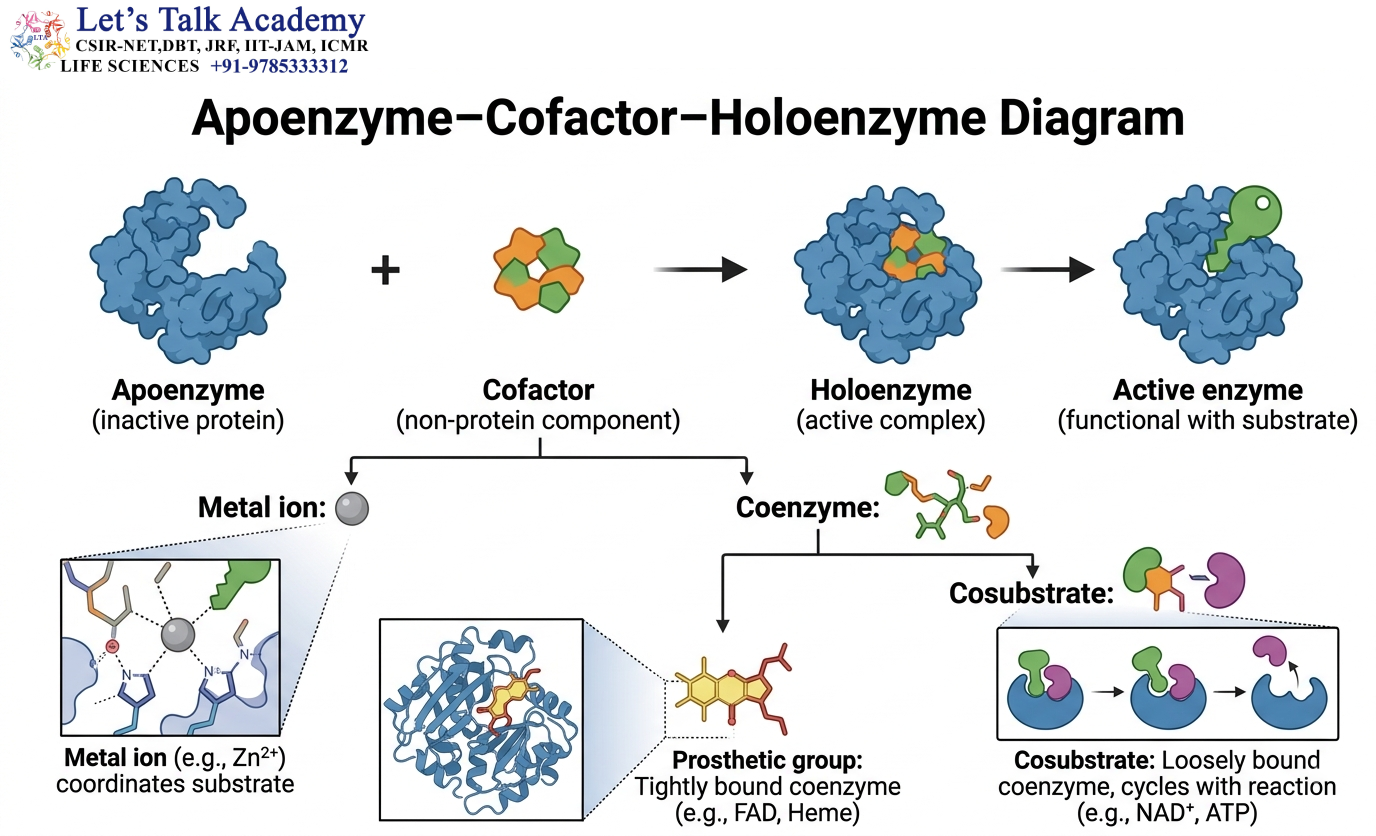
Some enzymes require non-protein components for catalytic activity.
The protein component alone is called the apoenzyme. When the apoenzyme is combined with its required non-protein component, the complete active enzyme is called the holoenzyme.
The relationship is:
Apoenzyme + required cofactor = holoenzyme
A cofactor may be an inorganic ion or an organic molecule.
Common inorganic cofactors include:
- Mg²⁺
- Zn²⁺
- Fe²⁺
- Fe³⁺
- Cu²⁺
- Mn²⁺
- Ca²⁺
Organic cofactors are commonly called coenzymes. Many coenzymes are derived from vitamins.
Important examples include NAD⁺, NADP⁺, FAD, FMN, coenzyme A, thiamine pyrophosphate, pyridoxal phosphate, biotin and tetrahydrofolate.
Some cofactors are tightly bound to enzymes and are called prosthetic groups, whereas others associate transiently and function as cosubstrates.
6. Active Site
The active site is the specialized region of an enzyme where substrate binding and catalysis occur.
It is generally a three-dimensional pocket, cleft or groove formed by amino acid residues that may be separated in the primary amino acid sequence but are brought together by protein folding.
The active site can broadly be divided into a substrate-binding region and a catalytic region.
The substrate-binding region recognizes and positions the substrate, while catalytic residues participate directly in the chemical transformation.
Interactions between enzyme and substrate may involve hydrogen bonds, ionic interactions, hydrophobic interactions, van der Waals forces and, in certain catalytic mechanisms, temporary covalent interactions.
7. Enzyme-Substrate Complex
The enzyme-substrate complex is a transient complex formed when a substrate binds to the active site.
The general reaction is:
E + S ⇌ ES → E + P
Formation of the ES complex allows the enzyme to position reactive groups correctly and create a favorable microenvironment for catalysis.
The enzyme does not simply hold the substrate. It actively changes the energetic and structural environment around the substrate so that the transition state can be reached more efficiently.
8. Models of Enzyme-Substrate Binding
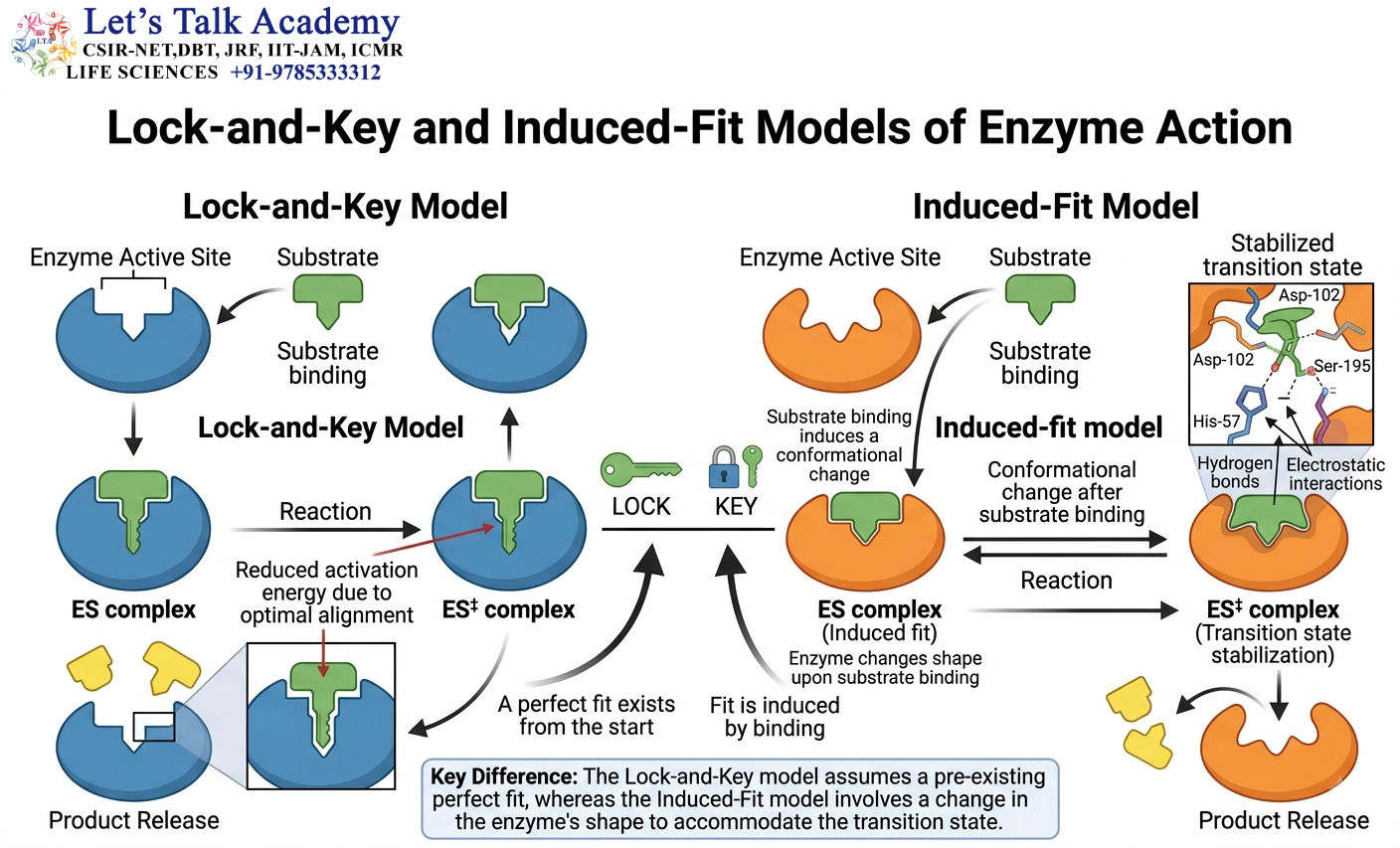
8.1 Lock-and-Key Model
The lock-and-key model was proposed by Emil Fischer.
According to this model, the active site has a relatively rigid structure that is complementary to the substrate. The substrate fits into the active site in a manner similar to a key fitting into a lock.
The model explains enzyme specificity but does not fully explain the conformational flexibility observed in many enzymes.
8.2 Induced-Fit Model
The induced-fit model was proposed by Daniel Koshland.
According to this model, the active site is not completely rigid. Binding of the substrate induces conformational changes in the enzyme, allowing the active site to adopt a more favorable catalytic configuration.
Induced fit can position catalytic residues, improve substrate orientation, stabilize the transition state and promote product formation.
9. Enzymes and Activation Energy
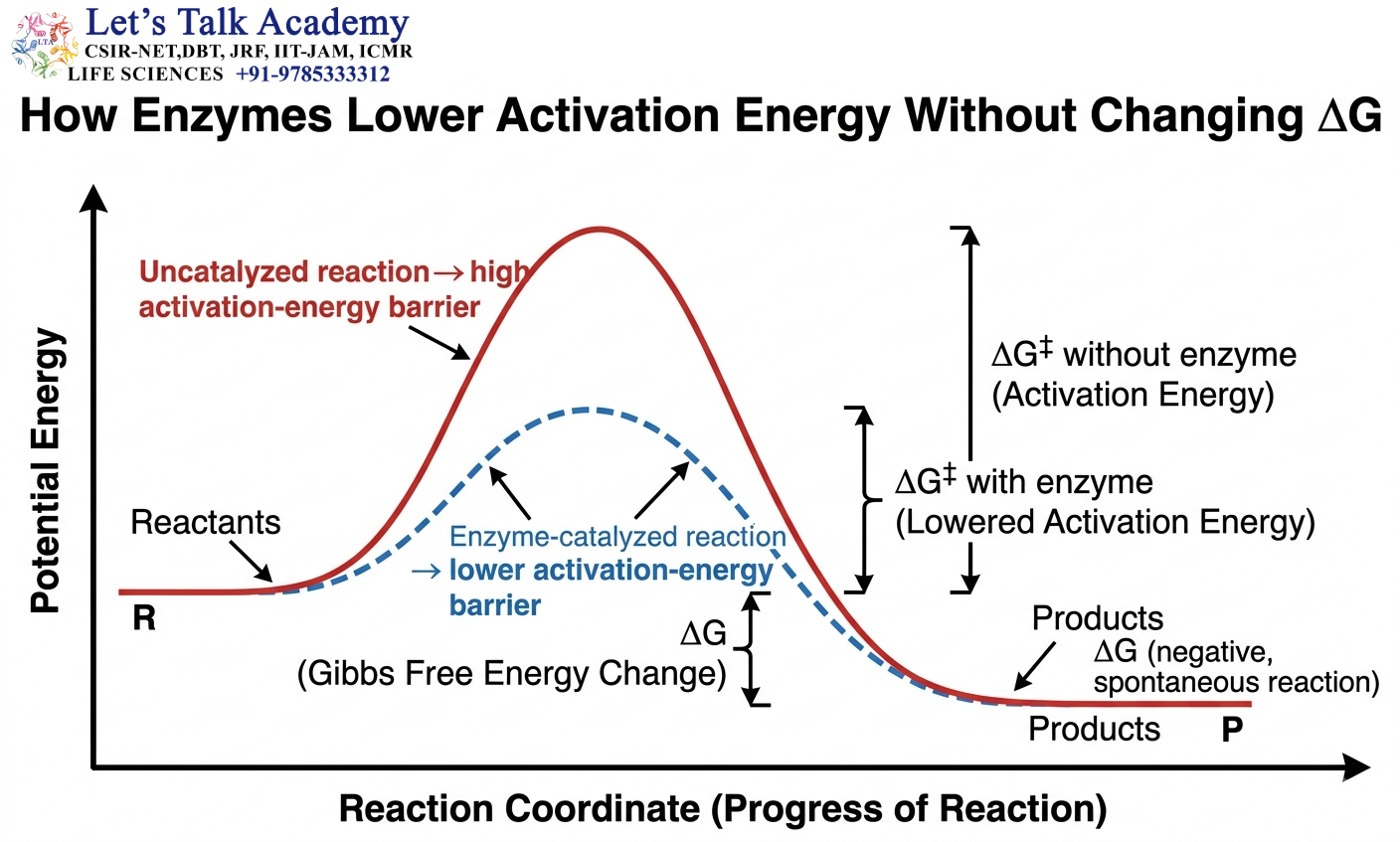
Chemical reactions require an energy barrier to be overcome before reactants can be converted into products. This barrier is called the activation energy, represented as ΔG‡.
Enzymes accelerate reactions by providing an alternative pathway with a lower activation-energy barrier.
The overall free-energy change is:
ΔG = Gproducts − Greactants
Therefore:
Enzyme → lowers activation energy → increases reaction rate
but:
Enzyme does not change ΔG or the equilibrium constant.
An enzyme can accelerate both the forward and reverse reactions of a reversible reaction without changing the final equilibrium position.
10. Transition State
The transition state is a high-energy molecular configuration formed during the conversion of reactants into products.
Enzymes accelerate reactions primarily by stabilizing the transition state relative to the uncatalyzed reaction.
The active site can contain charged groups, hydrogen-bond donors and acceptors, metal ions and hydrophobic regions that interact favorably with the transition-state configuration.
The activation free energy can be represented as:
ΔG‡ = activation free energy
Lowering ΔG‡ increases the reaction rate.
11. Major Mechanisms of Enzyme Catalysis
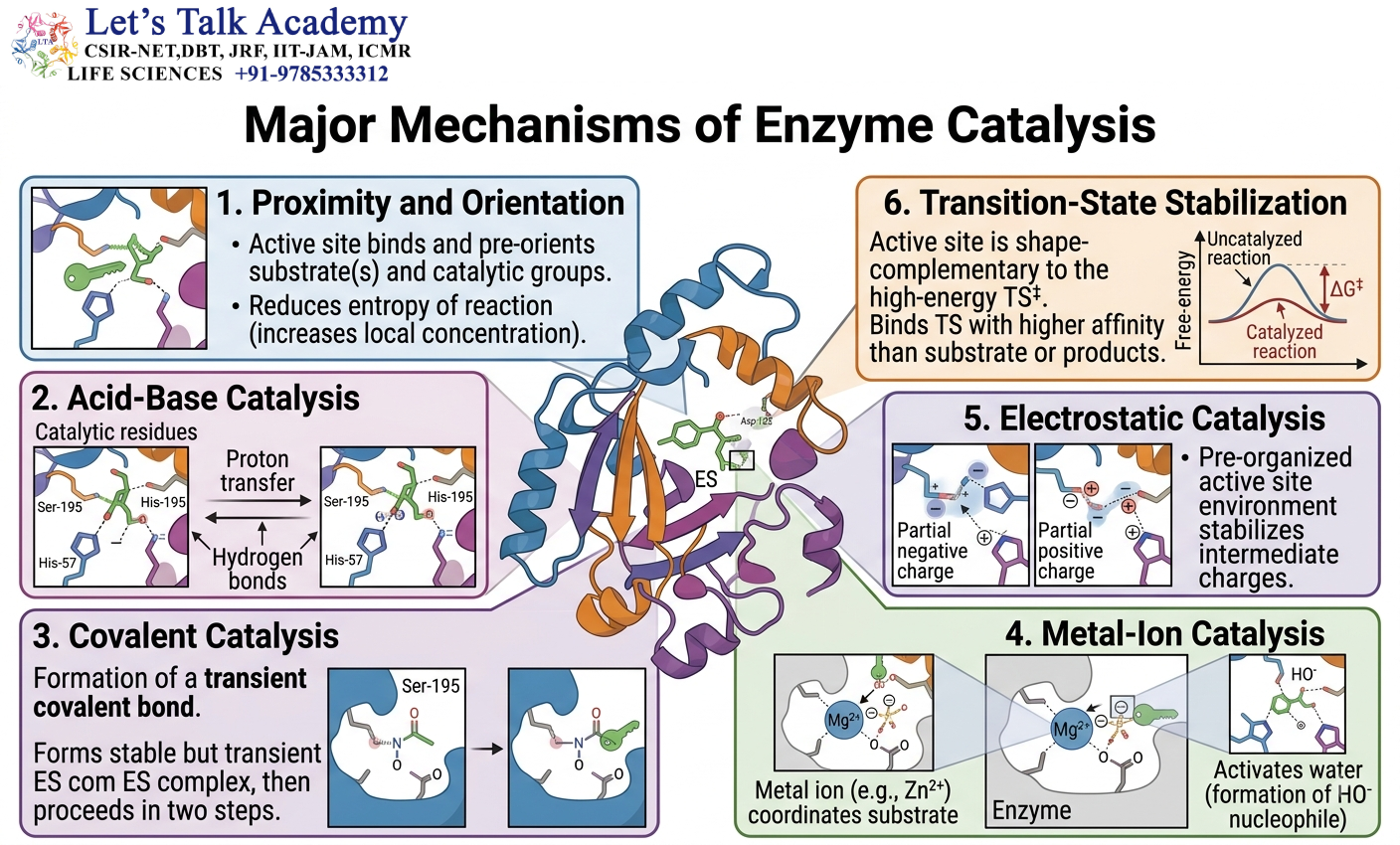
Enzymes employ several catalytic strategies. In many enzymes, more than one mechanism operates simultaneously.
11.1 Proximity and Orientation Effects
Enzymes bring reacting molecules close together and orient them in a favorable geometry.
In solution, molecules move randomly, so productive collisions may occur relatively infrequently. The active site reduces this problem by precisely positioning substrates.
11.2 Acid-Base Catalysis
In acid-base catalysis, amino acid residues donate or accept protons during the reaction.
Important residues include histidine, aspartate, glutamate, lysine, tyrosine and cysteine.
Histidine is particularly important because its side chain can function as either a proton donor or proton acceptor under appropriate conditions.
11.3 Covalent Catalysis
In covalent catalysis, the enzyme forms a temporary covalent bond with the substrate or an intermediate.
This creates an alternative reaction pathway with a lower activation-energy barrier.
Serine proteases provide a classical example.
11.4 Metal-Ion Catalysis
Metal ions can stabilize charges, orient substrates, activate water molecules or participate in redox reactions.
Examples include Zn²⁺ in carbonic anhydrase and Mg²⁺ in many nucleotide-dependent reactions.
11.5 Electrostatic Catalysis
Charged groups within the active site can stabilize charged intermediates and transition states.
This stabilization reduces the energetic cost of the reaction and increases catalytic efficiency.
11.6 Transition-State Stabilization
The active site may bind and stabilize the transition state more strongly than the ground-state substrate.
This preferential stabilization lowers the activation-energy barrier and represents one of the central principles of enzyme catalysis.
12. Enzyme Specificity and Molecular Recognition
Enzyme specificity results from precise structural and chemical complementarity between the substrate and active site.
The enzyme recognizes substrate characteristics such as molecular shape, charge distribution, hydrogen-bonding groups, hydrophobic regions and stereochemical configuration.
Specificity is not always absolute. Some enzymes act on structurally related substrates when these substrates share important chemical features.
The overall effectiveness of an enzyme depends on both substrate binding and catalytic conversion.
13. Enzyme Kinetics
Enzyme kinetics is the quantitative study of the rates of enzyme-catalyzed reactions and the factors that influence those rates.
Kinetic analysis provides information about catalytic rate, substrate dependence, enzyme concentration, substrate affinity, inhibition, activation, reaction mechanism and cooperativity.
The reaction velocity is commonly represented by v, while v₀ represents the initial velocity.
Initial velocity is especially useful because product concentration is initially very low. Therefore, reverse reactions and product inhibition are relatively small during the earliest stage of the reaction.
14. Factors Affecting Enzyme Activity
14.1 Enzyme Concentration
When substrate is sufficiently abundant, initial velocity is generally proportional to enzyme concentration:
v ∝ [E]
Therefore, increasing enzyme concentration increases the catalytic capacity of the reaction.
14.2 Substrate Concentration
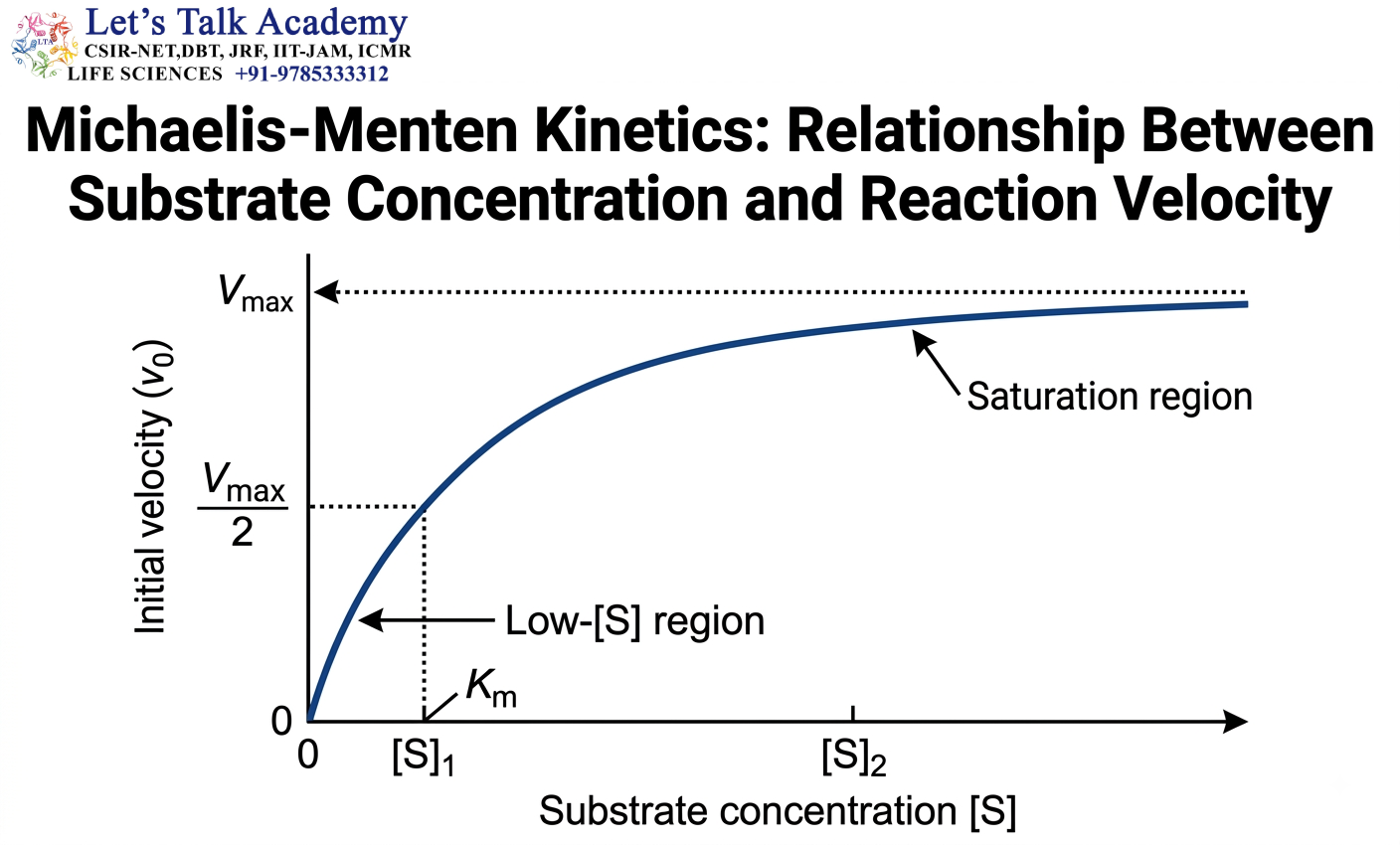
At low substrate concentration, increasing substrate concentration produces a substantial increase in velocity.
At high substrate concentration, the enzyme approaches saturation and the velocity approaches Vmax.
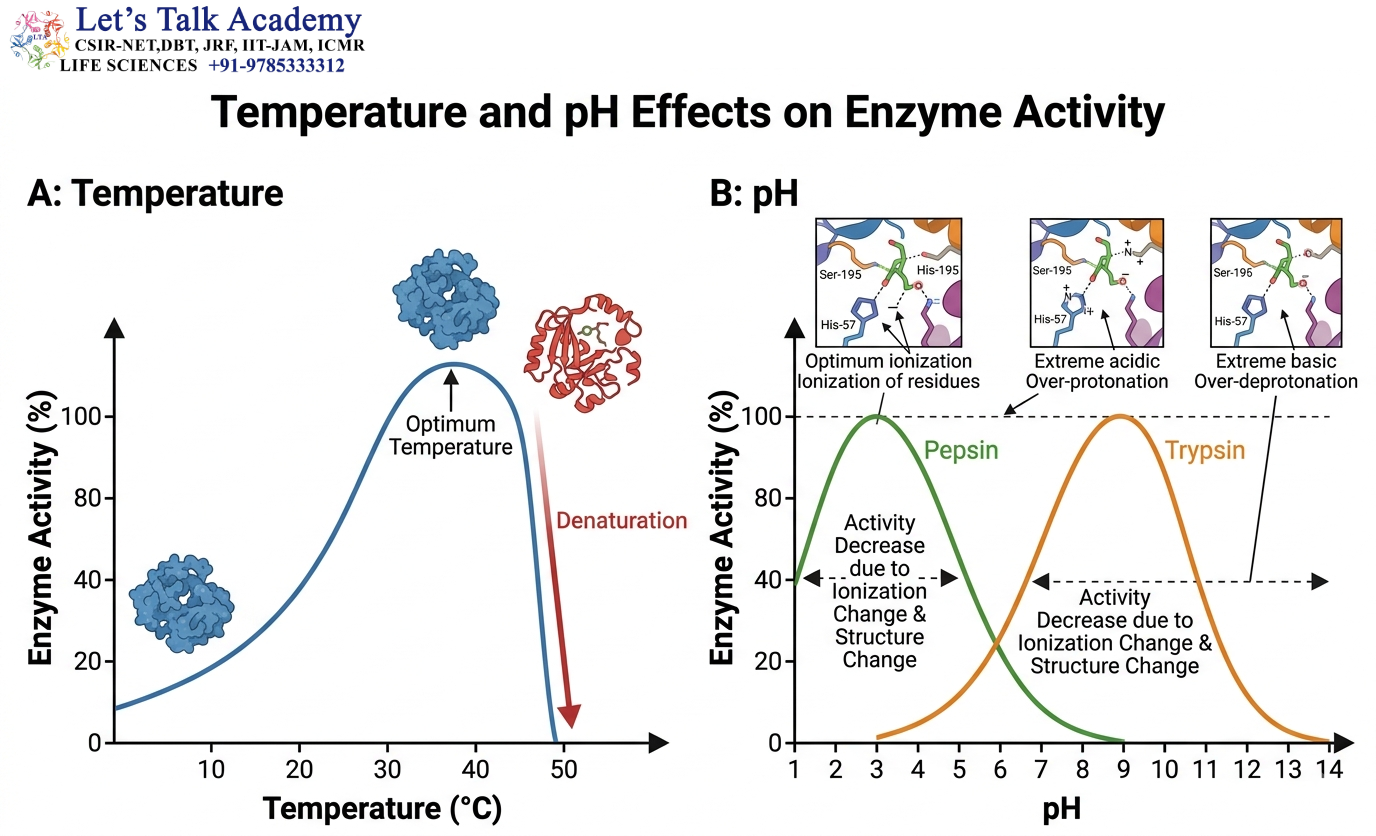
14.3 Temperature
Increasing temperature generally increases reaction rate because molecular movement and collision frequency increase.
However, excessive temperature can disrupt the non-covalent interactions responsible for protein structure. Therefore, enzyme activity generally increases to an optimum and then decreases as denaturation becomes dominant.
14.4 pH
Enzymes are sensitive to pH because proton concentration influences the ionization states of amino acid side chains.
Changes in pH can affect substrate binding, catalytic residue activity, protein conformation, electrostatic interactions and enzyme stability.
14.5 Ionic Strength
Ionic strength influences electrostatic interactions between charged molecules and can affect enzyme conformation, substrate binding and catalytic activity.
Very high salt concentrations can interfere with enzyme-substrate interactions or destabilize proteins.
14.6 Cofactors and Activators
Some enzymes require specific metal ions or organic cofactors for activity. Removal of a required cofactor may reduce or completely eliminate catalytic activity.
Activators can increase enzyme activity by stabilizing an active conformation or participating directly in catalysis.
14.7 Inhibitors
Inhibitors decrease enzyme activity by interfering with substrate binding, catalytic chemistry, enzyme conformation or other steps of the catalytic cycle.
15. Michaelis-Menten Kinetics
The Michaelis-Menten model describes many simple single-substrate enzyme-catalyzed reactions.
The basic mechanism is:
E + S ⇌ ES → E + P
The Michaelis-Menten equation is:
v₀ = Vmax[S] / (Km + [S])
where:
- v₀ = initial reaction velocity
- Vmax = maximum reaction velocity
- [S] = substrate concentration
- Km = Michaelis constant
The equation produces a characteristic hyperbolic relationship between substrate concentration and reaction velocity.
16. Meaning of Vmax
Vmax is the maximum reaction velocity approached when the enzyme is saturated with substrate.
At very high substrate concentration:
[S] ≫ Km
the Michaelis-Menten equation approaches:
v₀ ≈ Vmax
Vmax depends on the total concentration of active enzyme. Therefore, Vmax is not an intrinsic constant independent of enzyme concentration.
The relationship between Vmax and enzyme concentration is:
Vmax = kcat[E]T
where [E]T represents the total active enzyme concentration.
17. Meaning of Km
Km is the substrate concentration at which the reaction velocity is half of Vmax.
Therefore:
When [S] = Km, v₀ = Vmax/2
For the simple Michaelis-Menten mechanism:
Km = (k₋₁ + k₂) / k₁
Km is a kinetic parameter rather than simply a binding constant.
A lower Km often indicates that half-maximal velocity is reached at a lower substrate concentration. Under appropriate assumptions, this is commonly interpreted as higher apparent substrate affinity.
However, Km incorporates both substrate dissociation and catalytic conversion and therefore should not automatically be equated with a true equilibrium dissociation constant.
18. Derivation of the Michaelis-Menten Equation
The Michaelis-Menten mechanism can be represented as:
E + S ⇌ ES → E + P
The rate constants are:
- k₁ = rate constant for ES formation
- k₋₁ = rate constant for ES dissociation
- k₂ = rate constant for product formation
Under the steady-state assumption, the concentration of the ES complex remains approximately constant during the initial phase of the reaction:
d[ES]/dt ≈ 0
The Michaelis constant is:
Km = (k₋₁ + k₂) / k₁
The resulting velocity equation is:
v₀ = Vmax[S] / (Km + [S])
and:
Vmax = kcat[E]T
These relationships form the mathematical basis of simple enzyme kinetics.
19. Michaelis-Menten Curve
A plot of initial velocity against substrate concentration produces a hyperbolic curve.
At low substrate concentration:
[S] ≪ Km
the equation becomes:
v₀ ≈ (Vmax/Km)[S]
Thus, velocity is approximately proportional to substrate concentration.
At high substrate concentration:
[S] ≫ Km
the equation becomes:
v₀ ≈ Vmax
The enzyme is saturated and further increases in substrate concentration produce little additional increase in velocity.
20. First-Order and Zero-Order Behavior
At low substrate concentration: v ∝ [S]
The reaction therefore behaves approximately as a first-order reaction with respect to substrate.
At high substrate concentration: v ≈ Vmax
The reaction becomes approximately zero-order with respect to substrate because the enzyme is saturated.
The overall transition is:
Low [S] → First-order behavior
High [S] → Zero-order behavior
21. Turnover Number
The turnover number, represented by kcat, indicates the number of substrate molecules converted into product per enzyme molecule per unit time under saturating substrate conditions.
It is calculated as:
kcat = Vmax / [E]T
The usual unit of kcat is: s⁻¹
A high kcat indicates rapid catalytic turnover under saturating substrate conditions.
22. Catalytic Efficiency
Catalytic efficiency is commonly expressed as: kcat/Km
This parameter is particularly useful for comparing enzyme performance at low substrate concentrations.
A high kcat/Km indicates that the enzyme is efficient at both interacting with substrate and converting the bound substrate into product.
Thus, kcat/Km combines important information about substrate utilization and catalytic turnover.
23. Lineweaver-Burk Plot
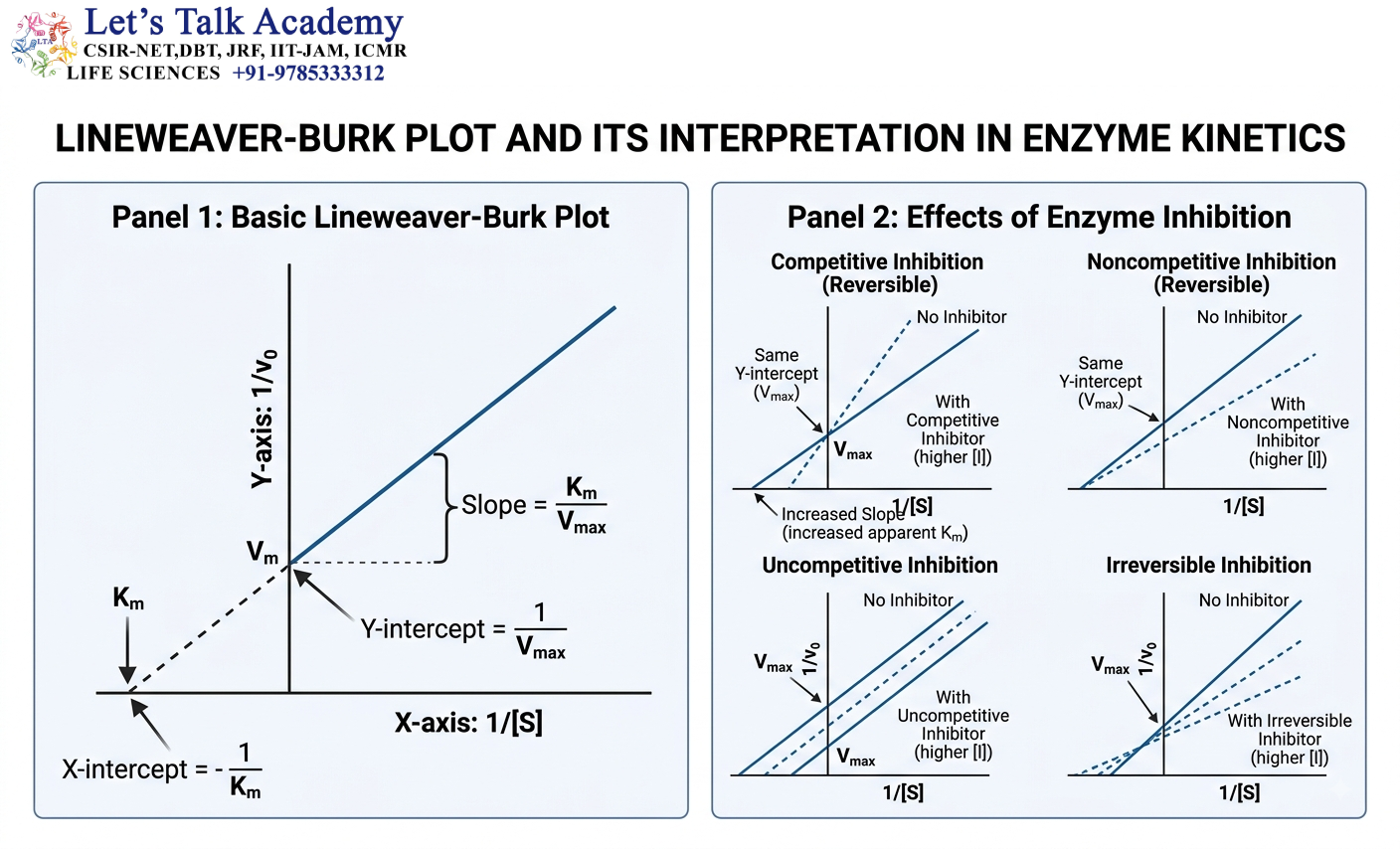
The Michaelis-Menten equation can be converted into a linear form by taking reciprocals.
The Lineweaver-Burk equation is:
1/v₀ = Km/Vmax × 1/[S] + 1/Vmax
In a Lineweaver-Burk plot:
y-axis = 1/v
x-axis = 1/[S]
y-intercept = 1/Vmax
x-intercept = −1/Km
slope = Km/Vmax
The Lineweaver-Burk plot is historically important for analyzing enzyme inhibition. However, reciprocal transformation magnifies experimental errors, particularly at low substrate concentrations. Modern quantitative analysis generally favors nonlinear fitting of the original Michaelis-Menten equation.
24. Eadie-Hofstee and Hanes-Woolf Representations
The Eadie-Hofstee equation is:
v = Vmax − Km(v/[S])
A plot of v against v/[S] gives:
y-intercept = Vmax
slope = −Km
The Hanes-Woolf equation is:
[S]/v = [S]/Vmax + Km/Vmax
These transformations are useful for understanding kinetic relationships, although nonlinear regression is generally preferred for accurate parameter estimation.
25. Reversible Enzyme Inhibition
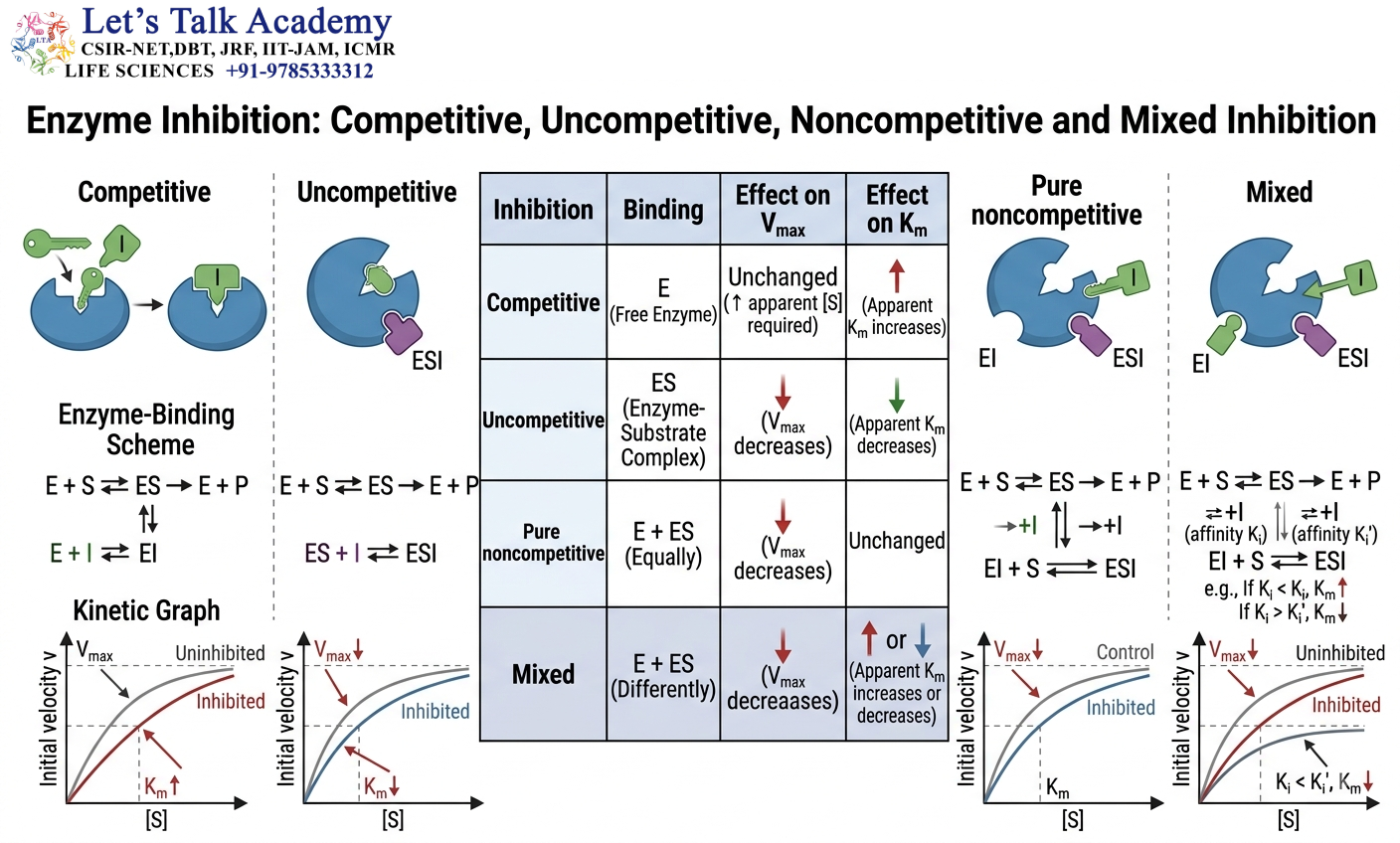
An inhibitor is a molecule that decreases enzyme activity.
Reversible inhibitors generally interact with enzymes through non-covalent interactions and can dissociate from the enzyme.
The major reversible inhibition patterns are:
- Competitive inhibition.
- Uncompetitive inhibition.
- Pure noncompetitive inhibition.
- Mixed inhibition.
The kinetic effect depends on whether the inhibitor binds free enzyme, enzyme-substrate complex or both.
26. Competitive Inhibition
In competitive inhibition, the inhibitor competes with the substrate for the active site or an overlapping binding region.
The inhibitor binds free enzyme:
E + I ⇌ EI
Because substrate and inhibitor compete, sufficiently high substrate concentration can overcome ideal competitive inhibition.
The characteristic kinetic effects are:
Vmax remains unchanged
Km increases
Therefore, a higher substrate concentration is required to achieve a particular fraction of Vmax.
27. Uncompetitive Inhibition
In uncompetitive inhibition, the inhibitor binds preferentially to the enzyme-substrate complex:
ES + I ⇌ ESI
The inhibitor does not effectively bind free enzyme.
The characteristic kinetic effects are:
Vmax decreases
Km decreases
Under ideal conditions, both parameters decrease by the same factor.
Increasing substrate concentration cannot restore the original Vmax.
28. Pure Noncompetitive Inhibition
In pure noncompetitive inhibition, the inhibitor binds free enzyme and enzyme-substrate complex with equal affinity.
The characteristic kinetic effects are:
Vmax decreases
Km remains unchanged
Increasing substrate concentration cannot restore the original Vmax because the inhibitor reduces the effective catalytic capacity of the enzyme.
29. Mixed Inhibition
In mixed inhibition, the inhibitor binds both free enzyme and enzyme-substrate complex but with different affinities.
The characteristic effects are:
Vmax decreases
Km may increase or decrease
If the inhibitor preferentially binds free enzyme, Km tends to increase. If it preferentially binds the ES complex, Km tends to decrease.
Mixed inhibition is common in real biochemical systems because inhibitors frequently interact differently with free enzyme and enzyme-substrate complex.
30. Irreversible Inhibition
Irreversible inhibitors cause long-lasting or effectively permanent loss of enzyme activity.
They may form highly stable interactions, often involving covalent modification of specific amino acid residues.
Important residues that may be modified include serine, cysteine and lysine, depending on the enzyme and inhibitor.
Because active enzyme molecules are permanently inactivated, increasing substrate concentration generally cannot restore the original activity.
31. Allosteric Enzymes
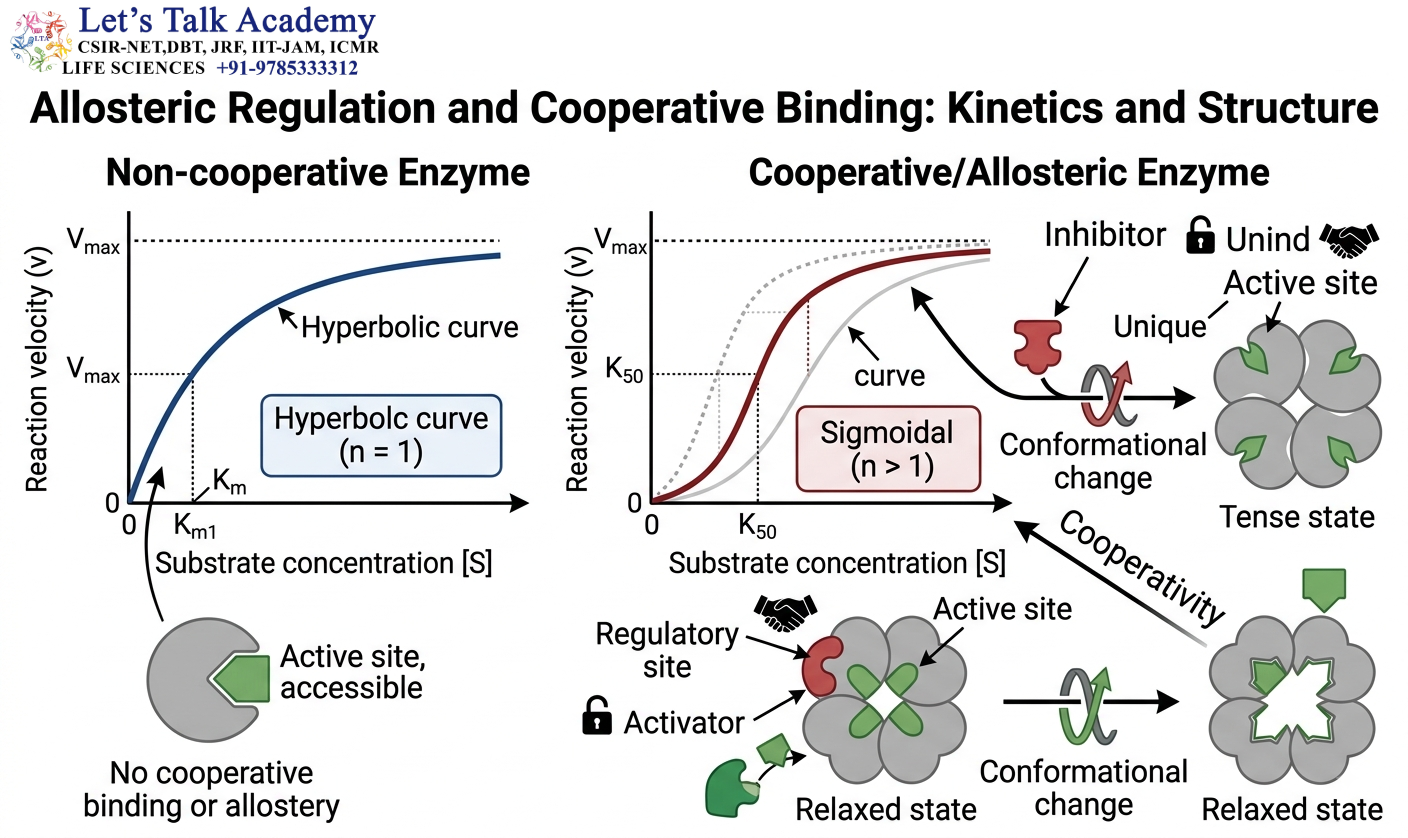
Allosteric enzymes contain regulatory sites that are distinct from their active sites.
Binding of an activator or inhibitor to an allosteric site can alter enzyme conformation and consequently modify catalytic activity.
Allosteric enzymes frequently regulate important metabolic pathways.
Many allosteric enzymes exhibit cooperative substrate binding and therefore produce sigmoidal velocity-substrate curves rather than the simple hyperbolic curves characteristic of Michaelis-Menten enzymes.
32. Cooperativity
Cooperativity occurs when binding of a ligand at one site influences binding at another site.
In positive cooperativity, binding at one site increases the affinity of other sites.
In negative cooperativity, binding at one site decreases the affinity of other sites.
Positive cooperativity often produces a sigmoidal substrate-velocity curve.
The Hill equation can be represented as: θ = [L]ⁿ / (Kd + [L]ⁿ)
where θ represents fractional occupancy, [L] represents ligand concentration, Kd represents a dissociation-related parameter and n represents the Hill coefficient.
33. Hill Coefficient
The Hill coefficient provides an empirical measure of cooperativity.
When: nH > 1 the system shows positive cooperativity.
When: nH = 1 there is no apparent cooperativity.
When: nH < 1 the system shows negative cooperativity.
The Hill coefficient should not automatically be interpreted as the exact number of ligand-binding sites because it is an empirical parameter describing the shape of the binding relationship.
34. Regulation of Enzyme Activity
Cells regulate enzyme activity at several levels.
34.1 Allosteric Regulation
Small molecules bind to regulatory sites and alter enzyme conformation and activity.
34.2 Covalent Modification
Enzymes may be activated or inhibited through reversible covalent modifications such as phosphorylation, acetylation and methylation.
34.3 Proteolytic Activation
Some enzymes are synthesized as inactive precursors called zymogens or proenzymes. Specific proteolytic cleavage converts them into active enzymes.
34.4 Feedback Inhibition
The final product of a metabolic pathway can inhibit an enzyme acting earlier in the pathway. This prevents unnecessary production and contributes to metabolic homeostasis.
34.5 Compartmentalization
Enzymes and substrates may be separated into different cellular compartments. This controls substrate availability and allows different metabolic pathways to operate under different conditions.
34.6 Regulation of Enzyme Synthesis
Cells can regulate enzyme concentration through transcription, translation, degradation and protein turnover.
This mechanism is slower than allosteric regulation or covalent modification but produces longer-lasting changes.
35. Zymogens
Zymogens are inactive enzyme precursors that require specific proteolytic cleavage for activation.
This mechanism prevents potentially destructive enzymes from becoming active at inappropriate locations.
For example:
Trypsinogen → Trypsin
Trypsin can then activate additional digestive enzyme precursors.
Because activation involves peptide-bond cleavage, zymogen activation is generally effectively irreversible.
36. Isoenzymes
Isoenzymes, or isozymes, are different molecular forms of an enzyme that catalyze the same overall reaction but differ in structure, kinetic properties, tissue distribution or regulation.
They may differ in:
- amino acid sequence,
- subunit composition,
- Km,
- Vmax,
- regulatory properties,
- tissue distribution,
- electrophoretic mobility.
Isoenzymes allow different tissues to adapt the same biochemical reaction to their specific physiological requirements.
Lactate dehydrogenase is a classical example of an enzyme with different isoenzyme forms.
37. Enzyme Classification
Enzymes are classified according to the type of chemical reaction they catalyze.
37.1 Oxidoreductases
Oxidoreductases catalyze oxidation-reduction reactions.
Examples include dehydrogenases and oxidases.
37.2 Transferases
Transferases transfer functional groups from one molecule to another.
Examples include kinases and aminotransferases.
37.3 Hydrolases
Hydrolases catalyze bond cleavage through hydrolysis.
Examples include proteases, lipases, nucleases and phosphatases.
37.4 Lyases
Lyases catalyze bond cleavage or formation without hydrolysis or oxidation-reduction being the primary mechanism.
Examples include decarboxylases and aldolases.
37.5 Isomerases
Isomerases catalyze intramolecular rearrangements.
Examples include mutases and racemases.
37.6 Ligases
Ligases catalyze the joining of two molecules, generally coupled to hydrolysis of ATP or another nucleoside triphosphate.
Examples include DNA ligase and aminoacyl-tRNA synthetases.
37.7 Translocases
Translocases are recognized as a seventh enzyme class and catalyze the movement of ions or molecules across membranes or their separation within membranes.
38. Enzyme Units and Specific Activity
The SI unit of catalytic activity is the katal.
One katal corresponds to the conversion of one mole of substrate per second under specified conditions.
Biochemical laboratories also commonly use the enzyme unit (U), generally defined as the amount of enzyme required to convert one micromole of substrate per minute under specified assay conditions.
Specific activity is calculated as:
Specific activity = Total enzyme activity / Total protein
Specific activity is an important indicator of enzyme purity.
39. Enzyme Purification
Enzyme purification involves separating the desired enzyme from other cellular proteins.
A typical purification strategy may include:
- Cell disruption.
- Extraction.
- Centrifugation.
- Fractionation.
- Chromatography.
- Desalting.
- Final purification.
- Activity measurement.
During purification, total protein, total enzyme activity, specific activity, purification fold and percentage yield are commonly measured.
Purification fold is calculated as:
Purification fold = Specific activity after purification / Specific activity of starting material
As purification proceeds, the specific activity of the target enzyme generally increases.
40. Enzyme Assays
An enzyme assay measures catalytic activity under defined experimental conditions.
A good assay should produce a measurable change associated with substrate disappearance or product formation.
Common techniques include spectrophotometry, fluorometry, radioactive assays, chromatography, electrophoresis and electrochemical detection.
NADH and NADPH absorb strongly at approximately 340 nm: λmax ≈ 340 nm
Therefore, many dehydrogenase reactions can be monitored spectrophotometrically by measuring changes in absorbance at approximately 340 nm.
41. Initial Velocity Measurements
Initial velocity measurements are performed during the early stage of an enzyme-catalyzed reaction.
During this phase, product concentration is low, reverse reactions are relatively limited, product inhibition is small, substrate concentration has not changed substantially and enzyme concentration remains approximately constant.
These conditions make initial velocity particularly useful for determining kinetic parameters.
42. Steady-State Assumption
The steady-state assumption states that after a short initial period, the concentration of the enzyme-substrate complex remains approximately constant.
Mathematically: d[ES]/dt ≈ 0
This does not mean that ES formation and breakdown stop.
Instead, the rate of ES formation becomes approximately equal to the rate of ES disappearance.
The steady-state approximation is central to the derivation of the Michaelis-Menten equation.
43. Rapid-Equilibrium Approximation
The rapid-equilibrium approximation assumes that substrate binding and dissociation occur much faster than chemical conversion of substrate into product.
Under this assumption, the dissociation constant of the enzyme-substrate complex can be related directly to substrate-binding affinity.
The rapid-equilibrium approximation and the steady-state approximation are conceptually different and should not be treated as identical assumptions.
44. Free Energy and Enzyme Catalysis
The free-energy difference between reactants and products determines the thermodynamic favorability of a reaction.
An enzyme does not make an unfavorable reaction favorable simply by binding its substrate.
Instead, it lowers the activation-energy barrier.
For:
A ⇌ B
an enzyme accelerates both:
A → B
and:
B → A
without changing the equilibrium position.
This distinction between thermodynamics and kinetics is fundamental to understanding enzyme function.
45. Enzyme Catalysis and Reaction Coupling
Many cellular reactions are coupled to thermodynamically favorable reactions.
ATP hydrolysis is frequently used to drive otherwise unfavorable cellular processes.
For example, an energetically unfavorable biosynthetic reaction can be coupled to ATP hydrolysis so that the overall coupled reaction becomes favorable.
Enzymes facilitate the individual steps and provide controlled pathways for coupled reactions.
46. Multisubstrate Enzyme Reactions
Some enzymes catalyze reactions involving two or more substrates.
The major mechanisms include ordered, random and ping-pong mechanisms.
In an ordered mechanism, substrates bind in a defined sequence.
In a random mechanism, either substrate can bind first.
In a ping-pong mechanism, one substrate reacts first and produces a modified enzyme intermediate before the second substrate binds and reacts.
These mechanisms can be distinguished through kinetic analysis by varying substrate concentrations and examining the resulting kinetic patterns.
47. Enzyme Kinetics and Experimental Interpretation
Kinetic parameters should always be interpreted in the context of experimental conditions.
An apparent increase in Km may result from competitive inhibition, but changes in pH, ionic strength, temperature or protein conformation can also alter substrate binding.
Similarly, a decrease in Vmax can result from reduced catalytic efficiency, irreversible enzyme inactivation, noncompetitive inhibition, mixed inhibition or a decrease in the concentration of active enzyme.
Therefore, Km and Vmax should not be interpreted in isolation.
48. Enzyme Catalysis in Cellular Metabolism
Enzymes rarely function as isolated reactions inside cells. Instead, they operate as components of interconnected metabolic pathways.
The product of one enzyme-catalyzed reaction may become the substrate for another enzyme.
This organization allows cells to control metabolic flux, prevent accumulation of harmful intermediates, coordinate energy production and biosynthesis, respond to environmental changes and maintain homeostasis.
Regulatory enzymes frequently occupy strategically important positions in metabolic pathways.
49. Rate-Limiting and Flux-Controlling Steps
The term rate-limiting enzyme is commonly used for an enzyme whose activity strongly influences pathway throughput.
However, metabolic control is usually distributed among multiple reactions.
The enzyme with the slowest intrinsic reaction rate is not necessarily the enzyme that exerts the greatest control over pathway flux.
The flux control coefficient provides a more quantitative description of how changes in enzyme activity influence metabolic flux.
50. Enzyme Adaptation to Environmental Conditions
Enzymes have evolved to function under specific environmental conditions.
Enzymes from thermophilic organisms may possess structural characteristics that provide stability at high temperatures.
Cold-adapted enzymes may possess increased structural flexibility that allows sufficient catalytic activity at low temperatures.
Similarly, enzymes from organisms living in acidic or alkaline environments can possess structural adaptations that maintain catalytic activity under unusual pH conditions.
51. Enzyme Denaturation
Denaturation is the disruption of the native three-dimensional structure of a protein without necessarily breaking its primary peptide-bond sequence.
Heat, extreme pH, organic solvents, detergents, heavy metals and other conditions can cause denaturation.
Because catalytic activity depends strongly on three-dimensional structure, denaturation commonly results in loss of enzyme activity.
This demonstrates the direct relationship between protein structure and catalytic function.
52. Enzyme Inactivation by Heavy Metals
Certain heavy-metal ions can inhibit enzymes by interacting strongly with functional groups within proteins.
Cysteine sulfhydryl groups are particularly susceptible to modification by some heavy metals.
These interactions can alter active-site geometry, disrupt structural interactions or interfere with catalytic residues.
The effect depends on the identity and concentration of the metal ion and the properties of the enzyme.
53. Temperature Dependence of Enzyme Reactions
Reaction rates generally increase with temperature over a limited range because molecules possess greater kinetic energy and collide more frequently.
However, high temperatures can simultaneously decrease protein stability.
Therefore:
Increasing temperature → increased reaction rate
but beyond the optimum:
Increasing temperature → protein denaturation → decreased enzyme activity
Enzyme activity consequently often rises to an optimum temperature and then decreases.
54. Enzyme Kinetics in Drug Action
Many drugs function by modifying enzyme activity.
A drug may act as a:
- competitive inhibitor,
- noncompetitive or mixed inhibitor,
- irreversible inhibitor,
- allosteric modulator,
- substrate analog,
- transition-state analog.
Understanding enzyme kinetics helps explain drug selectivity, dose-response relationships, resistance mechanisms and the consequences of altering enzyme activity in physiological pathways.
55. Transition-State Analogs
Transition-state analogs are molecules designed to resemble the geometry or electronic properties of a reaction transition state.
Because enzymes often bind transition-state configurations strongly, transition-state analogs can act as potent inhibitors.
This principle is important in rational drug design.
The conceptual relationship is:
Transition-state analog → strong enzyme binding → inhibition
56. Enzyme Evolution and Catalytic Function
Enzyme sequences evolve through mutation, recombination, gene duplication, natural selection and other evolutionary processes.
Changes in amino acid sequence can alter substrate specificity, catalytic efficiency, stability, regulation and cellular localization.
Evolution can therefore produce related enzymes that catalyze similar reactions but have different kinetic properties in different organisms.
Homologous enzymes may retain important structural characteristics even when their physiological roles have diverged.
57. Relationship Between Structure and Enzyme Function
Enzyme activity is directly connected to molecular structure.
The overall relationship can be represented as:
Primary structure → three-dimensional structure → active-site organization → catalytic function
The primary sequence determines protein folding, folding determines the three-dimensional arrangement of residues, and this arrangement determines substrate recognition and catalytic properties.
A mutation in a catalytic residue may greatly reduce enzyme activity. A mutation elsewhere may affect folding, stability, substrate binding, regulation or cellular localization.
58. Quantitative Relationships in Enzyme Kinetics
The major equations used in enzyme kinetics can be summarized as follows.
Michaelis-Menten equation:
v₀ = Vmax[S] / (Km + [S])
At [S] = Km:
v₀ = Vmax/2
Maximum velocity:
Vmax = kcat[E]T
Turnover number:
kcat = Vmax/[E]T
Catalytic efficiency:
kcat/Km
Michaelis constant:
Km = (k₋₁ + k₂) / k₁
Lineweaver-Burk equation:
1/v₀ = Km/Vmax × 1/[S] + 1/Vmax
Low-substrate approximation:
v₀ ≈ (Vmax/Km)[S]
High-substrate approximation:
v₀ ≈ Vmax
These equations connect experimentally measured reaction velocities with meaningful kinetic parameters.
59. Comparative Kinetic Behavior of Major Inhibitors
Inhibition Type |
Inhibitor Binding |
Vmax |
Km |
Effect of Increasing Substrate |
|---|---|---|---|---|
| Competitive | Free enzyme | Unchanged | Increased | Can overcome ideal inhibition |
| Uncompetitive | ES complex | Decreased | Decreased | Cannot restore original Vmax |
| Pure noncompetitive | E and ES equally | Decreased | Unchanged | Cannot restore original Vmax |
| Mixed | E and ES differently | Decreased | Increased or decreased | Cannot fully restore original Vmax |
| Irreversible | Usually stable/covalent interaction | Effective activity decreased | Variable | Generally cannot overcome inhibition |
The comparison is based on the binding preference of the inhibitor and its resulting effect on the kinetic parameters.
60. Conceptual Flow of Enzyme Catalysis
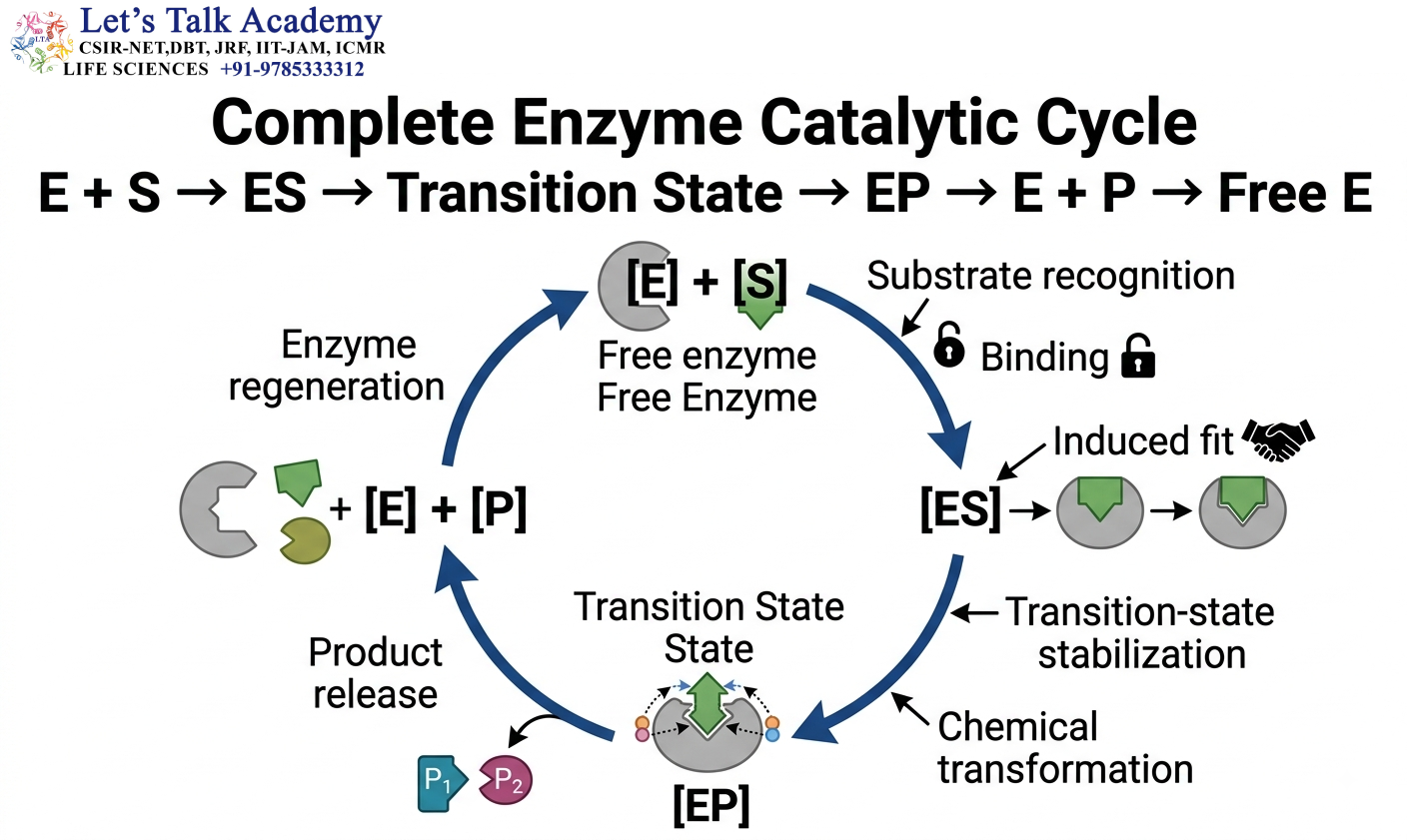
The complete catalytic process can be represented as:
Enzyme + Substrate → Enzyme-Substrate Complex → Transition-State Stabilization → Product Formation → Product Release → Free Enzyme
The enzyme is regenerated after product release and can participate in another catalytic cycle.
At the molecular level, the process involves substrate recognition, binding, conformational adjustment, transition-state stabilization, chemical transformation and product release.
61. Integrated View of Enzyme Function
The complete relationship among enzyme structure, binding, catalysis, kinetics and regulation can be represented as:
Protein/RNA structure → Active-site formation → Substrate recognition → ES complex formation → Transition-state stabilization → Product formation → Product release → Enzyme regeneration
The rate of this process is influenced by substrate concentration, enzyme concentration, temperature, pH, ionic strength, cofactors, inhibitors, activators and regulatory mechanisms.
At the cellular level:
Individual enzyme reactions → Metabolic pathways → Metabolic flux → Cellular homeostasis
This integrated view connects molecular structure with biochemical function and cellular regulation.


