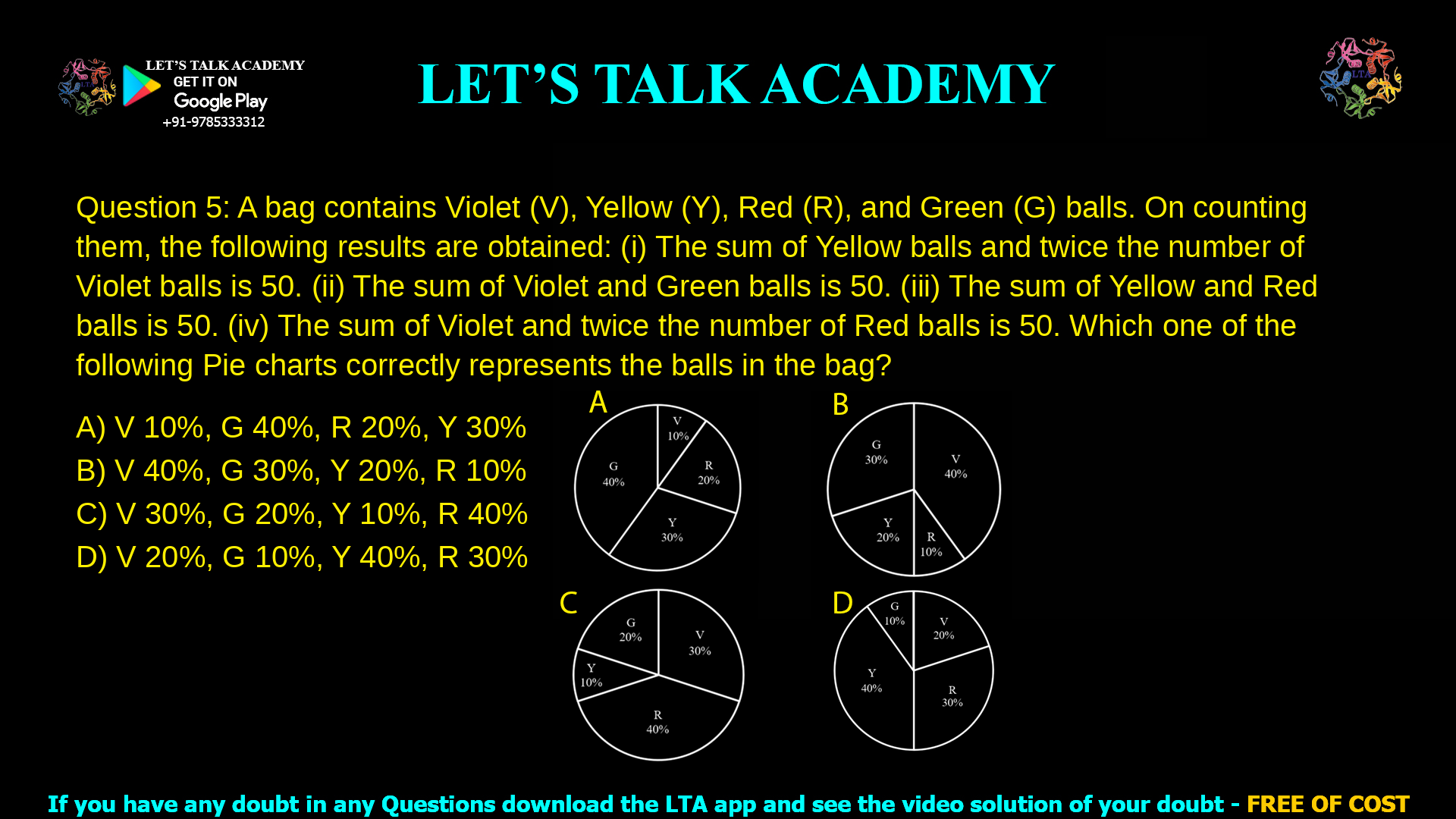
Q.5 A bag contains Violet (V), Yellow (Y), Red (R), and Green (G) balls. On counting
them, the following results are obtained:
(i) The sum of Yellow balls and twice the number of Violet balls is 50.
(ii) The sum of Violet and Green balls is 50.
(iii) The sum of Yellow and Red balls is 50.
(iv) The sum of Violet and twice the number of Red balls is 50.
Which one of the following Pie charts correctly represents the balls in the bag?
A bag contains Violet (V), Yellow (Y), Red (R), and Green (G) balls. On counting, the following results are obtained:
(i) The sum of Yellow and Black balls twice the number of Violet balls is 50.
(ii) The sum of Violet and Green balls is 30.
(iii) Twice the sum of Violet and Yellow balls is 50.
(iv) The sum of Violet and Blue balls twice the number of Red balls is 50.
Which one of the following Pie charts correctly represents the balls in the bag?
(A)
[Here multiple pie charts are described in the original question; however, due to incomplete information and textual inconsistencies (e.g., black and blue balls are never mentioned in the legend, and the visible percentages in the pie charts are not clearly readable from the provided image), the problem statement as given is not fully coherent. Consequently, it is not possible to definitively match the stated algebraic conditions with any specific pie chart without clearer data.]


