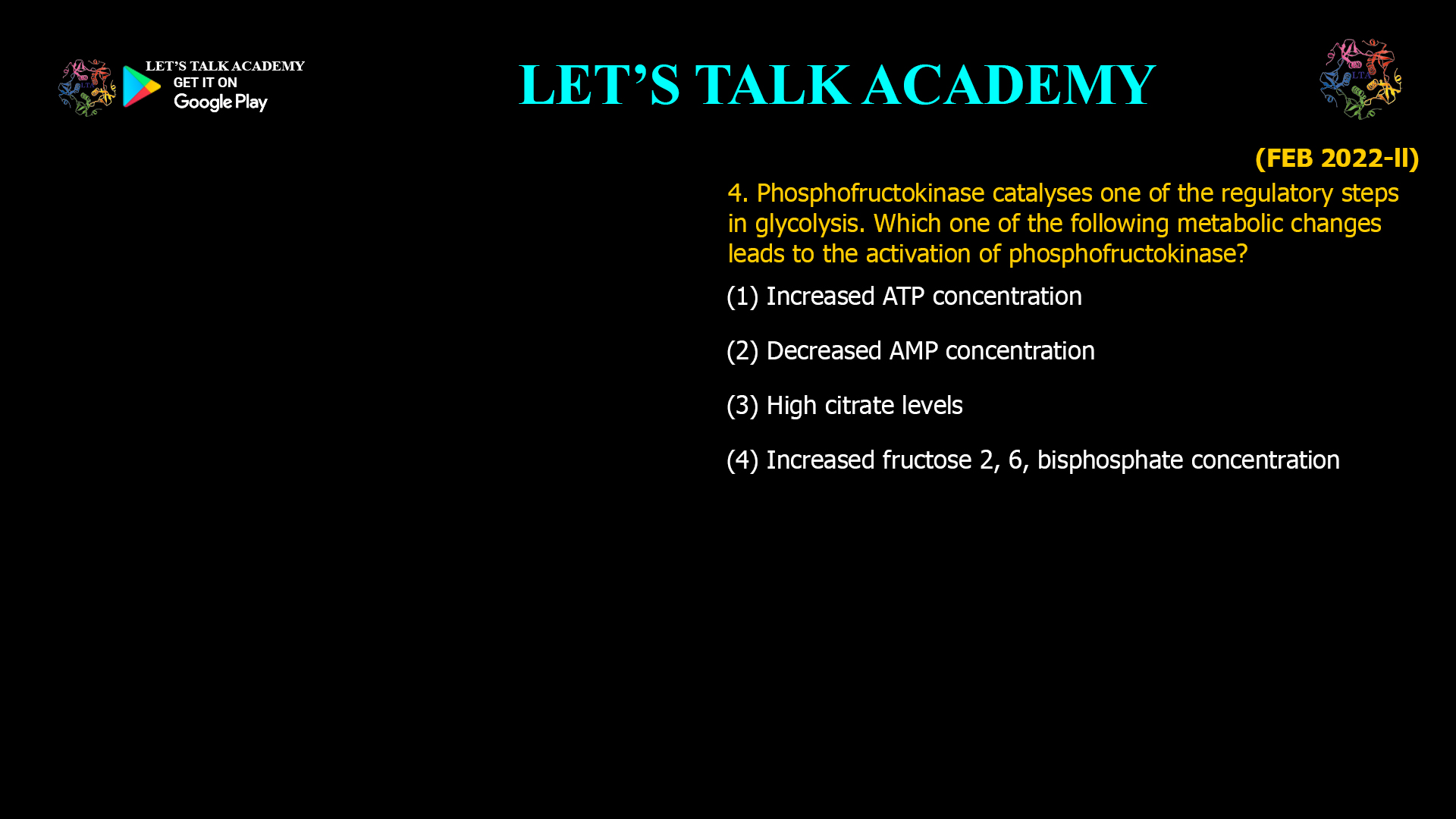
- Phosphofructokinase catalyses one of the regulatory steps in glycolysis. Which one of the following metabolic changes leads to the activation of phosphofructokinase?
(1) Increased ATP concentration
(2) Decreased AMP concentration
(3) High citrate levels
(4) Increased fructose 2, 6, bisphosphate concentration
Phosphofructokinase-1 (PFK-1) is the major regulatory enzyme in glycolysis, catalyzing the irreversible conversion of fructose-6-phosphate (F6P) to fructose-1,6-bisphosphate (FBP). This step commits glucose to energy production and biosynthesis, making PFK-1 a critical control point for cellular metabolism.
Understanding what activates or inhibits PFK-1 is essential to grasp how cells regulate glycolytic flux in response to energy needs.
Key Activators and Inhibitors of Phosphofructokinase-1
PFK-1 activity is finely tuned by several allosteric effectors reflecting the cell’s energy status:
-
Activators:
-
AMP and ADP: Indicate low energy status, signaling the need to increase ATP production.
-
Fructose 2,6-bisphosphate (F2,6BP): A potent activator that increases PFK-1 affinity for its substrate F6P and reduces ATP inhibition.
-
-
Inhibitors:
-
ATP: High ATP levels signal sufficient energy, inhibiting PFK-1 to slow glycolysis.
-
Citrate: An intermediate of the citric acid cycle that enhances ATP’s inhibitory effect, indicating abundant biosynthetic precursors and energy.
-
Why Fructose 2,6-Bisphosphate Is the Most Effective Activator
Fructose 2,6-bisphosphate is synthesized from fructose-6-phosphate by phosphofructokinase-2 (PFK-2). It is not an intermediate of glycolysis but acts as a powerful allosteric activator of PFK-1 by:
-
Increasing PFK-1’s affinity for fructose-6-phosphate, promoting glycolysis even when ATP levels are high.
-
Counteracting the inhibitory effect of ATP, allowing glycolysis to proceed when glucose is abundant and energy demand is high.
This feedforward mechanism ensures that glycolysis is upregulated in response to glucose availability.
Role of AMP in Activation
AMP is generated from ATP during energy consumption. Elevated AMP levels signal low cellular energy and activate PFK-1, increasing glycolytic flux to restore ATP levels.
Why Increased ATP and High Citrate Inhibit PFK-1
-
ATP: Acts as both a substrate and an allosteric inhibitor. When ATP is abundant, it binds to an inhibitory site on PFK-1, reducing enzyme activity to prevent excess ATP production.
-
Citrate: Reflects the status of the citric acid cycle and biosynthetic pathways. High citrate levels amplify ATP’s inhibitory effect, signaling that energy and biosynthetic precursors are sufficient.
Summary of Effects on Phosphofructokinase-1
Metabolic Change Effect on PFK-1 Activity Explanation Increased ATP concentration Inhibits Signals energy sufficiency, slows glycolysis Decreased AMP concentration Inhibits (indirectly) Less activation signal, reduces glycolysis High citrate levels Inhibits Enhances ATP inhibition, signals biosynthetic sufficiency Increased fructose 2,6-bisphosphate Activates Potent activator, enhances substrate affinity, counters ATP inhibition
Conclusion
Among the options, increased fructose 2,6-bisphosphate concentration is the key metabolic change that activates phosphofructokinase-1, promoting glycolysis even in the presence of high ATP. This molecule acts as a crucial regulator, integrating signals of glucose availability and energy demand to fine-tune glycolytic flux.
Final Answer:
(4) Increased fructose 2,6-bisphosphate concentration -


35 Comments
Kirti Agarwal
September 18, 2025Formation of fructose 1,6 bis phosphate
Aakansha sharma Sharma
September 19, 2025Increased fructose 2,6-bisphosphate concentration
Sonal Nagar
September 20, 2025Increased fructose 2,6-bisphosphate concentration.
Neha Yadav
September 20, 2025Increased fructose 2,6-bisphosphate concentration
Khushi Agarwal
September 21, 2025Option 4 is correct answer Increased fructose 2, 6, bisphosphate concentration
Bcz it is a strong allosteric activator
Manisha choudhary
September 21, 2025Phosphofructokinase ( 2PFK-2 ) fructose 6 phosphate ko Fructose 2,6 bis phosphate m convert krta h
Y glycolysis kaa intermediate nhi h pr powerful allosteric activator h PFK-1 ka even in high concentration of ATP
ATP inhibitor ko counter krta h
PFK-1 ki substate k liye affinity bdha deta h jis s glycolysis rate bdhbjaati h
ATP k consumption m y amp m convert hota h
Hight level amp kaa y btata h ki atp kaa consumption jyada ho rha h cell ko atp ki requirement h jis s glycolysis chlta rhta h
Jabki amp kaa level km hone pr mtlb ATP,AMP m convert nhi ho rha mtlb ATP use nhi ho rha glycolysis indirectly inhibit hoga
More concentration of ATP and citrate glycolysis inhibit krwate h allosteric inhibitor h
Soniya Shekhawat
September 21, 2025Phosphofructokinase-1 is a strong allosteric activator even ATP level is high it convert fructose 6 phosphate into fructose 2,6 bis phosphate and increase a fructose 2, 6 bis phosphate .
Minal Sethi
September 22, 2025PFK 1 is activated by F-2,6-bis phosphate
Pallavi Ghangas
September 22, 2025fructose 26 phosphate is an allostatic activator of PFK 1
Roopal Sharma
September 23, 2025Fru tose 2,6 bis phosphate increase the activity of glycolysis
Heena Mahlawat
September 23, 2025Increased 2,6 bisphosphate concentration acts as activator in glycolysis
Dharmpal Swami
September 23, 2025Increased 2,6 BP con.
Aafreen Khan
September 23, 2025Increased fructose 2,6-bisphosphate concentration , it is a strong allosteric inhibitor
Deepika sheoran
September 23, 2025Increased fructose 2 ,6 bis phosphate
Anurag Giri
September 23, 2025Phosphofructokinase-1 is a strong allosteric activator even ATP level is high it convert fructose 6 phosphate into fructose 2,6 bis phosphate and increase a fructose 2, 6 bis phosphate
Devika
September 23, 2025Increased F-2,6-BP concentration
Mohd juber Ali
September 24, 2025Phosphofractokinase is allosteric activator and convert f6p into 1,6 bis phosphate in the presence of hight atp phosphofructokinase promot glycolysis and increase fructo 1,6 bis phosphate
Divya rani
September 24, 2025F26BP is a activator for glycolysis even if the ATP is high so it is a potent activator .
Nilofar Khan
September 24, 2025Increase fructose 2,6 BP consentration
Deepika sheoran
September 24, 2025Phosphofruactosekinase 1,6 bis phosphate
Khushi Singh
September 24, 2025Phosphofructokinase is a allosteric activator
Santosh Saini
September 24, 2025Increased fructose 2, 6 bisphosphate concentration
Arushi Saini
September 24, 2025Fructose2,6 bis phosphate Increases PFK-1’s affinity for fructose-6-phosphate, promoting glycolysis even when ATP levels are high.
Harish Kumar
September 25, 2025Option 4 sahi h because ye fast activeter
Payal Gaur
September 25, 2025Increase fructose 2,6 bisphosphate concentration.
Sonam Saini
September 25, 2025Increase 5,6 factose concentration
Kavita Choudhary
September 25, 2025Phosphofructokinase catalysis one of the regulatory step in glycolysis it’s convert fructose 6 phosphate to fructose 2-6 bis phosphate concentration
Avni
September 25, 2025(4) Increased fructose 2,6-bisphosphate concentration
Priya dhakad
September 25, 2025Increased fructose 2,6-bisphosphate concentration.
Muskan Yadav
September 26, 2025Increased fructose 2,6-bisphosphate concentration is the key metabolic change that activates phosphofructokinase-1, promoting glycolysis even in the presence of high ATP.
Bhavana kankhedia
September 29, 2025Increased fructose 2,6-bisphosphate concentration
karishma don
October 1, 2025Fructose 2,6-bisphosphate (F2,6BP): A potent activator that increases PFK-1 affinity for its substrate F6P and reduces ATP inhibition.
Kajal
October 3, 2025Option 4
sakshi khatri
October 18, 2025increased fructose 2,6-bisphosphate concentration is the key metabolic change that activates phosphofructokinase-1, promoting glycolysis even in the presence of high ATP.
Sakshi Kanwar
November 25, 2025Increased fructose 2,6-bisphosphate concentration