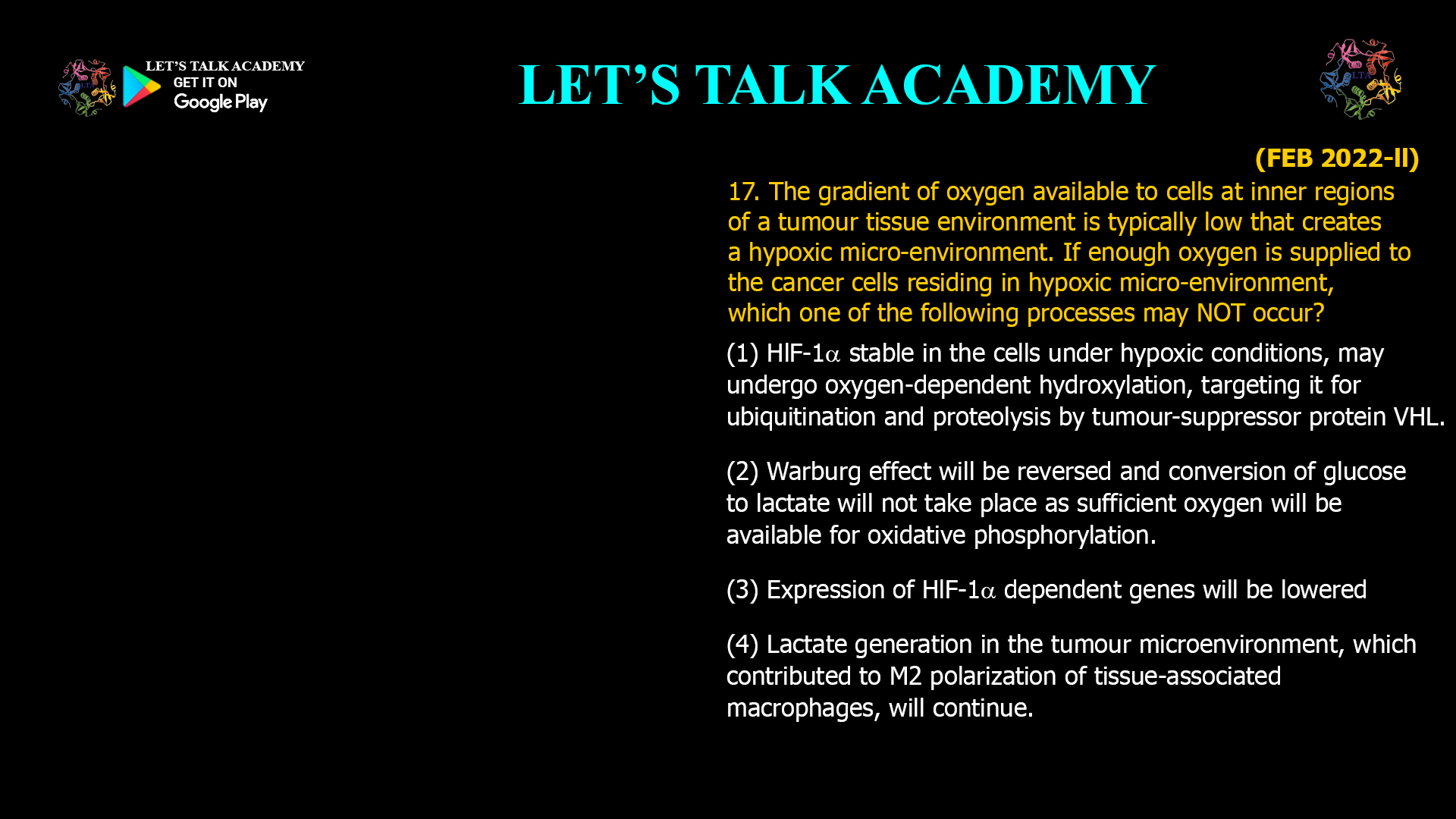
- The gradient of oxygen available to cells at inner regions of a tumour tissue environment is typically low that creates a hypoxic micro-environment. If enough oxygen is supplied to the cancer cells residing in hypoxic micro-environment, which one of the following processes may NOT occur?
(1) HlF-1α stable in the cells under hypoxic conditions, may undergo oxygen-dependent hydroxylation, targeting it for ubiquitination and proteolysis by tumour-suppressor protein VHL.
(2) Warburg effect will be reversed and conversion of glucose to lactate will not take place as
sufficient oxygen will be available for oxidative phosphorylation.
(3) Expression of HlF-1α dependent genes will be lowered
(4) Lactate generation in the tumour microenvironment, which contributed to M2 polarization of tissue-associated macrophages, will continue.1. HIF-1α Regulation Under Oxygen Supply
Hypoxia-inducible factor 1-alpha (HIF-1α) is a transcription factor stabilized under low oxygen conditions. It promotes the expression of genes that facilitate adaptation to hypoxia, including those involved in glycolysis, angiogenesis, and survival.
-
Under normoxia (adequate oxygen): HIF-1α undergoes oxygen-dependent hydroxylation on specific proline residues.
-
This modification targets HIF-1α for recognition by the tumor suppressor protein von Hippel-Lindau (VHL), leading to ubiquitination and proteasomal degradation.
-
Therefore, when oxygen is supplied, HIF-1α is hydroxylated and degraded, reducing its stability and activity.
This process is described in option (1) and is expected to occur with increased oxygen.
2. Warburg Effect and Oxygen Availability
The Warburg effect describes cancer cells’ preference for aerobic glycolysis—converting glucose to lactate even when oxygen is sufficient for oxidative phosphorylation.
-
Reversal of Warburg effect: It is often assumed that providing oxygen would shift metabolism back to oxidative phosphorylation, reducing lactate production.
-
However, research shows that many cancer cells maintain high glycolytic rates and lactate production despite adequate oxygen, due to oncogenic signaling and metabolic reprogramming.
-
Thus, the Warburg effect may persist even with sufficient oxygen, meaning conversion of glucose to lactate continues.
Option (2) claims the Warburg effect will be reversed and lactate production will cease, which is unlikely.
3. Expression of HIF-1α Dependent Genes
Since HIF-1α is degraded under normoxia, the expression of its target genes involved in glycolysis, angiogenesis, and survival decreases.
-
Therefore, expression of HIF-1α dependent genes will be lowered with sufficient oxygen, as stated in option (3).
4. Lactate Generation and Tumor Microenvironment
Lactate accumulation in tumor microenvironments contributes to immune modulation, including M2 polarization of tumor-associated macrophages (TAMs), which supports tumor progression.
-
Given the persistence of aerobic glycolysis in many cancers, lactate generation often continues despite oxygen availability.
-
This supports option (4), indicating lactate production and its immunomodulatory effects persist.
Which Process May NOT Occur?
-
Option (1): HIF-1α degradation via hydroxylation and VHL-mediated proteolysis will occur with oxygen.
-
Option (2): Reversal of the Warburg effect and cessation of lactate production may NOT occur because cancer cells often maintain aerobic glycolysis.
-
Option (3): Lowered expression of HIF-1α dependent genes will occur.
-
Option (4): Continued lactate generation and M2 macrophage polarization will occur.
Thus, the process that may NOT occur is:
(2) Warburg effect will be reversed and conversion of glucose to lactate will not take place as sufficient oxygen will be available for oxidative phosphorylation.
Summary Table
Option Process Description Occurrence with Oxygen Supply (1) HIF-1α hydroxylation and degradation by VHL Occurs (2) Reversal of Warburg effect; no lactate production May NOT occur (3) Lowered expression of HIF-1α dependent genes Occurs (4) Continued lactate generation contributing to M2 macrophage polarization Occurs
Conclusion
Supplying oxygen to cancer cells in a hypoxic tumor microenvironment leads to degradation of HIF-1α and reduced expression of its target genes. However, the Warburg effect—high glycolytic flux and lactate production—often persists despite oxygen availability, supporting tumor growth and immune evasion. Therefore, the Warburg effect reversal and cessation of lactate production may not occur upon oxygen supply.
Correct answer: (2) Warburg effect will be reversed and conversion of glucose to lactate will not take place as sufficient oxygen will be available for oxidative phosphorylation.
Understanding these metabolic dynamics is crucial for developing therapies targeting tumor metabolism and improving cancer treatment outcomes.
-


4 Comments
Pallavi Ghangas
September 22, 2025in warberg effect cancerous cells take much glucose and even in presence of oxygen lactate is formed
Aakansha sharma Sharma
September 22, 2025(4) Lactate generation in the tumour microenvironment, which contributed to M2 polarization of tissue-associated macrophages, will continue is incorrect
Minal Sethi
September 24, 2025Warburg effect will be reversed and conversion of glucose to lactate will not take place as sufficient oxygen will be available for oxidative phosphorylation.
this will not occur
Arushi Saini
September 27, 2025Warburg effect will be reversed and conversion of glucose to lactate will not take place as sufficient oxygen will be available for oxidative phosphorylation.
this will not occur