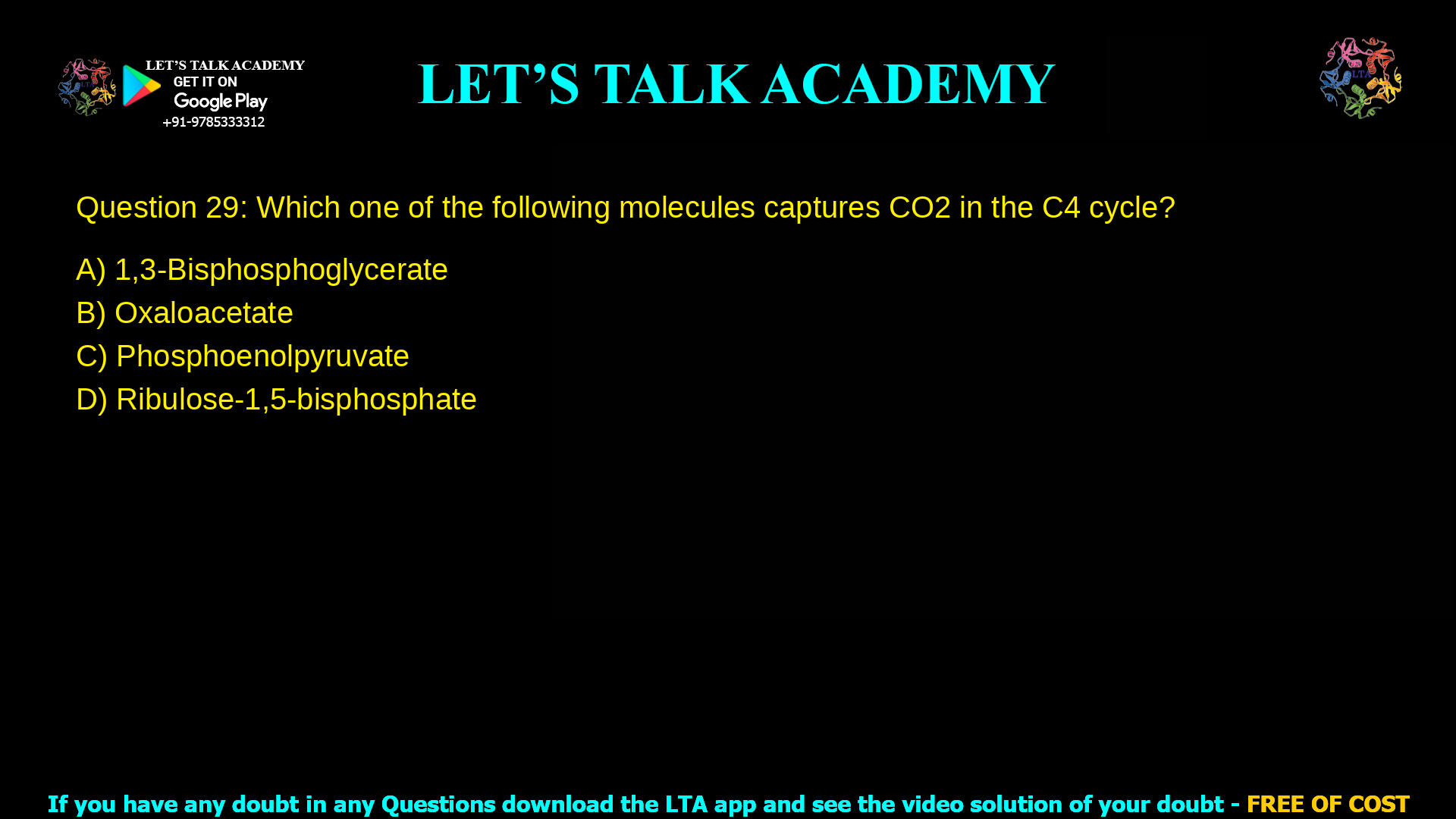
Q.29 Which one of the following molecules captures CO2 in the C4 cycle?
(A) 1,3–Bisphosphoglycerate
(B) Oxaloacetate
(C) Phosphoenolpyruvate
(D) Ribulose–1,5–bisphosphate
Phosphoenolpyruvate (PEP) captures CO2 in the C4 cycle through carboxylation by PEP carboxylase in mesophyll cells, forming the first stable C4 compound oxaloacetate. This initial fixation step distinguishes the C4 pathway from C3 photosynthesis and minimizes photorespiration. The correct answer is (C) Phosphoenolpyruvate.
Option Analysis
-
(A) 1,3-Bisphosphoglycerate: This molecule functions as an intermediate in the Calvin cycle (C3 pathway) during reduction of 3-phosphoglycerate to glyceraldehyde-3-phosphate, and also in glycolysis; it plays no role in initial CO2 capture in C4 plants.
-
(B) Oxaloacetate: Oxaloacetate forms as the first product after PEP captures CO2, but it does not accept CO2 itself; it gets reduced to malate or converted to aspartate for transport to bundle sheath cells.
-
(C) Phosphoenolpyruvate: PEP, a 3-carbon molecule, directly fixes CO2 in mesophyll cell chloroplasts via PEP carboxylase, producing oxaloacetate—this is the primary CO2 acceptor in the C4 cycle.
-
(D) Ribulose-1,5-bisphosphate: RuBP serves as the CO2 acceptor in the C3 Calvin cycle via RuBisCO, but in C4 plants, RuBisCO and RuBP operate only in bundle sheath cells after CO2 concentration.
The molecule that captures CO2 in C4 cycle is phosphoenolpyruvate (PEP), enabling efficient photosynthesis in tropical plants like maize and sugarcane. This C4 carbon fixation process, also called the Hatch-Slack pathway, pumps CO2 to bundle sheath cells to avoid photorespiration.
C4 Cycle Steps
CO2 fixation starts in mesophyll cells where PEP carboxylase adds CO2 to PEP, yielding oxaloacetate (OAA)—a 4-carbon acid. OAA converts to malate or aspartate, travels to bundle sheath cells, decarboxylates to release CO2, and enters the Calvin cycle via RuBisCO.
-
PEP + CO2 → OAA (mesophyll, PEP carboxylase)
-
OAA → malate/aspartate (transport)
-
Malate decarboxylation → CO2 + pyruvate (bundle sheath)
-
Pyruvate regenerates PEP (via ATP)
This spatial separation boosts efficiency in hot, dry conditions.
C4 vs C3 Pathway
C4 plants fix CO2 twice: initial PEP-based capture, then RuBP in Calvin cycle. C3 plants use only RuBP via RuBisCO, risking oxygenation and photorespiration.
| Feature | C3 Pathway | C4 Pathway |
|---|---|---|
| Primary CO2 Acceptor | RuBP (5C) | PEP (3C) |
| First Enzyme | RuBisCO | PEP carboxylase |
| Cells Involved | Mesophyll only | Mesophyll + bundle sheath |
| Photorespiration | High in heat | Minimal |
Exam Relevance for CSIR NET
For CSIR NET Life Sciences, memorize PEP as the molecule captures CO2 in C4 cycle—options like oxaloacetate confuse as product, not acceptor. Practice diagrams of Kranz anatomy.


2 Comments
Sonal Nagar
January 5, 2026Phosphoenolpyruvate
Bhanwar
January 21, 2026PEP☑️