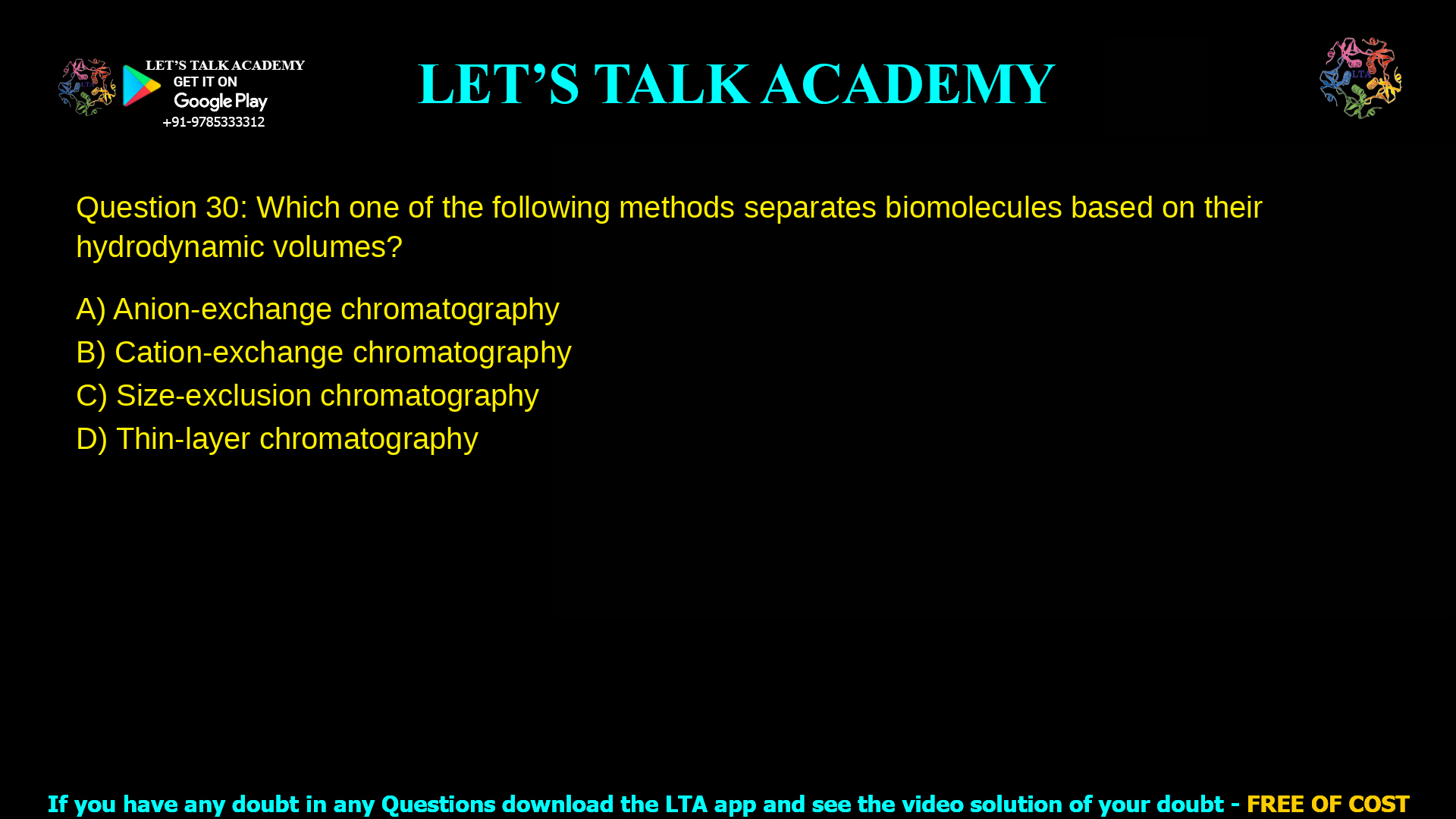
Q.30 Which one of the following methods separates biomolecules based on their
hydrodynamic volumes?
(A) Anion–exchange chromatography
(B) Cation–exchange chromatography
(C) Size–exclusion chromatography
(D) Thin–layer chromatography
Size-exclusion chromatography separates biomolecules based on their hydrodynamic volumes, making it the correct answer for this question. This method is essential in biochemistry for purifying proteins and other macromolecules without relying on charge or affinity. Below is a detailed explanation of each option, followed by an SEO-optimized article tailored for CSIR NET Life Sciences aspirants.
Option Analysis
(A) Anion-Exchange Chromatography
This technique uses a positively charged stationary phase to bind negatively charged (anionic) biomolecules. Separation occurs based on differences in net negative charge and ionic strength of the eluent, not size or hydrodynamic volume.
(B) Cation-Exchange Chromatography
Here, a negatively charged stationary phase attracts positively charged (cationic) biomolecules. Molecules elute by varying pH or salt concentration, relying on charge interactions rather than physical size.
(C) Size-Exclusion Chromatography
Also called gel filtration, this method employs a porous matrix where larger biomolecules with greater hydrodynamic volumes elute first (in the void volume), while smaller ones enter pores and elute later. It directly separates based on hydrodynamic volume, independent of charge or hydrophobicity.
(D) Thin-Layer Chromatography
TLC separates small molecules on a stationary phase (like silica) using a mobile phase, based on differential partitioning driven by polarity and solubility. It does not use hydrodynamic volume and suits low-molecular-weight compounds, not large biomolecules.
Correct Answer: (C) Size-exclusion chromatography.
Size-exclusion chromatography stands out as the key method that separates biomolecules based on their hydrodynamic volumes, a critical concept for CSIR NET Life Sciences preparation. This technique, also known as gel filtration chromatography, enables precise purification of proteins, nucleic acids, and polysaccharides by leveraging molecular size in solution. Understanding its principles alongside other chromatography types ensures exam success in molecular biology and biochemistry sections.
Hydrodynamic Volume in Size-Exclusion Chromatography
Hydrodynamic volume refers to the effective size a biomolecule occupies in solution, influenced by shape, solvation, and conformation. In size-exclusion chromatography, porous beads act as the stationary phase; larger molecules (high hydrodynamic volume) cannot enter pores and elute quickly, while smaller ones delay by diffusing in and out. Calibration with standards like thyroglobulin plots elution volume against log of molecular weight for accurate sizing.
Comparison of Chromatography Methods
| Method | Separation Basis | Stationary Phase | Best For |
|---|---|---|---|
| Anion-Exchange | Net negative charge | Positively charged resin | Acidic proteins |
| Cation-Exchange | Net positive charge | Negatively charged resin | Basic proteins |
| Size-Exclusion | Hydrodynamic volume | Porous gel beads | Size-based purification |
| Thin-Layer | Polarity/solubility | Silica/alumina plate | Small molecules |
This table highlights why size-exclusion chromatography uniquely targets hydrodynamic volumes for biomolecule separation.
Applications in Life Sciences
Researchers use size-exclusion chromatography for protein desalting, aggregate removal, and determining molecular weights in biotechnology. Combined with dynamic light scattering, it measures absolute hydrodynamic radii without calibration. For CSIR NET, focus on its non-denaturing nature versus charge-based methods.


2 Comments
Sonal Nagar
January 5, 2026Size–exclusion chromatography
Bhanwar
January 21, 2026Size-exclusion chromatography
C☑️