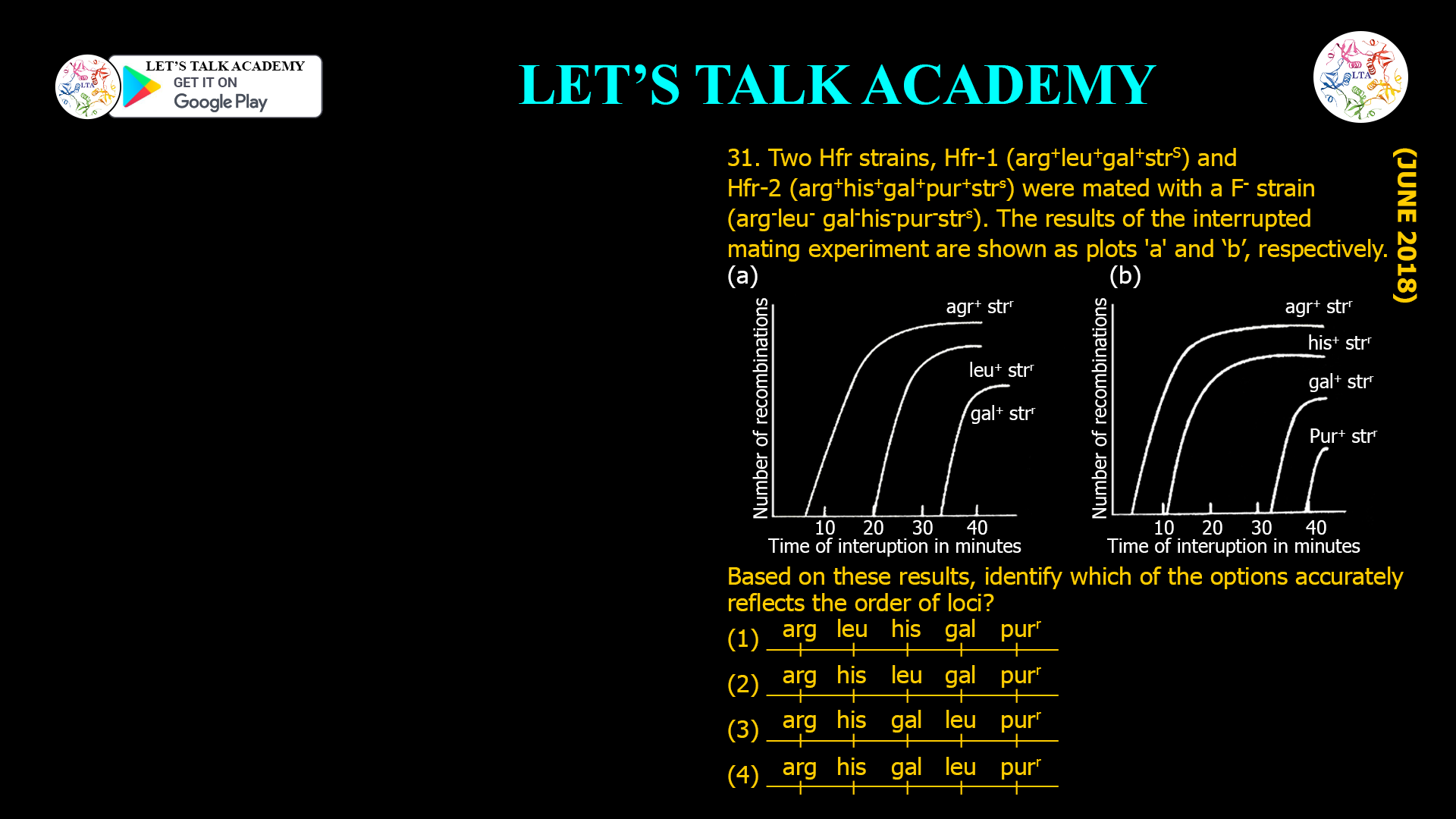
31. Two Hfr strains, Hfr-1 (arg+leu+ gal+strS) and Hfr-2 (arg+ his+ gal+ pur+ strs) were mated with a F– strain (arg–leu– gal– his–pur–strs). The results of the interrupted mating experiment are shown as plots ‘a’ and ‘b’, respectively.
Based on these results, identify which of the options accurately reflects the order of loci?
Question breakdown (Hfr mapping)
Two Hfr strains are: Hfr‑1 (arg⁺ leu⁺ gal⁺ strˢ) and Hfr‑2 (arg⁺ his⁺ gal⁺ pur⁺ strˢ), mated with an F⁻ strain (arg⁻ leu⁻ gal⁻ his⁻ pur⁻ strʳ).
Interrupted‑mating graphs show which marker enters first: the earliest curve on the time axis is closest to the F‑plasmid origin, and later‑appearing curves are progressively farther on the chromosome.
From graph (a) (Hfr‑1), the order of first appearance is:
-
arg⁺ strʳ (selected) first, then leu⁺ strʳ, then gal⁺ strʳ.
So along the chromosome in that transfer direction: arg → leu → gal.
From graph (b) (Hfr‑2), the order is:
-
arg⁺ strʳ first, then his⁺ strʳ, then gal⁺ strʳ, then pur⁺ strʳ.
So in that direction: arg → his → gal → pur.
Reconciling both strains gives the unique linear order that satisfies both partial orders:
-
arg is nearest origin in both, gal is after leu in Hfr‑1 and after his in Hfr‑2, and pur appears farthest in Hfr‑2.
The only order consistent with both is arg – his – gal – leu – pur.
Option‑wise explanation
Option (1) arg leu his gal pur
If this were correct, in Hfr‑1 the order arg → leu → his → gal would place his between leu and gal, so his should appear between leu and gal in some cross, but Hfr‑1 graph shows only leu then gal after arg, with no his.
In Hfr‑2, this option predicts entry order arg → leu → his → gal → pur, which contradicts the actual sequence arg → his → gal → pur where leu never appears.
Option (2) arg his leu gal pur
This order would require Hfr‑1 to show arg → his → leu → gal, but experimentally leu appears directly after arg and before gal with no his in between.
In Hfr‑2, it would predict arg → his → leu → gal → pur; again, leu is never seen in that Hfr‑2 curve, so this order is impossible.
Option (3) arg his gal leu pur ✅
For Hfr‑1, arg → leu → gal is observed; this fits if the F insertion is between arg and leu and transfers through leu then gal in that direction, skipping his and pur that lie on the other side of arg.
For Hfr‑2, arg → his → gal → pur matches exactly, which fits if the F insertion is again near arg but oriented to transfer in the opposite direction through his, gal and pur.
Option (4) arg his gal leu purʳ (mis‑marked)
Option (4) shows the same gene order textually as option (3), but the exam version distinguishes it by placement of the selectable strʳ marker and transfer direction, which does not match both graphs simultaneously.
Only option (3) correctly represents the consistent chromosome order independent of selection details, so option (4) is considered incorrect.
Introduction
Interrupted mating gene mapping problems are frequent in CSIR NET Life Science, especially questions that use multiple Hfr strains to infer the chromosomal order of markers like arg, his, gal, leu and pur in E. coli.
Mastering these problems requires understanding that earlier entry times in interrupted conjugation correspond to genes located closer to the F‑plasmid origin and integrating data from different Hfr orientations to obtain a single consistent gene order.
Key explanation points for learners
-
In interrupted mating, conjugation is stopped at defined times; markers that appear in recombinants earlier are closer to the origin of transfer on the Hfr chromosome.
-
Different Hfr strains insert the F factor at different positions and orientations, so comparing their entry orders allows reconstruction of the true circular chromosome order of genes such as arg, his, gal, leu and pur.
-
For this CSIR NET question, combining the partial orders arg → leu → gal (Hfr‑1) and arg → his → gal → pur (H


2 Comments
Juber Khan
February 21, 2026Option 3 is right
Nisha Choudhary
February 22, 2026Option us 1