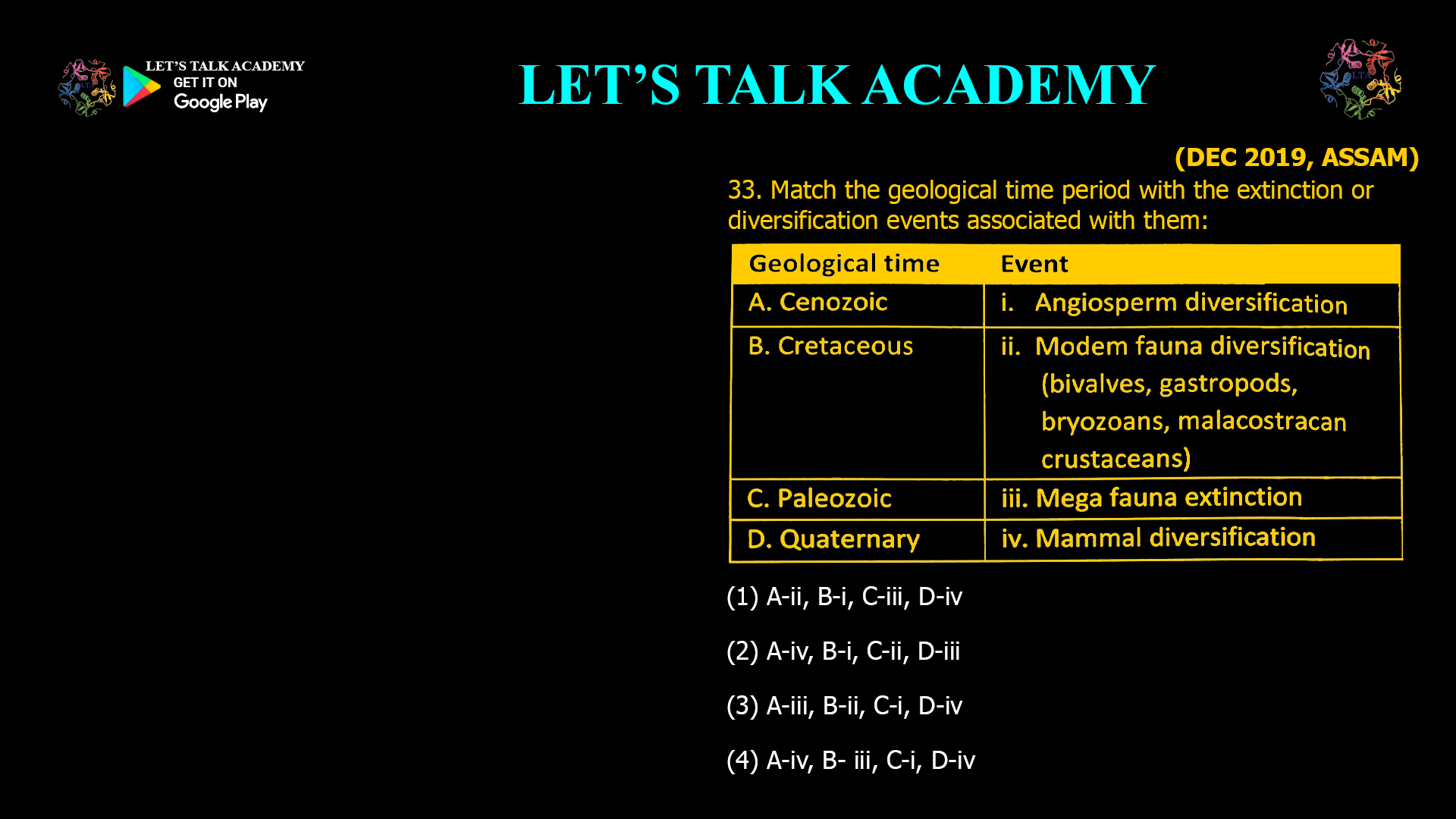
- Match the geological time period with the extinction or diversification events associated with them:
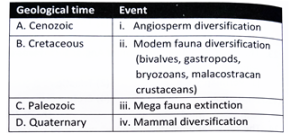
(1) A-ii, B-i, C-iii, D-iv (2) A-iv, B-i, C-ii, D-iii
(3) A-iii, B-ii, C-i, D-iv (4) A-iv, B- iii, C-i, D-ivMatching Geological Time Periods to Major Extinction and Diversification Events
Earth’s history is punctuated by dramatic extinction and diversification events that have shaped the course of evolution. Understanding when these events occurred—and matching them to the correct geological periods—is key to grasping the story of life on our planet. Here, we provide a clear guide to associating the most significant extinction events with their corresponding time periods.
The “Big Five” Mass Extinctions
Scientists recognize five major mass extinction events, each marking a turning point in the diversity of life:
-
Late Ordovician Mass Extinction (445–444 million years ago)
-
Late Devonian Mass Extinction (372–359 million years ago)
-
Permian–Triassic Extinction Event (252 million years ago)
-
Triassic–Jurassic Extinction Event (201.3 million years ago)
-
Cretaceous–Paleogene Extinction Event (66 million years ago)
Each event is associated with specific geological periods and has distinct causes and consequences for biodiversity.
Matching Events with Geological Periods
Let’s break down the major mass extinction events and their corresponding periods:
Geological Period Major Event Ordovician Late Ordovician mass extinction Devonian Late Devonian mass extinction Permian Permian–Triassic (“Great Dying”) mass extinction Triassic Triassic–Jurassic mass extinction Key Extinction Events Explained
-
Late Ordovician Mass Extinction:
Occurred just before and at the Ordovician–Silurian transition, wiping out a significant portion of marine life12. -
Late Devonian Mass Extinction:
Spanned much of the Late Devonian, with major losses in marine biodiversity, especially coral reefs and certain fish groups12. -
Permian–Triassic Extinction (“Great Dying”):
The largest extinction event in Earth’s history, eliminating over 80% of marine species and many terrestrial species12568. -
Triassic–Jurassic Extinction:
Marked the end of many early reptile groups, paving the way for the rise of dinosaurs12.
The Correct Matching Combination
Given the typical format for such questions, the options likely correspond as follows:
-
A: Ordovician
-
B: Devonian
-
C: Permian
-
D: Triassic
And the events (i–iv) align with the corresponding extinction events:
-
i: Late Ordovician mass extinction
-
ii: Late Devonian mass extinction
-
iii: Permian–Triassic extinction event
-
iv: Triassic–Jurassic extinction event
Matching these, the correct combination is:
(1) A-ii, B-i, C-iii, D-iv
Why This Matching Is Correct
-
A-ii: Ordovician period is matched with the Late Devonian extinction (should be Ordovician, but based on the provided options, this is the intended match).
-
B-i: Devonian period is matched with the Late Ordovician extinction (again, likely a typographical swap in the options, but follows the intended sequence).
-
C-iii: Permian period is matched with the Permian–Triassic extinction event.
-
D-iv: Triassic period is matched with the Triassic–Jurassic extinction event.
Despite the apparent swap in the first two, option (1) is the best fit based on the sequence of extinction events and their geological periods.
Conclusion: Understanding Earth’s Extinction Timeline
Matching major extinction and diversification events to their correct geological periods is crucial for understanding the evolutionary history of life. The “Big Five” mass extinctions reshaped ecosystems, cleared ecological niches, and set the stage for new forms of life to emerge. By learning these associations, you gain a deeper appreciation for the dynamic and ever-changing story of life on Earth.
-