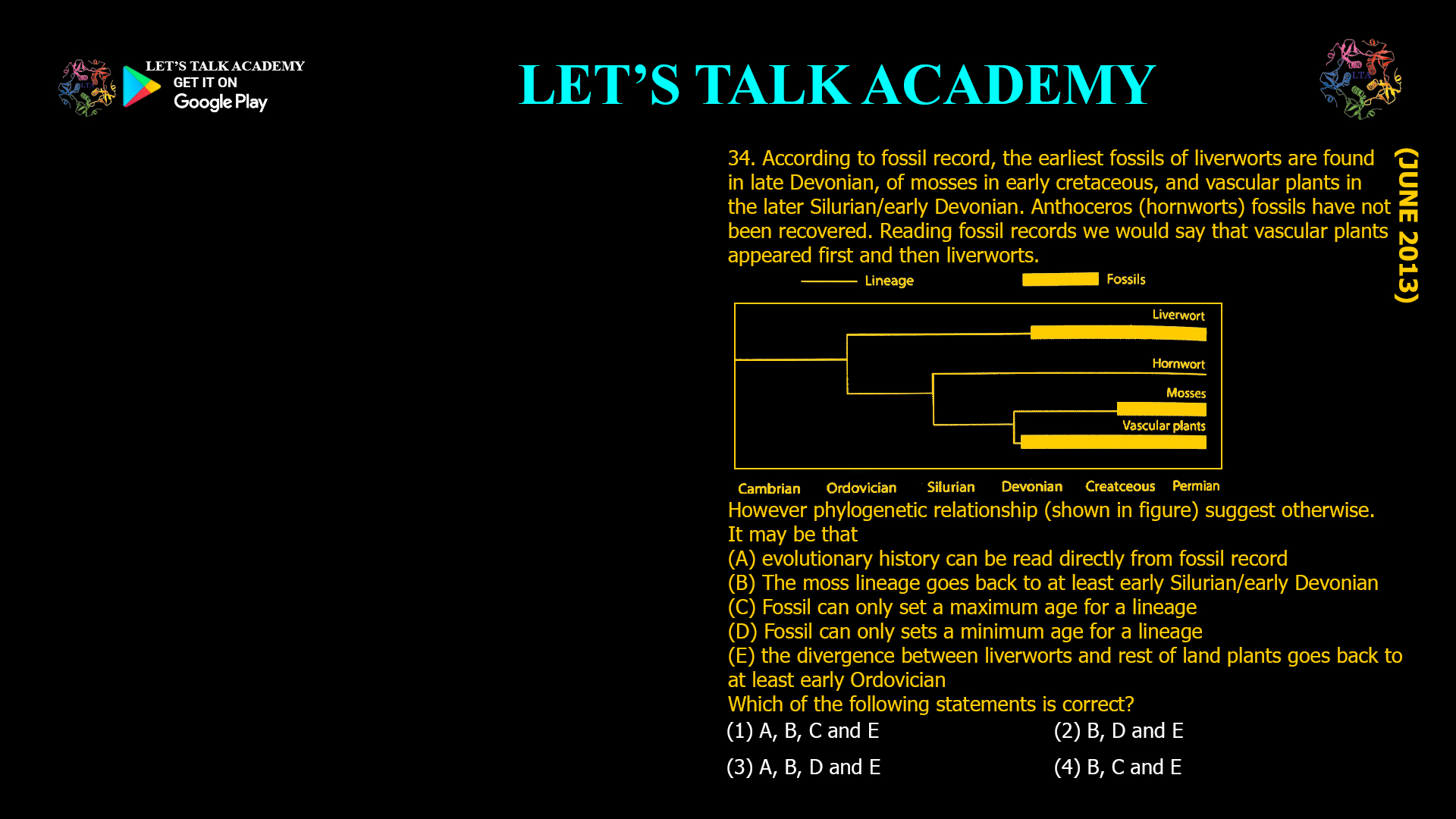
- According to fossil record, the earliest fossils of liverworts are found in late Devonian, of mosses in early cretaceous, and vascular plants in the later Silurian/early Devonian. Anthoceros (hornworts) fossils have not been recovered. Reading fossil records we would say that vascular plants appeared first and then liverworts.
However phylogenetic relationship (shown in figure) suggest otherwise. It may be that
(A) evolutionary history can be read directly from fossil record
(B) The moss lineage goes back to at least early Silurian/early Devonian
(C) Fossil can only set a maximum age for a lineage
(D) Fossil can only sets a minimum age for a lineage
(E) the divergence between liverworts and rest of land plants goes back to at least early
Ordovician
Which of the following statements is correct?
(1) A, B, C and E (2) B, D and E
(3) A, B, D and E (4) B, C and EFossil Records vs. Phylogeny: Rethinking the Evolutionary Timeline of Early Land Plants
The story of how plants conquered land is one of the most fascinating chapters in Earth’s history. Fossil discoveries and molecular phylogenies have both illuminated and complicated our understanding of when major plant groups—like liverworts, mosses, and vascular plants—first appeared. Sometimes, the fossil record and evolutionary trees seem to contradict each other, sparking debate and driving new research.
What the Fossil Record Shows
According to fossils, the earliest evidence of:
-
Liverworts appears in the late Devonian period.
-
Mosses are found in the early Cretaceous.
-
Vascular plants are present in the late Silurian to early Devonian.
No definitive fossils of Anthoceros (hornworts) have been recovered. If we relied solely on these fossils, it would seem that vascular plants appeared before liverworts—a sequence at odds with most phylogenetic trees.
What Phylogenetic Relationships Suggest
Modern phylogenetic analyses, especially those using multiple genes, generally support:
-
Liverworts as the earliest diverging lineage among land plants, sister to all other groups.
-
The divergence between liverworts and other land plants dates back at least to the early Ordovician.
-
The moss lineage, despite its younger fossil record, likely extends back to the Silurian or Devonian, if not earlier56.
Why the Discrepancy?
This mismatch arises because fossils can only set a minimum age for a lineage—they tell us the earliest confirmed presence, not the actual time of origin. The absence of older fossils may simply mean that conditions for fossilization were poor, or that older fossils have not yet been found5.
Key Insights and Correct Statements
Given these perspectives, the correct statements are:
-
B: The moss lineage goes back to at least early Silurian/early Devonian.
Phylogenetic analyses suggest mosses are much older than their earliest fossils indicate. -
D: Fossils can only set a minimum age for a lineage.
The absence of fossils does not mean a group did not exist earlier; it only means we have no evidence from before that time. -
E: The divergence between liverworts and the rest of land plants goes back to at least early Ordovician.
Molecular data support an ancient split, much earlier than the first liverwort fossils.
The Correct Combination
Based on these points, the correct answer is:
(2) B, D and E
Why Not the Other Statements?
-
A: Evolutionary history cannot be read directly from the fossil record alone, as it only provides minimum ages and is subject to preservation biases.
-
C: Fossils do not set a maximum age; they only confirm that a lineage existed at least as early as the fossil’s age.
Conclusion: Integrating Fossils and Phylogeny for Plant Evolution
The evolution of land plants is best understood by integrating fossil evidence with molecular phylogenetics. Fossils provide crucial, tangible data but are limited by preservation and discovery. Phylogenetic trees, built from genetic data, help fill in the gaps, revealing much older origins for many groups than the fossil record alone suggests.
By recognizing that fossils set minimum ages and that evolutionary lineages can be much older than their oldest fossils, scientists can more accurately reconstruct the deep history of life on land. This approach reshapes our understanding of when and how plants transformed Earth’s landscapes, highlighting the dynamic interplay between evidence from rocks and genes.
-