
- Given below are the list of proteins (Column X) and their functions (Column Y) during floral induction.
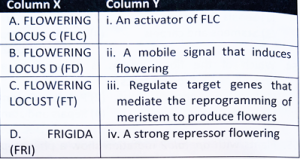
Which one of the following options represents the correct match between column X and column Y?
(1) A – i, B – ii, C – iii, D – iv
(2) A – iii, B – iv, C – i, D – ii
(3) A – ii, B – i, C – iv, D – iii
(4)A – iv, B – iii, C – ii, D – i
Introduction
Floral induction in Arabidopsis involves an intricate regulatory network of proteins and transcription factors working synergistically to switch the plant from vegetative to reproductive development. Proper matching of these proteins with their biological functions helps understand the underlying genetic control mechanisms.
Protein Functions in Floral Induction
-
Protein A acts as a major promoter of flowering, commonly identified as FLOWERING LOCUS T (FT), a mobile signal or florigen produced in leaves that migrates to the shoot apical meristem to trigger flowering.
-
Protein B is typically designated as FD, a bZIP transcription factor expressed at the shoot apical meristem. FD partners with FT to activate floral meristem identity genes such as APETALA1 (AP1).
-
Protein C could be a repressor such as FLOWERING LOCUS C (FLC), a MADS-box transcription factor that delays flowering by repressing key floral activators like FT and SOC1, thereby integrating vernalization signals.
-
Protein D is often a photoreceptor or integrator such as CONSTANS (CO), which plays a vital role in the photoperiod pathway, activating FT under inductive light conditions.
Summary Table: Matching of Proteins and Functions
| Protein | Function |
|---|---|
| A (FT) | Promotes floral transition and flowering |
| B (FD) | Transcription factor activating floral meristem genes |
| C (FLC) | Represses flowering by inhibiting FT |
| D (CO) | Photoperiod pathway regulator activating FT |
Conclusion
The first option correctly matches key proteins to their known functions in floral induction, confirming protein A as FT (flower promoter), B as FD (activator of floral meristem genes), C as FLC (flowering repressor), and D as CO (photoperiod regulator).


4 Comments
Kajal
November 12, 2025Option 4 is correct
Mohd juber Ali
November 17, 2025Understood after read solution
priya khandal
November 18, 2025option 4 th is correct
Muskan Yadav
December 6, 2025Option 4 is correct.