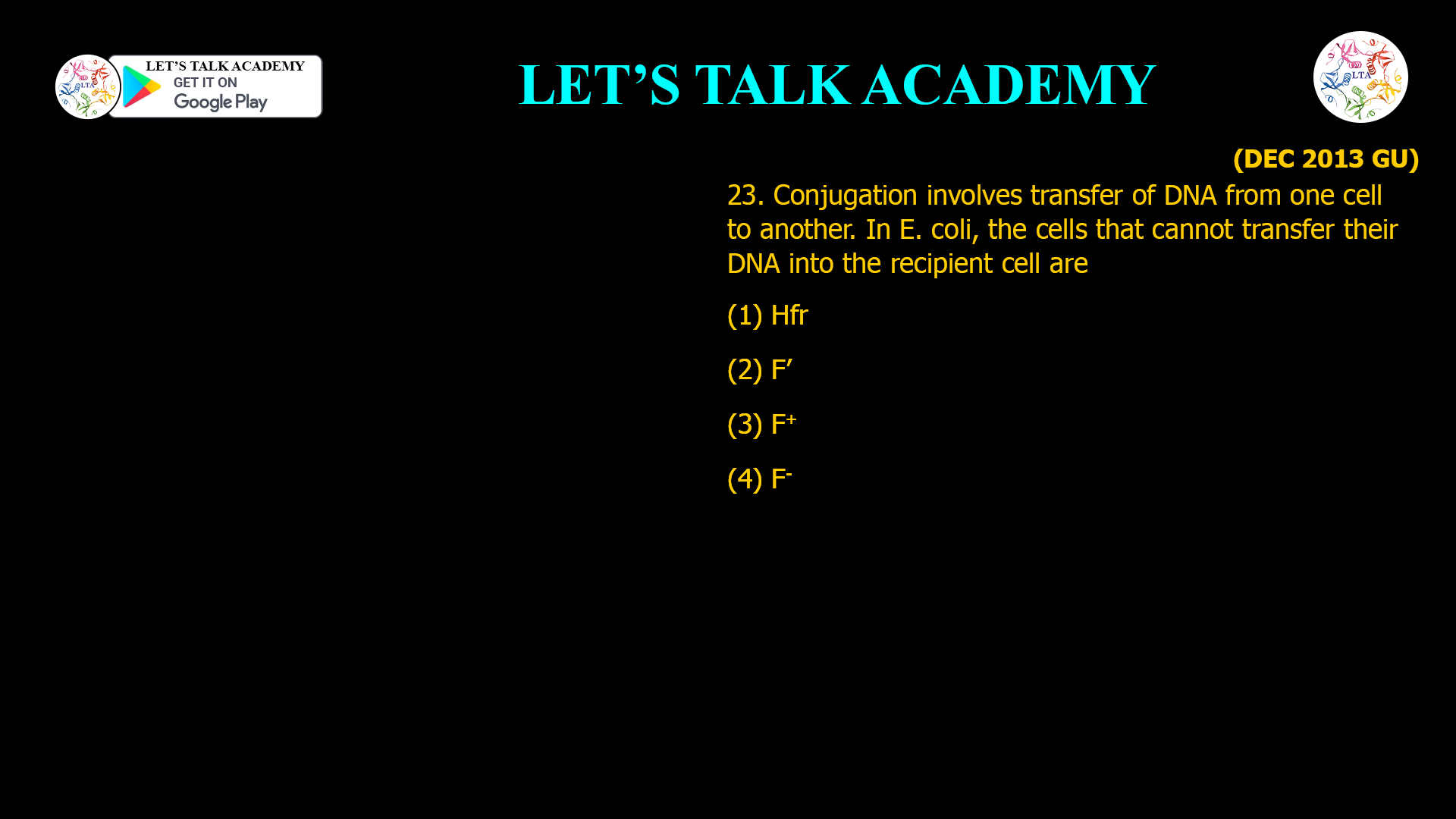
23. Conjugation involves transfer of DNA from one cell to another. In E. coli, the cells that cannot transfer their DNA into the recipient cell are
(1) Hfr (2) F’
(3) F+ (4) F–
Introduction
E coli conjugation cells cannot transfer DNA refers to bacterial genetic exchange where donor cells with F plasmid transfer DNA via a pilus to recipients. In E. coli, this process distinguishes donor types like Hfr, F+, and F’ from recipients, crucial for CSIR NET Life Sciences exam prep on horizontal gene transfer. Understanding which E coli conjugation cells cannot transfer DNA helps clarify donor-recipient dynamics in molecular genetics.
Question and Correct Answer
Conjugation involves transfer of DNA from one cell to another. In E. coli, the cells that cannot transfer their DNA into the recipient cell are (4) F-. F- cells lack the F plasmid, acting only as recipients without sex pili for initiating transfer. This unidirectional process ensures DNA moves solely from donors to F- recipients during conjugation.
Option-by-Option Analysis
-
(1) Hfr: High frequency recombination (Hfr) cells integrate the F plasmid into their chromosome, enabling transfer of chromosomal DNA alongside F factor to recipients via conjugation pilus. They actively donate large DNA segments, unlike non-donors.
-
(2) F’: F prime (F’) cells carry an F plasmid with chromosomal genes excised from Hfr, allowing transfer of both plasmid and extra genes to F- recipients during conjugation. These donors spread hybrid plasmids efficiently.
-
(3) F+: F+ cells possess autonomous F plasmids, producing sex pili to transfer complete F plasmid copies to F- recipients, converting them to F+. F+ donors initiate conjugation rapidly across populations.
-
(4) F- (Correct): F- cells lack F plasmid and sex pili, preventing DNA transfer; they receive but cannot donate, remaining recipients post-conjugation. This defines their role in E coli conjugation experiments.


2 Comments
Juber Khan
February 21, 2026All three option are donor so transfer dna but f➖is recipient can not transfer dna
Nisha Choudhary
February 22, 2026Ans F-