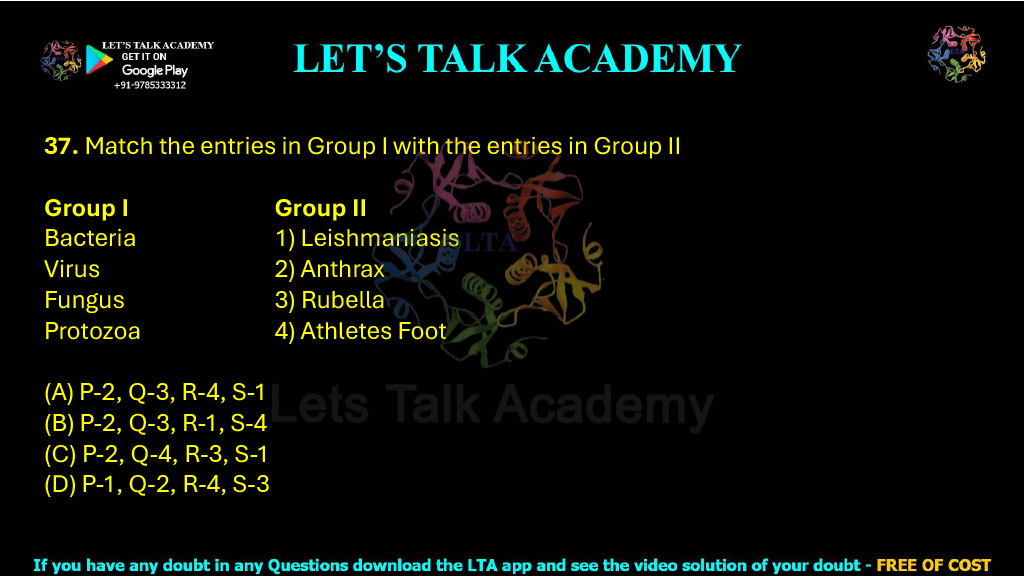
37. Match the entries in Group I with the entries in Group II
Group I Group II
Bacteria 1) Leishmaniasis
Virus 2) Anthrax
Fungus 3) Rubella
Protozoa 4) Athletes Foot
(A) P-2, Q-3, R-4, S-1
(B) P-2, Q-3, R-1, S-4
(C) P-2, Q-4, R-3, S-1
(D) P-1, Q-2, R-4, S-3
Match the Disease with Its Causative Microorganism: Bacteria, Virus, Fungus, and Protozoa Explained
Introduction
Microorganisms are responsible for a wide variety of infectious diseases affecting humans, animals, and plants. Based on their cellular organization and biological characteristics, disease-causing microorganisms are classified into bacteria, viruses, fungi, protozoa, and parasites. Correct identification of the causative organism is essential for disease diagnosis, treatment, epidemiology, and prevention. Since different groups of microorganisms respond to different classes of antimicrobial drugs, understanding their classification is also fundamental in clinical microbiology.
Among the most frequently discussed infectious diseases in microbiology are Anthrax, caused by a bacterium, Rubella, caused by a virus, Athlete’s Foot, caused by fungi, and Leishmaniasis, caused by protozoan parasites. These disease-organism associations are repeatedly tested in competitive examinations because they represent classic examples of bacterial, viral, fungal, and protozoan infections.
Correct Answer
Correct Option: (A)
P – 2, Q – 3, R – 4, S – 1
Detailed Explanation
Anthrax is a bacterial disease caused by Bacillus anthracis, a Gram-positive, spore-forming bacterium. The disease primarily affects herbivorous animals but can also infect humans through contact with infected animals or contaminated animal products. Depending on the route of infection, anthrax may occur as cutaneous, inhalational, or gastrointestinal anthrax.
Rubella, commonly known as German measles, is caused by the Rubella virus, a positive-sense single-stranded RNA virus belonging to the family Matonaviridae. Although generally mild in children and adults, Rubella infection during pregnancy can result in congenital rubella syndrome, making vaccination extremely important.
Athlete’s Foot, also called Tinea pedis, is a superficial fungal infection affecting the skin of the feet. It is commonly caused by dermatophytes such as Trichophyton rubrum, Trichophyton mentagrophytes, and Epidermophyton floccosum. Warm and moist environments promote fungal growth, making this infection common among athletes.
Leishmaniasis is a protozoan disease caused by species of the genus Leishmania. The parasite is transmitted by the bite of infected female sandflies (Phlebotomus or Lutzomyia). Clinical forms include cutaneous, mucocutaneous, and visceral leishmaniasis (Kala-azar).
Therefore, the correct matching is:
- Bacteria → Anthrax
- Virus → Rubella
- Fungus → Athlete’s Foot
- Protozoa → Leishmaniasis
Explanation of Each Match
P. Bacteria → Anthrax
This match is correct. Anthrax is caused by Bacillus anthracis, a Gram-positive spore-forming bacterium.
Q. Virus → Rubella
This match is correct. Rubella is caused by the Rubella virus and is prevented by the MMR vaccine.
R. Fungus → Athlete’s Foot
This match is correct. Athlete’s Foot is a dermatophyte fungal infection affecting the skin of the feet.
S. Protozoa → Leishmaniasis
This match is correct. Leishmaniasis is caused by protozoan parasites belonging to the genus Leishmania.
Why Option (A) is Correct
Option (A) correctly matches every microorganism with the disease it causes based on standard medical microbiology classification.
Why the Other Options are Incorrect
Option (B)
This option incorrectly assigns fungal diseases to Leishmaniasis and protozoan diseases to Athlete’s Foot.
Option (C)
This option incorrectly classifies Athlete’s Foot as a viral disease and Rubella as a fungal disease.
Option (D)
This option incorrectly matches bacteria with Leishmaniasis and protozoa with Rubella.
Comparison of All Options
| Option | Matching | Status |
|---|---|---|
| A | P-2, Q-3, R-4, S-1 | Correct |
| B | P-2, Q-3, R-1, S-4 | Incorrect |
| C | P-2, Q-4, R-3, S-1 | Incorrect |
| D | P-1, Q-2, R-4, S-3 | Incorrect |
Major Human Diseases and Their Causative Organisms
| Disease | Causative Organism | Microorganism Type |
|---|---|---|
| Anthrax | Bacillus anthracis | Bacterium |
| Rubella | Rubella virus | Virus |
| Athlete’s Foot | Trichophyton species | Fungus |
| Leishmaniasis | Leishmania species | Protozoan |
Quick Comparison of Microorganisms
| Microorganism | Cell Type | Example Disease |
|---|---|---|
| Bacteria | Prokaryotic | Anthrax |
| Virus | Acellular | Rubella |
| Fungus | Eukaryotic | Athlete’s Foot |
| Protozoa | Eukaryotic | Leishmaniasis |
Biological Significance
Correct identification of disease-causing microorganisms is essential for selecting appropriate antimicrobial therapy and designing preventive strategies. Bacterial infections are treated with antibiotics, fungal infections require antifungal drugs, protozoan diseases respond to antiprotozoal medications, and viral infections often require antiviral therapy or vaccination. Accurate classification therefore plays a critical role in clinical microbiology, epidemiology, and public health.
Final Answer
Correct Option: (A)
P – 2, Q – 3, R – 4, S – 1
- Bacteria → Anthrax
- Virus → Rubella
- Fungus → Athlete’s Foot
- Protozoa → Leishmaniasis


