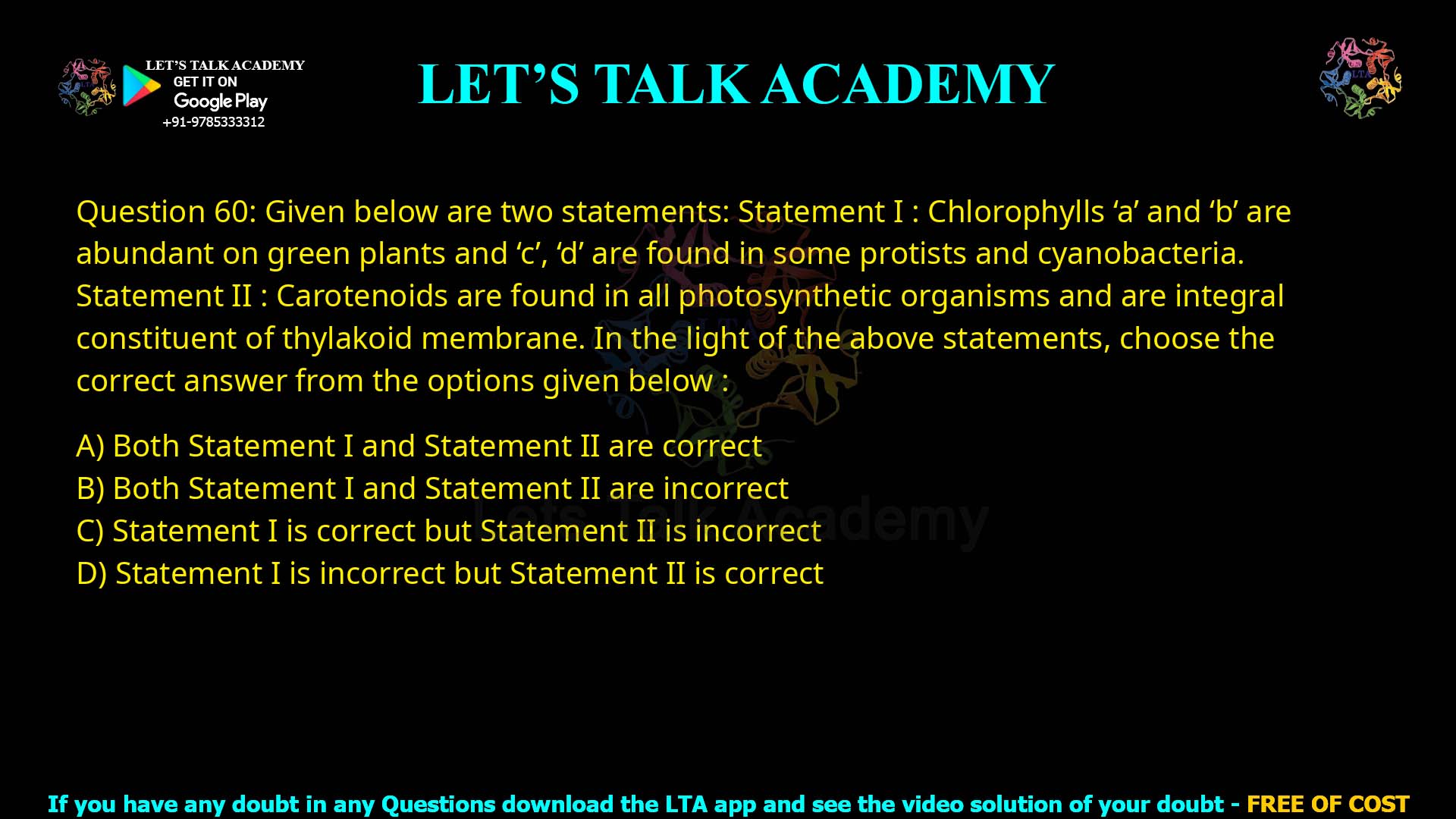
Q.60 Given below are two statements :
Statement I :
Chlorophylls ‘a’ and ‘b’ are abundant in green plants and ‘c’, ‘d’ are found
in some protists and cyanobacteria.
Statement II :
Carotenoids are found in all photosynthetic organisms and are integral
constituent of thylakoid membrane.
In the light of the above statements, choose the correct answer from the options given below :
- Both Statement I and Statement II are correct
- Both Statement I and Statement II are incorrect
- Statement I is correct but Statement II is incorrect
- Statement I is incorrect but Statement II is correct
Both statements about chlorophylls and carotenoids are correct, so the first option is right. Chlorophyll a and b dominate in green plants while c and d appear in specific protists and cyanobacteria, and carotenoids universally integrate into thylakoid membranes across photosynthetic organisms.
Chlorophyll Distribution
Chlorophyll a serves as the universal photosynthetic pigment, abundant alongside chlorophyll b in green plants and green algae. Chlorophyll c occurs in diatoms, brown algae, and dinoflagellates (protists), while chlorophyll d appears in some cyanobacteria and red algae.
Carotenoid Role
Carotenoids act as accessory pigments in all photosynthetic organisms, embedded within thylakoid membranes to aid light harvesting, photoprotection, and antenna complex stability.
Statement Evaluation
-
Statement I (Correct): Matches precise distribution—chlorophylls a/b in green plants; c/d in protists (e.g., diatoms) and cyanobacteria.
-
Statement II (Correct): Carotenoids universally present and structurally integral to thylakoids, not merely accessory.
Option Analysis
| Option |
Why Valid/Invalid |
Correct? |
| Both correct |
Aligns with pigment distribution and membrane integration facts. |
Yes |
| Both incorrect |
Contradicts verified chlorophyll locations and carotenoid universality. |
No |
| I correct, II incorrect |
Undermines carotenoids’ essential thylakoid role. |
No |
| I incorrect, II correct |
Misrepresents chlorophyll c/d habitats. |
No |
Chlorophylls a b green plants dominate photosynthesis while c d protists cyanobacteria adapt specific niches; carotenoids thylakoid membrane integration spans all photosynthetic lifeforms, essential for GATE Life Sciences mastery.
Chlorophyll Types
Chlorophyll a universal, b green plant-specific; c in brown algae protists, d cyanobacterial.
Carotenoid Universality
Present everywhere photosynthetic, thylakoid-embedded for protection and energy transfer.
Exam Strategy
Both statements precise, selecting option (1) for pigment biology questions.