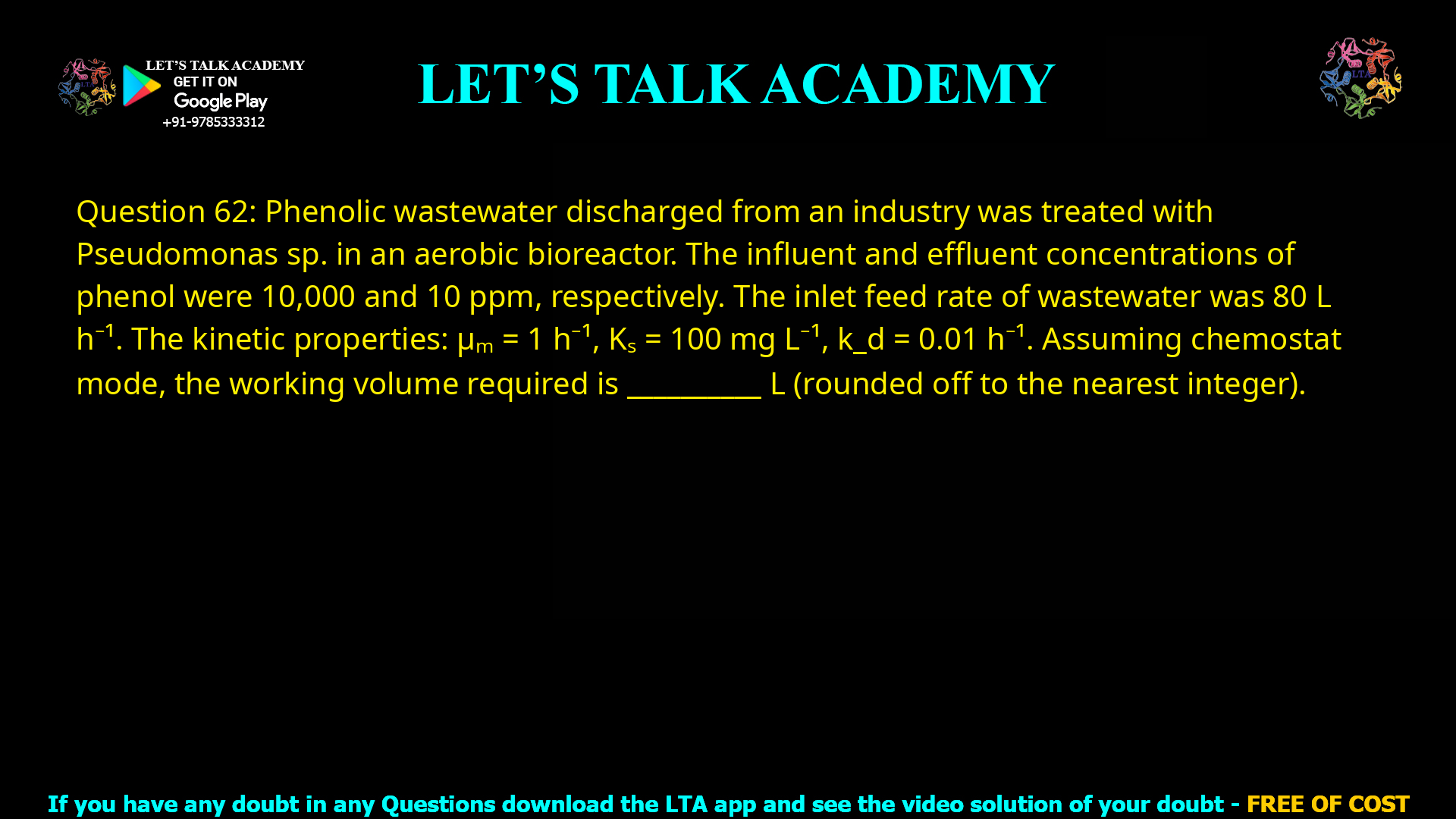
Q.62 Phenolic wastewater discharged from an industry was treated with Pseudomonas sp. in an aerobic bioreactor.
The influent and effluent concentrations of phenol were 10,000 and 10 ppm, respectively.
The inlet feed rate of wastewater was 80 L h−1.
The kinetic properties of the organism are as follows:
- Maximum specific growth rate (μm) = 1 h−1
- Saturation constant (KS) = 100 mg L−1
- Cell death rate (kd) = 0.01 h−1
Assuming that the bioreactor operates under ‘chemostat’ mode, the working volume required for this process is ________ L (rounded off to the nearest integer).
Final Answer
Working volume ≈ 8100 L (≈ 8.0 × 10³ L)
Given Data
- Influent phenol concentration S₀ = 10,000 mg/L = 10 g/L
- Effluent phenol concentration S = 10 mg/L = 0.01 g/L
- Flow rate F = 80 L/h
- Maximum specific growth rate μm = 1 h⁻¹
- Saturation constant KS = 100 mg/L = 0.1 g/L
- Death rate kd = 0.01 h⁻¹
Chemostat and Dilution Rate
D = F / V
At steady state (no washout): D = μ – kd
Step 1 — Monod Kinetics
μ = μm × S / (KS + S)
μ = 1 × 0.01 / (0.1 + 0.01) = 0.01 / 0.11 ≈ 0.0909 h⁻¹
Step 2 — Net Growth
μnet = μ – kd = 0.0909 – 0.01 = 0.0809 h⁻¹
Therefore, D = μnet ≈ 0.0809 h⁻¹
Step 3 — Working Volume
V = F / D
V = 80 / 0.0809 ≈ 8.0 × 10³ L
Rounded volume: ≈ 8100 L
Interpretation
This large volume ensures adequate residence time for Pseudomonas sp. to oxidize phenol from 10 g/L to 0.01 g/L, accounting for substrate limitation and microbial decay.
Introduction
Designing a bioreactor for phenolic wastewater treatment requires proper calculation of the chemostat working volume for phenolic wastewater treatment so that microorganisms like Pseudomonas can degrade high-strength phenol influent effectively.
Chemostat Principles
- Feed equals effluent → constant volume
- Dilution rate D = F/V
- At steady state, D = μnet
- μnet = μ − kd
Applying Monod Kinetics
μm = 1 h⁻¹, KS = 0.1 g/L, S = 0.01 g/L → μ ≈ 0.0909 h⁻¹
μnet = 0.0809 h⁻¹ → D = 0.0809 h⁻¹
Volume Result
With flow 80 L/h, V ≈ 80/0.0809 ≈ 8 × 10³ L = 8100 L


