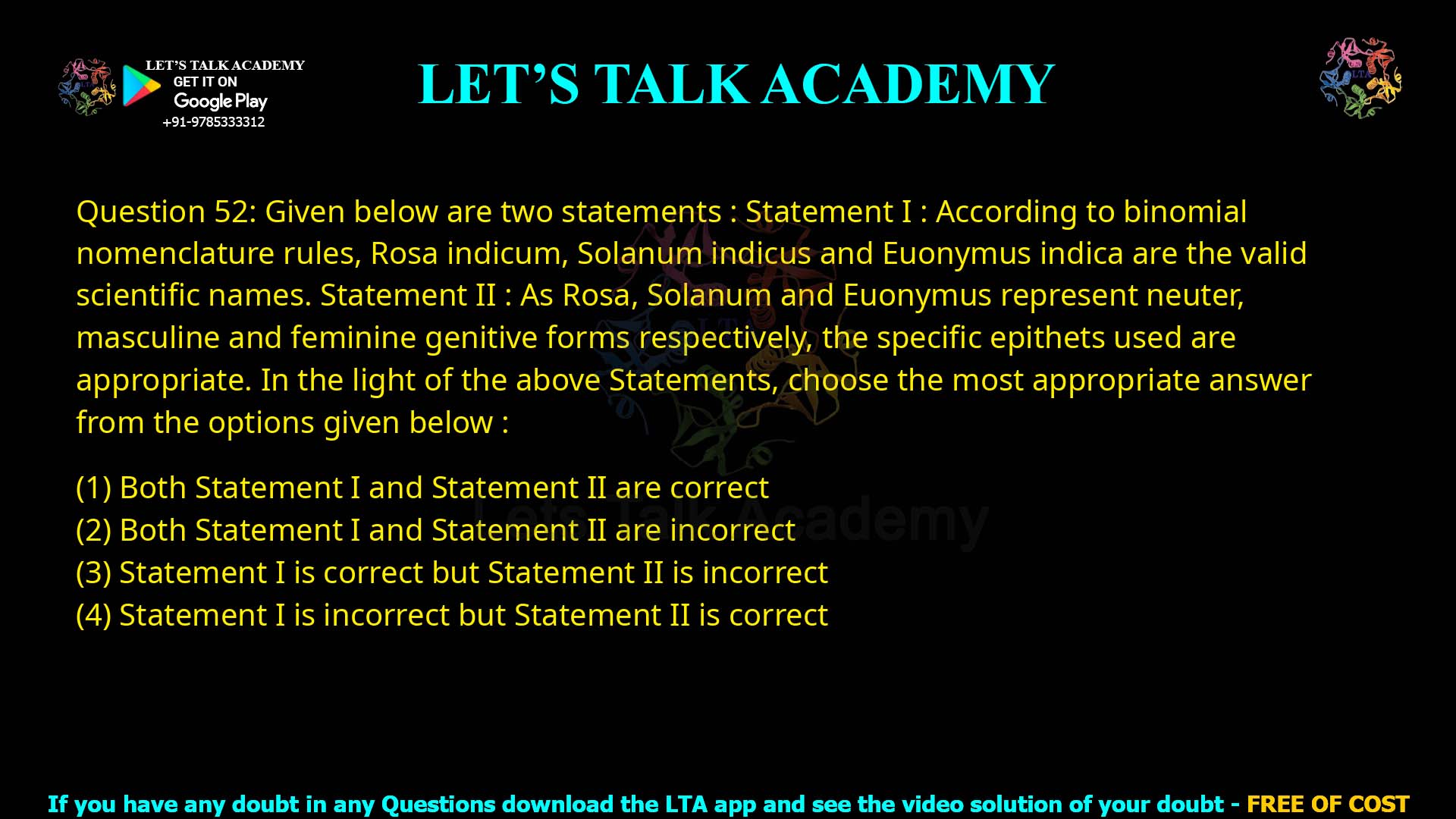
Q.52 Given below are two statements:
Statement I : According to binomial nomenclature rules,
Rosa indicum, Solanum indicus and Euonymus indica
are the valid scientific names.
Statement II : As Rosa, Solanum and Euonymus
represent neuter, masculine and feminine genitive forms respectively,
the specific epithets used are appropriate.
In the light of the above Statements, choose the most appropriate answer:
Both Statement I and Statement II are incorrect
Statement I is correct but Statement II is incorrect
Statement I is incorrect but Statement II is correct
Both Statement I and Statement II are incorrect.
Question Breakdown
The query tests binomial nomenclature rules from the International Code of Nomenclature for algae, fungi, and plants (ICN), focusing on genus-specific epithet agreement and validity of names like Rosa indicum, Solanum indicus, and Euonymus indica. Statement I claims these are valid scientific names, while Statement II attributes validity to supposed gender forms of the genera (neuter, masculine, feminine) matching the epithet indicum, indicus, or indica.
Option Analysis
-
Both Statement I and Statement II correct: Incorrect, as indicum/indicus/indica violate ICN Article 23.5 on identical endings; specific epithets must not repeat the genus name’s ending exactly. Rosa indicum (Rosa ends -a, indicum ends -um), Solanum indicus (Solanum ends -um, indicus ends -us), and Euonymus indica (Euonymus ends -us, indica ends -a) all share matching endings, making them invalid regardless of gender.
-
Both incorrect: Correct answer. Statement I fails due to the repetition rule (ICN priority over gender). Statement II wrongly classifies genera genders—Rosa (feminine), Solanum (neuter), Euonymus (masculine)—but indica/indicum/indicus (adjective/adjective/noun in apposition from “India”) do not require such matching here, and repetition invalidates anyway.
-
Statement I correct, II incorrect: Wrong, since Statement I is false per repetition prohibition; gender mismatch in II is secondary.
-
Statement I incorrect, II correct: Incorrect, as II misstates genders (Rosa not neuter; Solanum not masculine) and overlooks repetition rule.
Binomial nomenclature Rosa indicum Solanum indicus Euonymus indica is a classic trap in exams like NEET and GATE Life Sciences, testing ICN rules on specific epithet validity.
Core ICN Rules
Binomial names have a capitalized genus (e.g., Rosa) and lowercase specific epithet (e.g., indica), both italicized. Epithets must agree in gender with the genus if adjectival, but nouns in apposition (like indica, from “India”) retain fixed form. Crucially, Article 23.5 bans epithets with the same ending as the genus stem—indicum repeats Rosa‘s -um sound, invalidating it.
Why Names Fail
-
Rosa indicum: Rosa (feminine) expects indica; indicum (neuter) mismatches gender and repeats -um ending. Invalid.
-
Solanum indicus: Solanum (neuter) fits indic-um, but indicus (masculine) mismatches and repeats -us. Invalid.
-
Euonymus indica: Euonymus (masculine) expects indic-us; indica (feminine) mismatches and repeats -a indirectly via stem. Invalid.
Correct forms might be Rosa indica, Solanum indicum, Euonymus indicus, but repetition still voids them.
Exam Tip
Prioritize repetition (Art. 23.5) over gender (Art. 23.4)—it’s the decisive flaw here. Practice with tautonyms or Mangifera indica examples.


