17.
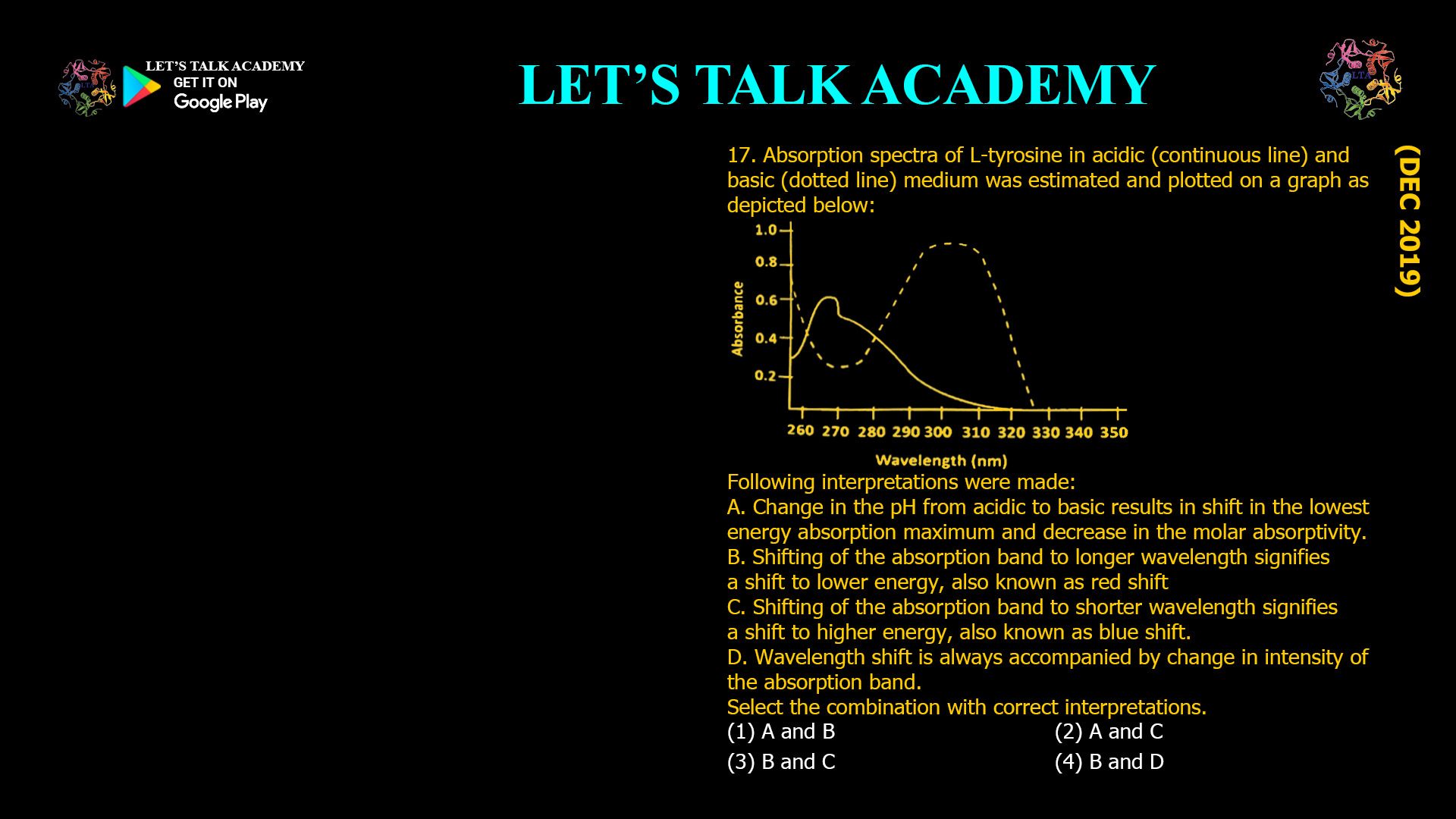
Absorption spectra of L-tyrosine in acidic (continuous line) and basic (dotted line) medium was estimated and plotted on a graph as depicted below:
Following interpretations were made:
A. Change in the pH from acidic to basic results in shift in the lowest energy absorption maximum and decrease in the molar absorptivity.
B. Shifting of the absorption band to longer wavelength signifies a shift to lower energy, also known as red shift.
C. Shifting of the absorption band to shorter wavelength signifies a shift to higher energy, also known as blue shift.
D. Wavelength shift is always accompanied by change in intensity of the absorption band.
Select the combination with correct interpretations.
(1) A and B
(2) A and C
(3) B and C
(4) B and D
Bathochromic and Hypsochromic Shift in UV-Visible Spectroscopy of Tyrosine: Understanding the Effect of pH on the Absorption Spectrum
Ultraviolet-visible (UV-Visible) spectroscopy is one of the most widely used analytical techniques in biochemistry, molecular biology, biotechnology, pharmaceutical sciences, and analytical chemistry. The absorption spectrum of a molecule depends on the electronic transitions occurring within its chromophores. Aromatic amino acids such as tyrosine, tryptophan, and phenylalanine possess conjugated π-electron systems that readily absorb ultraviolet light. Changes in pH alter the electronic environment of these chromophores, leading to measurable changes in both the position and intensity of absorption bands. These spectral changes provide valuable information about molecular structure, ionization state, protein conformation, and intermolecular interactions.
Correct Answer
Option (3): Statements B and C are Correct
The correct answer is Option (3). Statements B and C describe the universally accepted definitions of bathochromic and hypsochromic shifts in UV-Visible spectroscopy. A shift toward a longer wavelength corresponds to lower photon energy because wavelength and energy are inversely related. This phenomenon is called a bathochromic or red shift. Conversely, a shift toward a shorter wavelength corresponds to higher photon energy and is known as a hypsochromic or blue shift.
Statement A is incorrect because the graph shows that the absorption maximum shifts toward a longer wavelength in basic medium, but the molar absorptivity actually increases rather than decreases. Statement D is also incorrect because wavelength shifts and intensity changes are independent spectral phenomena. A molecule may exhibit a wavelength shift without any significant change in absorbance intensity.
Understanding the UV-Visible Spectrum of Tyrosine
Tyrosine contains an aromatic phenolic ring that functions as a chromophore capable of absorbing ultraviolet radiation through π→π* electronic transitions. In acidic solution, the phenolic hydroxyl group remains protonated. Under alkaline conditions, deprotonation generates the phenolate ion, increasing electron delocalization within the aromatic ring. This enhanced conjugation lowers the energy required for electronic excitation and shifts the absorption maximum toward longer wavelengths.
The increased electron delocalization also strengthens the probability of electronic transitions, often producing a higher absorbance. Therefore, alkaline conditions frequently produce both a bathochromic shift and a hyperchromic effect for tyrosine.
Why Statement A is Incorrect
Decrease in Molar Absorptivity Does Not Match the Spectrum
The first part of Statement A correctly recognizes that changing the pH alters the position of the absorption maximum. However, the second part claims that the molar absorptivity decreases. Examination of the spectrum shows the opposite trend. The absorption peak in basic medium is noticeably higher than that in acidic medium, indicating an increase rather than a decrease in molar absorptivity.
This increase in absorption intensity is known as the hyperchromic effect. Consequently, Statement A is only partially correct and is therefore considered incorrect.
Why Statement B is Correct
Longer Wavelength Means Lower Energy
The energy of electromagnetic radiation is described by the equation:
E = hc / λ
where E is energy, h is Planck’s constant, c is the speed of light, and λ is wavelength.
Since wavelength appears in the denominator, increasing wavelength decreases photon energy. Therefore, when an absorption band shifts toward a longer wavelength, the electronic transition requires less energy. This phenomenon is universally known as the bathochromic shift or red shift.
The alkaline spectrum of tyrosine clearly demonstrates this effect because its major absorption peak moves toward longer wavelengths after deprotonation of the phenolic group.
Why Statement C is Correct
Shorter Wavelength Means Higher Energy
A shift toward shorter wavelengths represents the opposite phenomenon. Because photon energy increases as wavelength decreases, absorption at shorter wavelengths corresponds to higher-energy electronic transitions.
This movement of an absorption maximum toward shorter wavelengths is called the hypsochromic shift or blue shift. Hypsochromic shifts commonly occur when conjugation decreases, solvent polarity changes, or structural modifications increase the energy gap between molecular orbitals.
Statement C therefore provides the correct definition of a hypsochromic shift.
Why Statement D is Incorrect
Wavelength Shift and Intensity Change are Independent Phenomena
A wavelength shift does not necessarily alter the height of an absorption peak. Spectral position and absorption intensity are governed by different physical factors. The position of an absorption maximum depends mainly on the energy difference between molecular electronic states, whereas absorbance intensity depends on transition probability and molar absorptivity.
Some molecules exhibit only a bathochromic or hypsochromic shift with almost no change in absorbance intensity. Others display hyperchromic or hypochromic effects without significant movement of the absorption maximum. Therefore, wavelength shifts are not always accompanied by changes in absorption intensity.
Bathochromic, Hypsochromic, Hyperchromic, and Hypochromic Effects
These four spectral phenomena are fundamental concepts in UV-Visible spectroscopy. A bathochromic shift represents movement of an absorption band toward longer wavelengths, whereas a hypsochromic shift represents movement toward shorter wavelengths. A hyperchromic effect refers to an increase in absorbance intensity, while a hypochromic effect refers to a decrease in absorbance intensity. Because these effects arise from different molecular mechanisms, they may occur independently or simultaneously depending on the chemical system being studied.
Importance in Protein and Biochemical Research
Changes in UV absorption spectra are widely used to investigate protein folding, enzyme catalysis, ligand binding, nucleic acid structure, drug interactions, and protein conformational changes. The ionization of aromatic amino acids such as tyrosine often produces characteristic spectral shifts that reveal changes in molecular environment. Researchers routinely analyze bathochromic and hypsochromic shifts to understand structural transitions and intermolecular interactions in biological systems.
Final Answer
Correct Option: (3) Statements B and C.
Changing the pH from acidic to basic alters the electronic structure of tyrosine, producing a bathochromic (red) shift toward longer wavelengths because the phenolate ion has greater electron delocalization and requires less energy for excitation. A shift toward shorter wavelengths is known as a hypsochromic (blue) shift because it corresponds to higher-energy electronic transitions. Although the graph also shows an increase in absorbance intensity, this does not mean that wavelength shifts are always accompanied by intensity changes. Therefore, only Statements B and C are universally correct, making Option (3) the correct answer.


