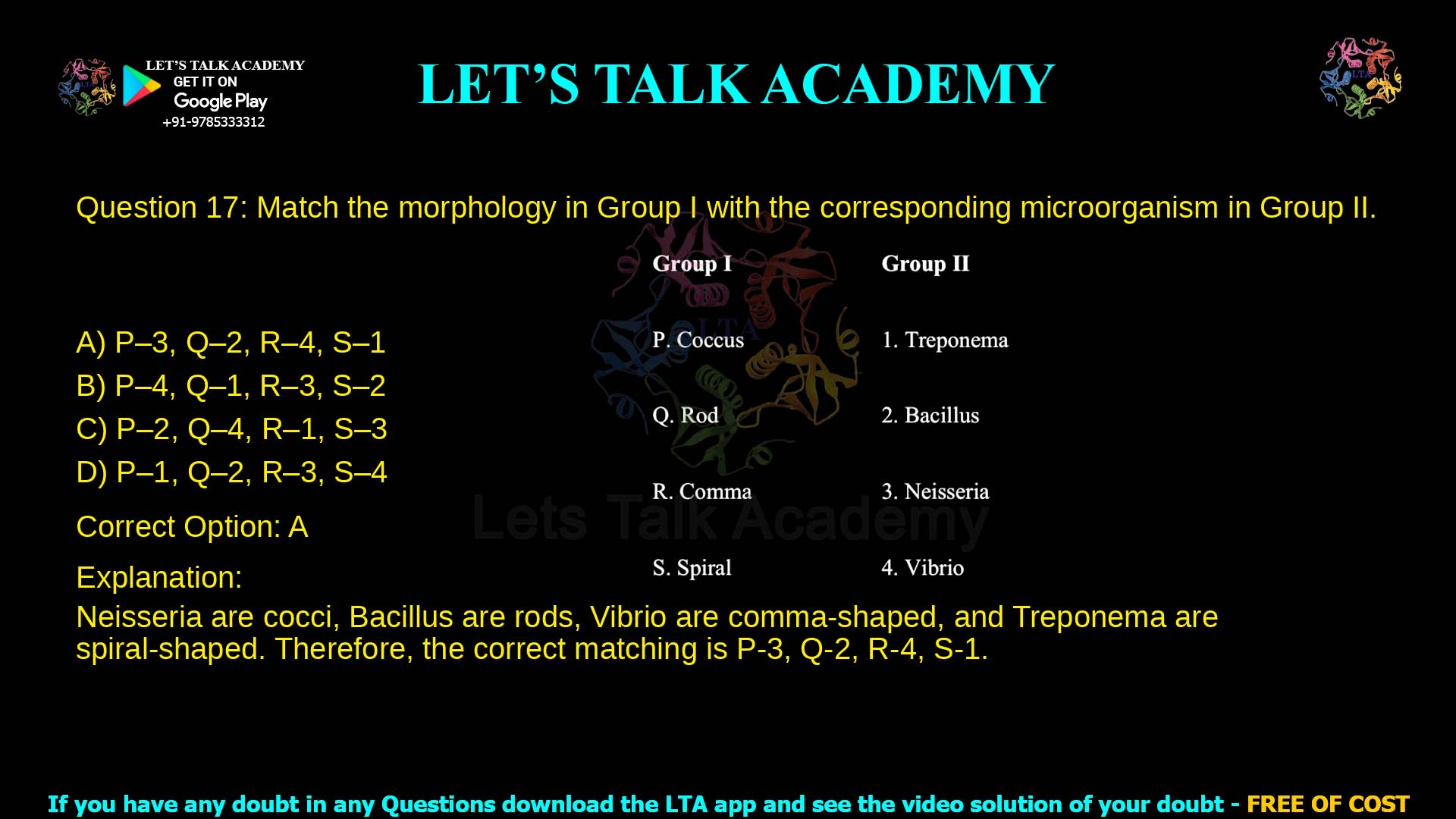
Q.17 Match the morphology in Group I with the corresponding microorganism
in Group II
Group I Group II
P. Coccus 1. Treponema
Q. Rod 2. Bacillus
R. Comma 3. Neisseria
S. Spiral 4. Vibrio
(A) P – 3, Q – 2, R – 4, S – 1
(B) P – 4, Q – 1, R – 3, S – 2
(C) P – 2, Q – 4, R – 1, S – 3
(D) P – 1, Q – 2, R – 3, S – 4
The correct answer is (A) P – 3, Q – 2, R – 4, S – 1. This matches coccus to Neisseria, rod to Bacillus, comma to Vibrio, and spiral to Treponema based on standard bacterial shapes observed under microscopy.
Morphology Matches
Coccus (P) describes spherical bacteria, best exemplified by Neisseria (3), which forms gram-negative diplococci resembling coffee beans in pairs. Rod (Q) refers to elongated bacilli, directly matching Bacillus (2), a gram-positive genus with straight, cylindrical cells often forming chains or endospores. Comma (R) shape fits Vibrio (4), curved rods like Vibrio cholerae with a single bend, less than one full twist. Spiral (S) aligns with Treponema (1), a spirochete featuring flexible, helical coils for corkscrew motility via endoflagella.
Option Analysis
Option (A) correctly pairs each shape: P-3 (coccus-Neisseria), Q-2 (rod-Bacillus), R-4 (comma-Vibrio), S-1 (spiral-Treponema), aligning with textbook morphologies.
Option (B) mismatches all: P-4 (coccus-Vibrio, curved not spherical), Q-1 (rod-Treponema, helical not straight), R-3 (comma-Neisseria, spherical), S-2 (spiral-Bacillus, rod).
Option (C) fails on multiple: P-2 (coccus-Bacillus, rod), Q-4 (rod-Vibrio, comma), R-1 (comma-Treponema, spiral), S-3 (spiral-Neisseria, coccus).
Option (D) incorrect: P-1 (coccus-Treponema, spiral), with others swapped wrongly.
| Group I | Correct Match | Shape Description | Key Example Traits |
|---|---|---|---|
| P. Coccus | 3. Neisseria | Spherical, diplococci | Gram-negative, 0.6-1 μm, paired |
| Q. Rod | 2. Bacillus | Straight rods | Gram-positive, spore-forming |
| R. Comma | 4. Vibrio | Curved, <1 twist | Motile, comma-like |
| S. Spiral | 1. Treponema | Helical, flexible | Spirochete, endoflagella |
Bacterial shapes aid identification in diagnostics and CSIR NET Unit 2 (Cell Biology). Neisseria causes gonorrhea/meningitis; Bacillus includes anthracis; Vibrio cholerae triggers diarrhea; Treponema pallidum syphilis. Practice visualizing Gram stains for exams.


