



























































53. E class homeotic genes in Arabidopsis thaliana are involved in the formation of: (a) Floral meristem (b) Petals and carpels (c) Sepals & petals (d) Shoot apical meristem Introduction […]
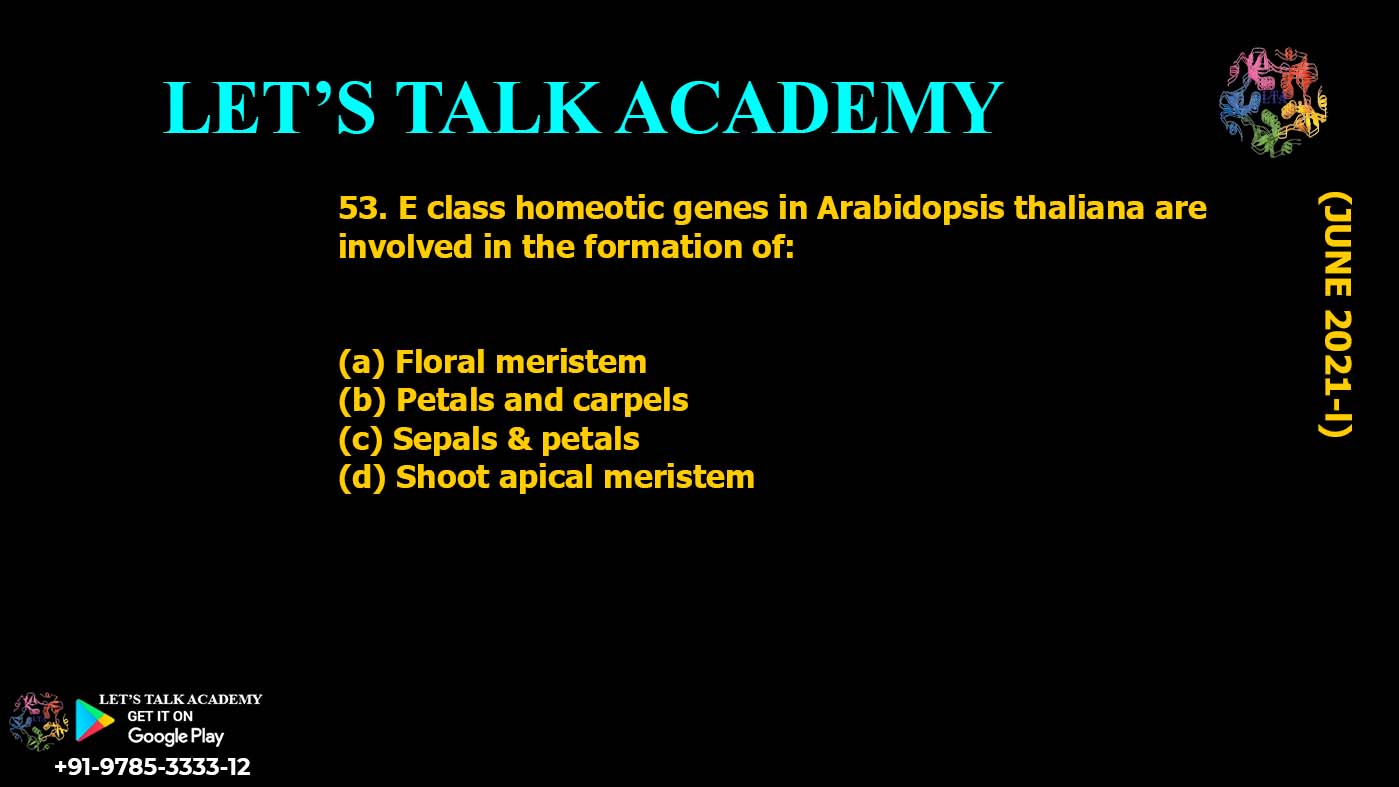

53. E class homeotic genes in Arabidopsis thaliana are involved in the formation of: (a) Floral meristem (b) Petals and carpels (c) Sepals & petals (d) Shoot apical meristem Introduction […]
Embryonic stem cells are 1. unipotent 2. totipotent 3. pluripotent 4. differentiated Introduction Embryonic stem cells (ESCs) have revolutionized the field of developmental biology and regenerative medicine due to their […]
95. Colour blindness (B) in human follows sex-linked recessive mode of inheritance. If a couple with normal colour vision have a colour-blind son. What will be the genotypes of the […]

52. Which one of the following combinations signify similar function? (a) Cryptochrome and flurochrome (b) Cryptochrome and phytochrome (c) Cytochrome and cryptochrome (d) Fluorochrome and cytochrome Introduction Light is a […]
94. You have two tubes containing bacteriophage labelled with radioactive phosphorous (tube A) and radioactive Sulphur (tube B) that are devoid of bacteria. You use these bacteriophage to infect separate […]
The malarial parasite that has caused recent outbreaks of Monkey malaria in humans is 1. Plasmodium berghei 2. Plasmodium vivax 3. Plasmodium knowlesi 4. Plasmodium malariae Introduction In recent years, […]

51. Which one of the following statements is NOT common between oxidativephosphorylation and photophosphorylation? (a) Generation of ATP (b) Involvement of a kinase (c) Involvement of electron transport (d) Involvement […]
93. A scientist performs a series of experiments to determine the recombination frequencies between the following genes. He acquires the following data: P – Q: 3%; Q – R: 2%; […]

50. Which one among the following is a nuclease? (a) DNase I (b) Helicase (c) Ligase (d) Polymerase What is a Nuclease? A nuclease is an enzyme responsible for cleaving […]
The primary structure of a protein is stabilized by 1. the angle formed between plane ABD and plane ACD 2. covalent bond 3. ionic bond 4. hydrogen bonds Introduction […]


