



























































































Fragmentation breaks up contiguous tracts of natural habitats into smaller patches. In a fragmented landscape where a previously large forest has become a mosaic of patches of different sizes, the […]


Fragmentation breaks up contiguous tracts of natural habitats into smaller patches. In a fragmented landscape where a previously large forest has become a mosaic of patches of different sizes, the […]

Fragmentation breaks up contiguous tracts of natural habitats into smaller patches. In a fragmented landscape where a previously large forest has become a mosaic of patches of different sizes, the […]

At a given time, the age class distribution of a population was as shown in figure: Which of the following can be inferred from the figure? (1) Age class 2 […]

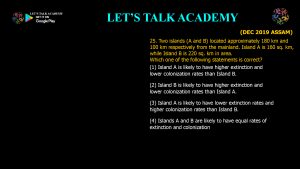
Two islands (A and B) located approximately 180 km and 100 km respectively from the mainland. Island A is 160 sq. km, while Island B is 220 sq. km in […]

Select the correct statement from the options given below to complete the following. In the 1960s, experiments were conducted to test the theory of island biogeography. The main findings of […]

17.Suppose a population has three age classes. Females in the second and third age classes produce four and three offsprings, respectively. While 50% female in the first age class survive […]

The equilibrium model of island biogeography proposed by MacArthur and Wilson assumes that the number of species on an island represents a balance between (1) resource consumption rate and predation […]

The following is the life table of a natural population of a small annual succulent where ‘x’ is its life phase, ‘lx‘ is its survivorship till that stage and ‘dx‘ […]

Which of the following is NOT a prediction arising out of Wilson-MacArthur’s -Theory of Island Biogeography? (1) The number of species on an island should increase with its size/area. (2) […]

According to MacArthur and Wilson’s equilibrium theory, which of the following is true? (1) Larger islands and islands closer to continent are expected to have more species than smaller and […]


